Discover The Urantia Book \Papers\Easy \The Dawn Races of Early Man

Paper 62 Overview: The Dawn Races of Early Man
Superior primates evolved into the first true human beings—mind-endowed, volitional creatures. These dawn races possessed spiritual potential and marked the beginning of human history on Urantia.
Reading Level:
-
Summary
About one million years ago, the ancestors of humans appeared through three sudden mutations from lemur-type mammals. These early ancestors came mostly from western life groups with some contributions from African life implantations, but almost nothing from eastern groups. The development of humans progressed from dawn mammals to mid-mammals to Primates and finally to the first true humans.
These first humans were born as twins to Primate parents and were very different from their animal ancestors. They could speak to each other, walk upright, and showed new emotions like worship and gratitude. When they decided to leave their animal family and start their own family to the north, Urantia was officially recognized as an inhabited world.
-
Introduction
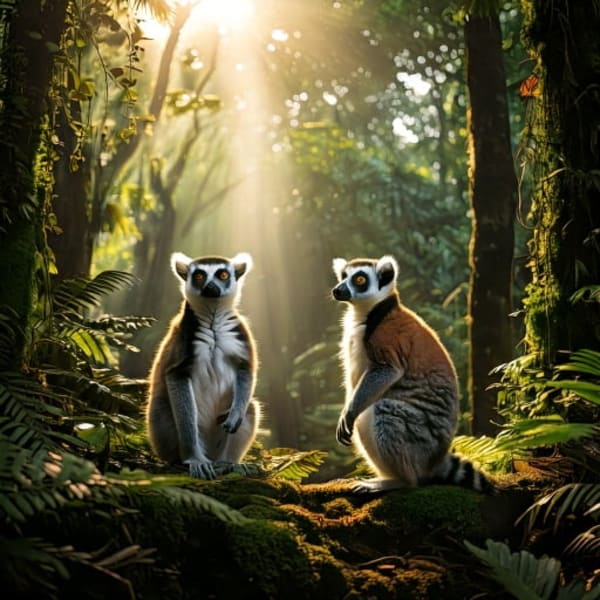
About one million years ago, the direct ancestors of mankind appeared through three successive and sudden mutations from early lemur-type mammals. The main genetic material came from western or American groups of evolving life, with some contributions from African life groups. The eastern life groups contributed almost nothing to the actual human species.
-
1. The Early Lemur Types
The early lemurs that were part of human ancestry were not directly related to the gibbons and apes living in Eurasia and northern Africa at that time. They were also not related to modern lemurs, though they did share a distant common ancestor that is now extinct.
The early lemurs evolved in the Western Hemisphere, but the direct mammalian ancestry of mankind became established in southwestern Asia. Several million years ago, North American lemurs migrated westward over the Bering land bridge and slowly made their way to the area west of India. In these lands, they mixed with other favorable genetic strains and established the ancestry of the human race.
-
2. The Dawn Mammals
A little more than one million years ago, the Mesopotamian dawn mammals appeared as direct descendants of the North American lemur type of placental mammal. They were active little creatures, almost three feet tall, and while they didn't usually walk on their hind legs, they could easily stand upright. They were hairy, agile, and ate meat, unlike the monkey tribes.
The dawn mammals had primitive opposable thumbs and useful grasping big toes. They grew to full size in three or four years and typically lived about twenty years. These mammals had large brains for their size compared to other animals of that time and experienced many emotions that would later be found in primitive humans. They were curious, showed happiness when successful, fought to defend their families, and were loyal to their mates.
-
3. The Mid-Mammals
Early in the time of dawn mammals, twins (one male and one female) were born to a superior pair of these creatures. Compared to their ancestors, they were very attractive creatures with little hair, opposable thumbs, and they walked upright. They had larger brains than their ancestors but smaller than modern humans.
The twins showed higher intelligence and became leaders of their tribe, forming a primitive social organization. They had twenty-one children similar to themselves, all more than four feet tall and superior to the dawn mammals. This new group became the mid-mammals. After a terrible war, no dawn mammals remained alive, and only the more powerful and intelligent mid-mammals survived.
-
4. The Primates
The Primates were born as twins (one male and one female) to two leading members of the mid-mammal tribe. These babies had even less hair than their parents and insisted on walking upright from the beginning. They grew to over five feet tall with larger heads compared to others in the tribe. They created a system of communication but couldn't teach their signs and sounds to their parents.
When they were about fourteen years old, the twins left their tribe and went west to start their family and establish the new Primate species. They were more human and less animal than their mid-mammal predecessors. Their hands and feet were very similar to those of early human races, and they could walk and run as well as their later human descendants. After about nine hundred generations (twenty-one thousand years), the Primates gave birth to the first true human beings.
-
5. The First Human Beings
From the year 1934 back to the birth of the first two human beings is exactly 993,419 years. These two remarkable creatures were true human beings with perfect human thumbs and feet. They were walkers and runners, not climbers, and they matured at twelve years of age with a potential lifespan of about seventy-five years.
Many new emotions appeared in these human twins, including admiration for objects and other beings, vanity, and a group of worshipful feelings including awe, reverence, humility, and gratitude. They were very curious and adventurous, nearly losing their lives many times before they were eight years old. They created a language of almost fifty ideas by age ten but could not teach much of it to their parents.
-
6. Evolution of the Human Mind
The Life Carriers had been watching and waiting since first planting life in the planetary waters. The appearance of the first intelligent beings with free will brought them great joy and satisfaction. They had been observing the twins' mental development through the functioning of the seven adjutant mind-spirits assigned to Urantia.
Throughout the long evolution of planetary life, these mind ministers had shown increasing ability to connect with the expanding brain capacity of progressively superior animal creatures. The first five adjutants had been functioning through the dawn mammals, mid-mammals, and Primates. When the twins were about ten years old, the sixth adjutant (the spirit of worship) made its first contact with the female twin's mind and shortly after with the male's mind. About a year later, they decided to flee north, and the seventh adjutant (the spirit of wisdom) began to function in these first human minds.
-
7. Recognition as an Inhabited World
The Life Carriers did not have to wait long for confirmation of their success. At noon, the day after the twins ran away, there was a test flash of universe circuit signals at the planetary reception center of Urantia. Three days after the twins left, an archangel from Nebadon arrived to establish the first communication circuit.
The first message from Salvington confirmed the existence of mind with will dignity on Urantia. The twins' decision to flee northward and separate their offspring from inferior ancestors established the communication circuit. Messages from the Most Highs of Edentia directed the Life Carriers not to interfere with human progress. A message from Lucifer, then sovereign of the Satania system, officially accepted the Life Carriers' work on Urantia and freed them from future criticism.
UB Reference
-
Read the full Urantia Book paper using this link:
Paper 62 - The Dawn Races of Early Man