Discover The Urantia Book \Papers\Easy \The Mammalian Era on Urantia

Paper 61 Overview: The Mammalian Era on Urantia
The mammalian era marked a turning point on Urantia. Superior mammals evolved rapidly, leading to the eventual appearance of primates and laying the groundwork for human emergence and mind-endowed life.
Reading Level:
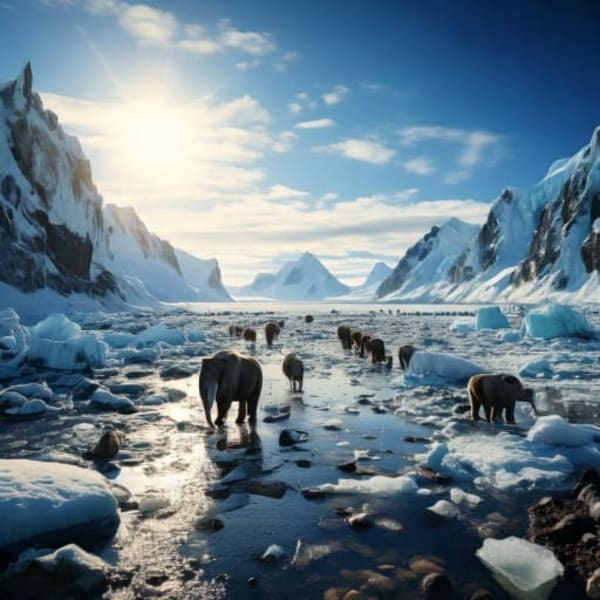
Table of Contents
Summary
The mammalian era on Urantia lasted for almost fifty million years, extending from when placental mammals first appeared to the end of the ice age. During this time, the landscape of the world changed significantly with land rising and falling, creating new continents and seas. The climate was generally mild, making the world a paradise for animals.
This period saw the rise of mammals as the dominant form of animal life, replacing dinosaurs. Over millions of years, mammals evolved from simple forms into thousands of different species, including horses, elephants, and eventually the ancestors of humans. The ice age that concluded this era played an important role in the appearance of the first humans about one million years ago.
Introduction
The mammalian era spans almost fifty million years, from when placental mammals first appeared to the end of the ice age. During this time, the world's landscape was beautiful, with rolling hills, broad valleys, wide rivers, and great forests. Animals thrived in this environment despite constantly competing with each other.
The deposits built up during this fifty-million-year period contain fossils that show how mammals developed over time. These fossil records document the successive dynasties of mammals and lead up to the time when humans first appeared on earth.
1. The New Continental Land Stage: The Age of Early Mammals
Fifty million years ago, most land areas were above water or only slightly submerged. The land gradually rose but was simultaneously being washed down to lower levels and toward the seas. Early in this period, placental mammals suddenly appeared in North America, representing the most important evolutionary development to that time.
Mammals had several advantages over other animals that helped them survive. They could bring forth well-developed offspring, nurture and protect their young, use their superior brain power, move quickly to escape enemies, and adapt better to their environments. As time passed, many new types of mammals appeared, including small horses, rhinoceroses, tapirs, pigs, squirrels, lemurs, and monkey-like animals. These early mammals were small, primitive, and best suited for living in mountain forests.
2. The Recent Flood Stage: The Age of Advanced Mammals
This period saw the rapid evolution and expansion of placental mammals, with more advanced forms of mammalian life developing. Early placental mammals came from meat-eating ancestors, but soon plant-eating branches developed, and eventually omnivorous mammalian families also appeared. Modern land plants, including most present-day plants and trees, had appeared during earlier periods.
As time went on, over one hundred species of earlier and more primitive mammals became extinct. Brain size and agility became more important than armor and size for animal survival. Various groups of mammals, including dogs, cats, rodents, and grazing animals began to appear during this time. By the end of this period, which lasted ten million years, most living things on earth were very much like they are today.
3. The Modern Mountain Stage: Age of the Elephant and the Horse
Land continued to rise and seas separated, gradually cooling the world's climate. The weather was still mild, but subtropical plants began moving southward. By the end of this period, these warm-climate plants had mostly disappeared from northern areas, replaced by hardier plants and deciduous trees. Grasses increased in variety, and many animals' teeth changed to better eat grass.
This was truly the golden age of mammals. The Bering Strait land bridge was up, allowing many animal groups to migrate to North America from Asia. Huge elephants with large brains overran the world except for Australia. Of the fifty species of elephants existing at the beginning of this period, only two have survived to modern times. This period also saw the development of the true types of both primitive monkeys and gorillas in central Asia, though neither is directly related to human ancestors.
4. The Recent Continental-Elevation Stage: The Last Great Mammalian Migration
During this period, there was widespread preglacial land elevation in North America, Europe, and Asia. The land changed greatly in topography, with new mountain ranges forming, streams changing their courses, and volcanoes erupting all over the world. For a short time, all the world's land was joined except for Australia.
The last great worldwide animal migration took place during this time. North America was connected to both South America and Asia, allowing animals to move freely between continents. Rhinoceroses spread across the whole world except Australia and South America but became extinct in the Western Hemisphere by the end of this period. About five million years ago, the horse evolved to its modern form and spread throughout the world from North America, though it later became extinct on its continent of origin.
5. The Early Ice Age
By the end of the previous period, lands in northeastern North America and northern Europe had risen significantly, with some areas in North America rising 30,000 feet or more. The climate in these northern regions had been mild, and the arctic waters were open and ice-free until almost the end of the glacial period. Changes in ocean currents and wind directions created constant precipitation over the northern highlands.
Snow began to fall on these cold, elevated regions and continued until it reached a depth of 20,000 feet. This enormous blanket of snow soon turned into solid but moving ice. Half of the glacial ice was in North America, one-fourth in Eurasia, and one-fourth elsewhere, mainly in Antarctica. Northern regions experienced six separate ice invasions, with many advances and retreats associated with each ice sheet.
6. Primitive Man in the Ice Age
The most important event of this glacial period was the evolution of primitive humans. Slightly west of India, on land now underwater, the dawn mammals suddenly appeared among descendants of the older North American lemur types. These small animals walked mostly on their hind legs and had large brains compared to their size and to other animals' brains.
About one million years ago, a mutation within the stock of the progressing Primates suddenly produced two primitive human beings, the actual ancestors of humankind. This happened around the time the third glacial advance began, meaning our early ancestors were born in a challenging environment. Human beings did not appear in the Western Hemisphere until near the end of the ice age, but during warmer periods between glacial advances, they moved westward around the Mediterranean and soon spread across Europe.
7. The Continuing Ice Age
Throughout the glacial period, other natural activities continued, but ice dominated in northern latitudes. Glaciers left distinctive evidence on the landscape, including boulders, lakes, displaced stones, and rock flour. Glaciers also created gentle surface swells known as drumlins, displaced rivers, and left behind various types of moraines—piles of rock and debris.
The sixth and last glacier began 250,000 years ago and reached its furthest southern points 150,000 years ago. During its retreat, this glacier carved out the present-day Great Lakes in North America. The ice age finally ended about 35,000 years ago, except in polar regions, marking approximately the beginning of the Holocene period and roughly corresponding to the arrival of a Material Son and Daughter and the beginning of the Adamic dispensation.
Table of Contents
UB Reference
Read the full Urantia Book paper using this link:
Paper 61 - The Mammalian Era on Urantia