Discover The Urantia Book \Papers\Easy \The Second Garden

Paper 76 Overview: The Second Garden
After the default, Adam and Eve moved to the Second Garden. Though diminished, they continued to uplift civilization, raise their family, and spread the violet race’s influence throughout Urantia’s evolving cultures.
Reading Level:
Summary
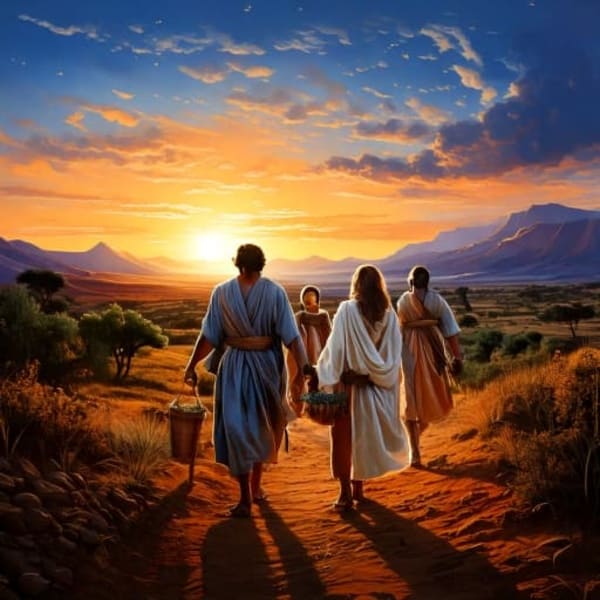
After leaving the first Garden of Eden, Adam and Eve journeyed eastward toward the area between the Tigris and Euphrates rivers. They could not go in other directions because of hostile tribes and geographical challenges. They established a new home in Mesopotamia which became known as the second garden.
Adam and Eve rebuilt their lives in the second garden and continued their work of improving human civilization. They had many children in this new location, including Cain and Abel. Although they lost their special physical status, they made significant contributions to advancing humanity through teaching, governing, and establishing family traditions.
Introduction
When Adam chose to leave the first garden, he and his followers traveled eastward because all other directions were blocked. The northern Nodites were approaching Eden, hostile tribes were in the south, and there was no way west. Their first children in the new location were Cain and Sansa, with Sansa's mother Laotta dying in childbirth.
Eve survived the difficult birth of Sansa and raised her alongside Cain. Sansa grew up to become the wife of Sargan, who led the northern blue races. Their relationship helped improve relations between the blue people and the Adamites throughout this time.
1. The Edenites Enter Mesopotamia
It took almost a year for Adam's group to reach the Euphrates River. They waited six weeks for the flood waters to go down before crossing to the area between the rivers, which would become their second garden. The people who had been living there fled when they heard Adam was coming.
This location was actually one of the three sites that Van and Amadon had originally suggested for the first garden. It was well-protected by natural defenses with the two rivers, and they built a wall to protect the southern border. Unlike the first garden which was prepared for them, this garden had to be created through their own hard work.
2. Cain and Abel
Abel was born less than two years after Cain's birth, and was the first child born to Adam and Eve in the second garden. When he grew up, Abel chose to be a shepherd while Cain became a farmer. This led to arguments between the brothers about which job was better.
The brothers fought about religious offerings, with Abel bringing animal sacrifices that seemed to be preferred by the priests. Cain believed plant offerings should be acceptable based on Adam's original teachings. Their conflict grew worse when Abel taunted Cain about not being a pure-blood son of Adam, since Cain's mother was Laotta. When the brothers were eighteen and twenty years old, Cain killed Abel in anger.
3. Life in Mesopotamia
Adam and Eve missed their beautiful first garden and the children who had been taken to Edentia. They had to adjust to living as ordinary humans, but they handled this change with grace and strength. Adam spent much time training his children in government, education, and religion.
Adam's son Adamson founded a northern settlement for the violet race. His second son Eveson became a great leader and helper to Adam. Seth, the eldest surviving son born in the second garden, became the religious leader and started a new priesthood. The Adamites maintained many cultural advantages over nearby tribes because of the seeds, animals, and knowledge they brought from the first garden.
4. The Violet Race
Adam and Eve were the founders of the violet race, which was the ninth human race on Urantia. Adam's children had blue eyes and fair skin with light hair colors. Unlike the evolutionary races, Eve didn't experience pain in childbirth until the races began to mix.
Adam and Eve were originally energized by both food and light, but their children only inherited the normal human blood circulation. The first generation didn't eat meat, though later generations began to include animal products in their diet. Adam and Eve had special senses that let them see spiritual beings like the Melchizedeks and Caligastia, but these abilities decreased with each new generation.
5. Death of Adam and Eve
After establishing the second garden, Adam and Eve learned that their repentance was accepted. Though they would die like regular humans, they would be eligible to be resurrected. They did not originally have Thought Adjusters on Jerusem or in the first garden, but received them after becoming mortal.
Adam and Eve received a special message from Michael that comforted them but was somewhat mysterious. Adam lived for 530 years before dying of old age, while Eve died nineteen years earlier from heart problems. They were buried in the center of the temple of divine service, starting the tradition of burying important people under places of worship.
6. Survival of Adam and Eve
Adam and Eve died believing the promises made by the Melchizedeks that they would wake up on the mansion worlds. They didn't stay unconscious for long after death. On the third day after Adam died, special orders came through Gabriel for a resurrection of distinguished survivors of the Adamic default on Urantia.
Adam and Eve were brought back to life on the mansion worlds along with 1,316 of their associates from the first garden. They quickly progressed through the worlds of ascension until they became citizens of Jerusem again. They were assigned to be among the twenty-four counselors who advise on Urantia affairs, making a significant contribution despite their earlier mistakes.