Discover The Urantia Book \Papers\Easy \The Marine-Life Era on Urantia

Paper 59 Overview: The Marine-Life Era on Urantia
Urantia’s marine-life era spanned millions of years. Primitive organisms evolved into complex sea creatures, laying the foundation for land life, all under the steady influence of evolutionary and celestial guidance.
Reading Level:
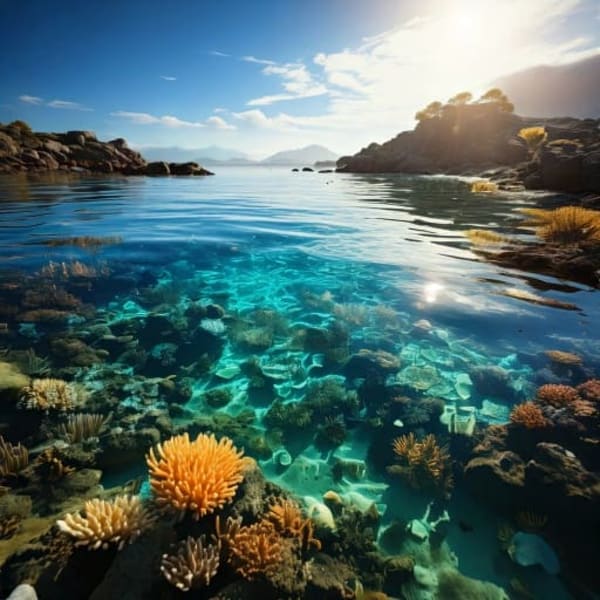
Table of Contents
Summary
The history of Urantia started about one billion years ago and is divided into five major time periods. The marine-life era lasted about 250 million years and is known as the Paleozoic era by scientists today. This era can be split into six periods, each with important developments in geology and biology.
During this era, the sea bottoms, continental shelves, and shallow basins near shores were covered with plant life. Animal organisms developed from plant life and spread along coastlines, making the inland seas full of marine life. North America has many fossil deposits from this time that help us understand what happened.
Introduction
We divide Urantia's history into five major eras that span one billion years. The first era was the prelife era, lasting 450 million years before life appeared. The second era was the life-dawn era, which lasted 150 million years when basic life was beginning. The third era was the marine-life era, lasting 250 million years when sea creatures dominated.
The fourth era was the early land-life era, lasting 100 million years, and the fifth era was the mammalian era, covering the last 50 million years. The marine-life era can be divided into six long periods with different developments in geology and biology. At the beginning of this era, sea bottoms and shallow waters were covered with plant life, and animal life developed from earlier plants.
1. Early Marine Life in the Shallow Seas: The Trilobite Age
About 400 million years ago, marine life was spread across the world as the climate grew warmer. The seashores of all continents were flooded, especially in North and South America, and new oceans appeared. Plants began to grow on land for the first time and adapted to living away from water.
The first multicellular animals suddenly appeared without any clear ancestors. Trilobites became the dominant sea creatures and gave this period its name. Much of North America and Europe rose above the sea, and trilobite fossils can be found in rock layers from this time. As the period ended, the trilobites shared control of the seas with several other invertebrate animals.
2. The First Continental Flood Stage: The Invertebrate-Animal Age
Land repeatedly rose and fell during this period, but these changes happened slowly without dramatic events. About 350 million years ago, a great flood covered all continents except central Asia. The land masses were repeatedly underwater, and only coastal highlands remained above the shallow inland seas.
By the end of this period, the world was quiet and peaceful with a mild climate. Land plants were spreading farther from shorelines. This was an important time for individual animal evolution, though all animals still lived in the sea. There was too much carbon dioxide in the air for land animals to breathe yet.
3. The Second Great Flood Stage: The Coral Period—The Brachiopod Age
About 300 million years ago, another period of land submergence began. The ancient Silurian seas moved north and south, covering most of Europe and North America. This created thick layers of limestone that now cover nearly all of Europe and North America, averaging about 1,000 feet thick.
Toward the end of this period, the continents emerged from the second Silurian flood. The rock deposits from this time in North America are known as Niagara limestone, which is the rock layer over which Niagara Falls flows today. The climate remained mild, and marine fossils can be found even in the arctic regions.
4. The Great Land-Emergence Stage: The Vegetative Land-Life Period: The Age of Fishes
As land emerged from the last Silurian flood, an important new period in world development began. The once bare landscape became covered with lush green plants, and the first magnificent forests would soon appear. Marine life was very diverse during this time, with brachiopods reaching their peak and barnacles making their first appearance.
The most important event was the sudden appearance of fish, making this the age of fishes. About 270 million years ago, all continents were above water for the first time in millions of years. Many of the largest true fish belong to this age, with some being 25 to 30 feet long. The earth was rapidly being covered by new types of land plants, including ferns that grew up to 100 feet tall.
5. The Crustal-Shifting Stage: The Fern-Forest Carboniferous Period: The Age of Frogs
The appearance of fish in the previous period marked the highest point of marine-life evolution. From this point on, land life became more important. About 220 million years ago, most continental areas, including North America, were above water and covered with lush plant life, especially ferns.
The first land animals appeared suddenly during this period. These air-breathing amphibians developed from arthropods whose swim bladders had evolved into lungs. Frogs, snails, and scorpions crawled out from the seas onto land. This could well be called the age of frogs. Insects also appeared and quickly spread across the continents, with some dragonflies measuring thirty inches across.
6. The Climatic Transition Stage: The Seed-Plant Period: The Age of Biologic Tribulation
This period marks the end of important evolutionary development in marine life and the beginning of the transition to land animals. It was a time when life nearly disappeared from both land and sea. At the start of the long marine era, more than 100,000 species lived on earth, but at the end of this transition period, fewer than 500 had survived.
The mild marine climate was disappearing as a harsher continental climate developed. Inland lakes and seas dried up, and glaciers formed, especially in the Southern Hemisphere. Two new climate factors appeared – glaciation and dryness. By 160 million years ago, the land was covered with vegetation that could support land animals, and the atmosphere was perfect for animal breathing, ending the marine-life era and beginning the next stage of evolution.
Table of Contents
UB Reference
Read the full Urantia Book paper using this link:
Paper 59 - The Marine-Life Era on Urantia