Discover The Urantia Book \Papers\Easy \The Trial Before Pilate

Paper 185 Overview: The Trial Before Pilate
Jesus appeared before Pilate, who found no fault in him but succumbed to public pressure. Jesus’ trial highlighted the cowardice of worldly power and the innocence of spiritual truth.
Reading Level:
-
Summary
Jesus was brought before Pilate, the Roman governor, early on Friday morning, April 7, 30 CE. The temple guards and Jewish leaders brought Jesus to Pilate with accusations against him, though they were reluctant to state specific charges. Pilate found no fault in Jesus but gave in to pressure from the Jewish leaders who threatened his position.
Throughout the trial, Jesus remained calm and dignified while facing false accusations. Pilate tried several times to release Jesus, including sending him to Herod and offering to release him instead of Barabbas, but the crowd demanded Jesus' crucifixion. In the end, Pilate surrendered to the mob's demands despite knowing Jesus was innocent.
-
Introduction
Jesus was brought before Pilate, the Roman governor, early Friday morning with about fifty accusers including temple guards, Sanhedrists, and the high priest Caiaphas. Pilate was already awake and ready to receive them, having given permission the previous evening for Roman soldiers to arrest Jesus. The trial took place outside the praetorium because the Jews refused to enter a Gentile building during Passover preparations.
The Jewish leaders were very concerned about ceremonial cleanness for the Passover feast, refusing to enter Pilate's headquarters. They carefully followed religious rules about cleanliness while at the same time planning to kill Jesus. This shows how people sometimes focus on small religious details while ignoring important moral issues.
-
1. Pontius Pilate
Pilate had been governor of Judea for ten years, which showed he was a reasonably good administrator. However, he was a moral coward who didn't understand the Jews and their deep religious convictions. He failed to realize that the Jews had strong religious beliefs that millions of them throughout the Roman Empire respected.
Pilate disliked the Jews, which made governing them difficult. He had made several serious mistakes early in his time as governor that gave the Jewish leaders power over him. Whenever they wanted to influence his decisions, they would threaten rebellion, and Pilate would give in because he feared losing his position with the emperor Tiberius.
-
2. Jesus Appears Before Pilate
When everyone gathered before Pilate's judgment hall, he asked what charges they had against Jesus. The Jewish leaders were reluctant to state specific accusations against Jesus even though they had spent all night discussing his supposed guilt. Pilate suggested they judge Jesus according to their own laws, but they reminded him that they could not legally execute anyone.
This approach showed the Jewish leaders' ill will toward Jesus and their disrespect for Pilate. After Pilate insisted on written charges, they accused Jesus of three things: perverting the nation and causing rebellion, forbidding people to pay taxes to Caesar, and calling himself King of the Jews. Jesus remained silent when these false charges were read, impressing Pilate with his dignified behavior.
-
3. The Private Examination by Pilate
Pilate took Jesus and John Zebedee into a private room for questioning, leaving the guards outside. He told Jesus he didn't believe the first charge about stirring up rebellion, then asked if Jesus had taught people not to pay taxes. Jesus directed Pilate to ask John, who testified that Jesus and his apostles paid taxes to both the temple and Caesar.
Pilate then asked Jesus if he was the king of the Jews. Jesus explained that his kingdom was not of this world but was a spiritual kingdom, a brotherhood of believers who become children of God through faith and love. Jesus stated he was born to show his Father to all people and to bear witness to God's truth. Pilate famously asked, "Truth, what is truth?" but was convinced Jesus was innocent and not a dangerous revolutionary.
-
4. Jesus Before Herod
Pilate sent Jesus to Herod, who was in Jerusalem for Passover, hoping to avoid responsibility for the case. Herod had long been curious about Jesus and hoped to see him perform a miracle. When Jesus was brought before him, Herod was impressed by his dignified appearance.
For about fifteen minutes, Herod questioned Jesus, but Jesus wouldn't answer. Herod taunted Jesus, trying to get him to perform a miracle, but Jesus remained silent. After listening to more accusations and making fun of Jesus, Herod put a purple robe on him and sent him back to Pilate, relieved that he wouldn't have to deal with Jesus in Galilee anymore.
-
5. Jesus Returns to Pilate
When Jesus was brought back, Pilate announced to the Jewish leaders that neither he nor Herod found Jesus guilty of the charges. He offered to punish Jesus and then release him. Just then, a crowd arrived requesting the traditional release of a prisoner for the Passover feast, and Pilate saw this as a way to free Jesus.
Pilate offered the crowd a choice between Jesus and Barabbas, a murderer and robber. The chief priests encouraged the crowd to ask for Barabbas's release and Jesus's death. The crowd, who had recently admired Jesus when he drove the money-changers from the temple, now turned against him because he appeared powerless as a prisoner. Pilate was angered by their preference for a murderer over Jesus but received a message from his wife warning him not to harm Jesus.
-
6. Pilate's Last Appeal
While these events were happening, Jesus's many friends were either unaware of his arrest or in hiding. Only his enemies and easily influenced people were in the crowd demanding his death. Pilate made one last appeal to their pity by having Jesus scourged, hoping this punishment would satisfy them.
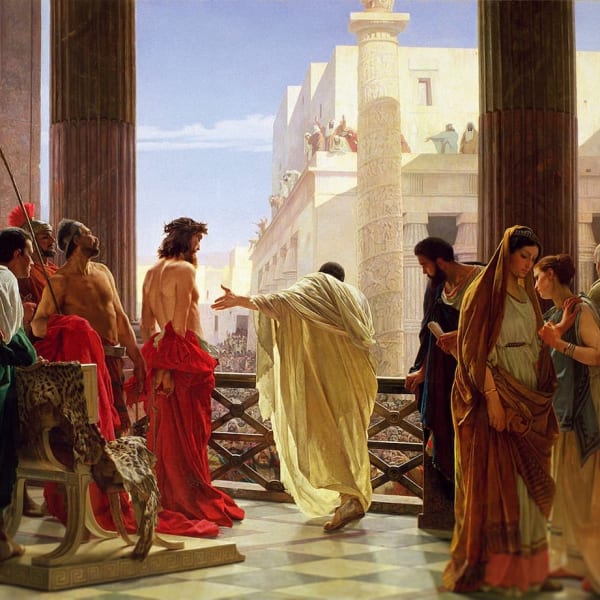
After the scourging, Pilate presented the bleeding and injured Jesus to the crowd, saying "Behold the man!" and declaring again that he found no crime in him. This sight sent a shudder through the universe but didn't move the hearts of the crowd. They shouted even louder for his crucifixion. When Pilate asked what crime Jesus had committed, the high priest declared that Jesus claimed to be the Son of God, which frightened Pilate even more.
-
7. Pilate's Last Interview
Trembling with emotion, Pilate took Jesus inside again and asked him where he came from and if he was truly the Son of God. Jesus looked directly at Pilate but didn't answer these questions. Pilate reminded Jesus that he had power to release or crucify him. Jesus replied that Pilate would have no power over him unless it were permitted from above.
This conversation deeply frightened Pilate, who was now afraid of both Jesus and the Jewish leaders. He appeared before the crowd again, saying Jesus was only a religious offender who should be judged by Jewish law. However, when Caiaphas threatened to report Pilate to Caesar, Pilate's fear for his own position overcame all other considerations. He brought Jesus before the judgment seat and mockingly presented him as their king.
-
8. Pilate's Tragic Surrender
Jesus was arrested without proper charges, accused without evidence, judged without witnesses, and punished without a verdict. He was about to be condemned to death by a judge who admitted Jesus was innocent. When Pilate called Jesus the "king of the Jews," the crowd responded by saying they had no king but Caesar, shocking even the common people.
Pilate was afraid of riots during Passover and had recently been reprimanded by Caesar. He ordered Barabbas released, then washed his hands in front of everyone, saying he was innocent of Jesus's blood. The crowd shouted that Jesus's blood should be on them and their children. Pilate surrendered to their demands despite knowing Jesus was innocent.