Discover The Urantia Book \Papers\Easy \Monday in Jerusalem

Paper 173 Overview: Monday in Jerusalem
On Monday in Jerusalem, Jesus boldly challenged religious hypocrisy and corruption. He cleansed the temple, taught openly, and intensified the growing tension with religious authorities plotting against him.
Reading Level:
-
Summary
Jesus and his apostles went to Jerusalem on Monday morning where Jesus cleansed the temple by driving out the animals being sold for sacrifice. The excited crowd of pilgrims then joined in by overturning the tables of the money-changers. The Jewish leaders tried to challenge Jesus's authority, but Jesus outsmarted them with a counter-question about John the Baptist that they could not answer.
Jesus then taught the people using several parables including the parable of the two sons, the absent landlord, and the marriage feast. These parables warned the Jewish leaders and described how they were rejecting God's messengers and would face consequences for their actions.
-
Introduction
Early on Monday morning, Jesus and the apostles met at Simon's home in Bethany and then went to Jerusalem. The apostles were quiet and worried as they followed Jesus down Mount Olivet, wondering what would happen that day.
When they arrived at the temple around nine o'clock, Jesus went to teach in the large court while the apostles waited nearby. Judas Iscariot was especially troubled, thinking about whether he should stay with Jesus or leave the group.
-
1. Cleansing the Temple
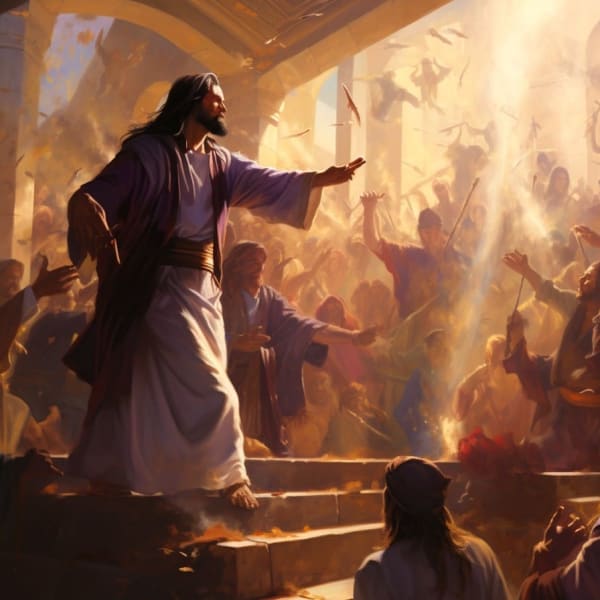
At the temple, merchants were selling animals for sacrifices and money-changers were exchanging foreign money for the temple currency. These businesses charged unfair prices and took advantage of worshippers who came to the temple. Jesus became angry when he saw a man from Galilee being mistreated by the temple merchants.
Jesus took action by taking a whip from a boy who was driving cattle and used it to drive the animals out of the temple. He then opened the gates of all the animal pens to free the animals. Seeing this, the crowd of pilgrims became excited and they rushed toward the bazaars and overturned the money-changers' tables. Jesus declared that God's house should be a place of prayer, not a "den of robbers." The temple was kept free of commerce for the rest of the day while Jesus taught there.
-
2. Challenging the Master's Authority
The Jewish leaders wanted to arrest Jesus but were afraid of the crowds who supported him. At their noon meeting, the Sanhedrin agreed that Jesus must be destroyed, but they could not decide how to capture him safely.
Around two o'clock, they sent representatives to ask Jesus by what authority he had cleansed the temple. Jesus responded with a clever counter-question about John the Baptist's authority, which the leaders could not answer without either recognizing John's divine mission or angering the people who believed John was a prophet.
-
3. Parable of the Two Sons
After the Jewish leaders refused to answer his question about John the Baptist, Jesus told the parable of the two sons. In this story, a father asked both his sons to work in his vineyard. One son said he would not go but later changed his mind and went, while the other son said he would go but never did.
Jesus explained that the first son represented tax collectors and sinners who initially rejected God but later believed, while the second son represented the religious leaders who claimed to serve God but did not actually do his will. Jesus said the sinners who repented would enter God's kingdom before these hypocritical leaders.
-
4. Parable of the Absent Landlord
Jesus then told another parable about a landowner who planted a vineyard and rented it to tenant farmers. When the owner sent servants to collect his share of the harvest, the tenants beat and killed them. Finally, the owner sent his son, whom the tenants also killed, thinking they would inherit the vineyard.
Jesus asked what the owner would do to these wicked tenants, and the people answered that he would destroy them. Jesus connected this story to how the Jewish leaders had rejected God's prophets and would reject him too. He warned that the kingdom of God would be taken from them and given to others who would produce good fruit.
-
5. Parable of the Marriage Feast
After the Jewish rulers left, Jesus told the crowd the parable of the marriage feast. A king prepared a wedding feast for his son, but the invited guests refused to come and even mistreated the king's messengers. The king then invited strangers from the streets to fill his banquet hall.
At the feast, the king found one guest without proper wedding clothes and threw him out. Jesus explained that this represented God's invitation to all people to join his kingdom, but they must come properly prepared and accept his terms. After this teaching, Jesus left the temple around four o'clock and returned to their camp at Gethsemane.