Discover The Urantia Book \Papers\Easy \Going into Jerusalem

Paper 172 Overview: Going into Jerusalem
Jesus' entry into Jerusalem was a peaceful yet profound public declaration of his spiritual mission. Though welcomed joyfully, he fully understood the rejection and suffering that soon awaited him.
Reading Level:
-
Summary
Jesus and his apostles arrived at Bethany on Friday afternoon, staying with Simon while Lazarus and his sisters welcomed many visitors. The chief priests knew Jesus was in Bethany but decided to wait until he came to Jerusalem to arrest him. Jesus remained remarkably calm despite knowing the danger, while his apostles kept watch over him that night as many pilgrims came to see Jesus and Lazarus.
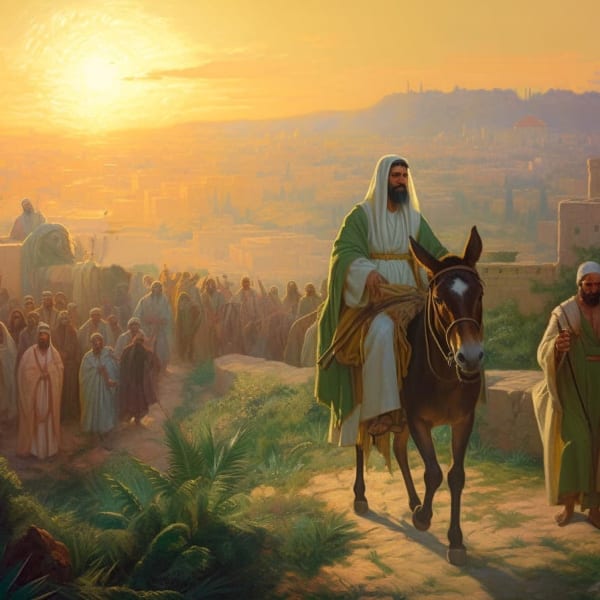
On Sunday, Jesus made a planned entry into Jerusalem riding on a donkey to fulfill ancient prophecy. Large crowds welcomed him by throwing their garments on the ground and waving palm branches while shouting "Hosanna to the son of David." As Jesus reached the top of Olivet and saw Jerusalem, he wept over the city, predicting its future destruction because it rejected the "Son of Peace."
-
Introduction
Jesus and the apostles arrived at Bethany on Friday afternoon and stayed with Simon instead of with Lazarus. Many people came to visit Jesus at Bethany, believing he might be going to Jerusalem to become king despite the Sanhedrin's death decree. The chief priests knew Jesus was in Bethany but decided not to try to capture him among his friends.
Jesus remained remarkably calm despite the danger, while his apostles slept in shifts to guard him. Many visitors came early Saturday morning, even on the Sabbath day, to see both Jesus and Lazarus, whom Jesus had raised from the dead.
-
1. Sabbath at Bethany
People in Judea had been wondering if Jesus would come to the feast, and they were glad to hear he was at Bethany. Six days before Passover, after the Sabbath, the people of Bethany and Bethpage held a public banquet at Simon's home to honor both Jesus and Lazarus, even though the Sanhedrin had ordered Jesus' arrest. Martha served the food while Mary watched with the other women according to Jewish custom.
During the dinner, Mary opened an expensive jar of ointment, poured it on Jesus' head and feet, and wiped his feet with her hair. When Judas Iscariot complained about the waste of money that could have helped the poor, Jesus defended Mary, saying she had saved the ointment for his burial. This rebuke from Jesus made Judas angry and led him to later seek revenge.
-
2. Sunday Morning with the Apostles
On Sunday morning in Simon's garden, Jesus gave final instructions to his twelve apostles before entering Jerusalem. He told them not to do any public work during Passover and to stay close to him. The apostles listened silently as Jesus reviewed their ministry from their ordination near Capernaum to the present day.
That morning, David Zebedee gave Judas money from selling the Pella camp equipment, which Judas then gave to Simon for safekeeping. Jesus also spoke privately with Lazarus, telling him to avoid being caught by the Sanhedrin who wanted to kill him too. Despite the serious situation, Jesus remained unusually cheerful, which prevented his followers from fully understanding the coming crisis.
-
3. The Start for Jerusalem
Jesus prepared to leave for Jerusalem around one-thirty Sunday afternoon, feeling great love for Bethany and its people who had accepted him. Unlike Nazareth, Capernaum, and Jerusalem, Bethany had welcomed Jesus and believed in him. Jesus chose this village to perform his greatest miracle—raising Lazarus—because the people already believed.
Jesus decided to make a public entry into Jerusalem, not to gain popular favor but to fulfill prophecy. He chose to ride on a donkey to symbolize peace rather than on a horse which would represent war. When Jesus reached the top of Olivet and saw Jerusalem, he wept over the city and predicted its destruction for rejecting him. The crowds from Jerusalem came out to meet him, waving palm branches and shouting "Hosanna," but their enthusiasm was shallow and would not last.
-
4. Visiting About the Temple
After arriving at the temple, Jesus and the ten apostles walked around observing the Passover preparations. The Sanhedrin feared arresting Jesus because of the crowds. Jesus had allowed the public demonstration to give the people of Jerusalem one last chance to hear his message.
As evening came, the crowds dispersed, leaving Jesus and his followers alone. Jesus watched a poor widow put two small coins into the treasury and told his apostles she had given more than the wealthy because she gave all she had. After walking around the temple courts one more time, Jesus said, "Let us go up to Bethany for our rest," and went with Peter and John to Simon's house while the other apostles found lodging nearby.
-
5. The Apostles' Attitude
The apostles walked back to Bethany in silence, confused by the day's events. Andrew worried about his responsibility as chief of the apostles and watched his fellow apostles carefully. Peter was disappointed that Jesus didn't follow up the popular welcome with a powerful speech at the temple.
Each apostle reacted differently to the events. James Zebedee was perplexed by Jesus allowing the celebration but then doing nothing at the temple. John understood some of the spiritual meaning of Jesus riding on a donkey. Nathaniel recognized that Jesus made the public entry to prevent immediate arrest. Judas Iscariot was disgusted by what he considered a childish display and was especially affected by the ridicule from a Sadducean friend, which pushed him closer to betraying Jesus.