Discover The Urantia Book \Papers\Easy \Tarrying and Teaching by the Seaside

Paper 151 Overview: Tarrying and Teaching by the Seaside
By the seaside, Jesus taught using parables to reveal spiritual truths to diverse audiences. He emphasized personal decision, faith growth, and the inner realities of the kingdom rather than seeking signs or material rewards.
Reading Level:
-
Summary
By March 10, Jesus and his followers gathered at Bethsaida after their preaching tours. Jesus spent Saturday mostly alone in the hills. That evening he spoke to the group about the mission of adversity and the value of disappointment. Jesus was still sad about his recent rejection at Nazareth, and the apostles could see this in his manner.
During this time at the seaside, Jesus began teaching with parables. He used the parable of the sower to teach his followers about the kingdom. He also helped his apostles understand the true purpose of parables and their value in teaching spiritual truths to different types of people.
-
Introduction
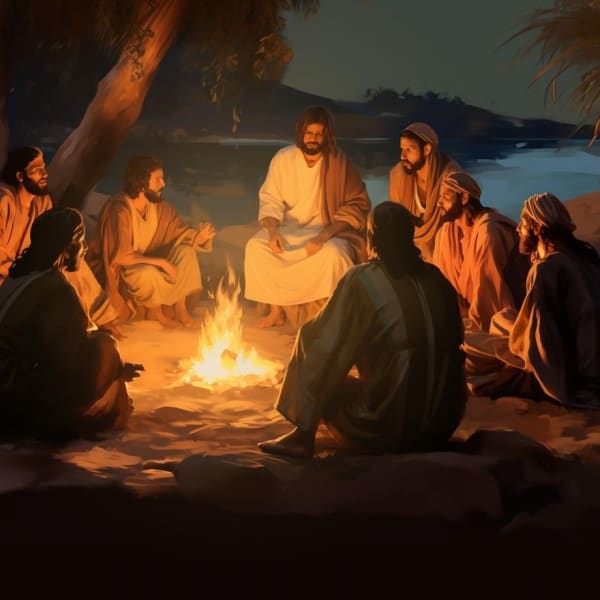
By March 10, all of the preaching and teaching groups had gathered at Bethsaida. Many went fishing on Thursday night and Friday, while on the Sabbath they attended the synagogue. Jesus spent most of that Sabbath day alone in the hills. That night, he talked to the assembled groups about "The mission of adversity and the spiritual value of disappointment," which was a memorable lesson.
Jesus had not fully recovered from his rejection at Nazareth, and his apostles noticed his sadness mixed with his usual cheerfulness. James and John spent much time with him, while Peter was busy managing the evangelists. The women spent this waiting time visiting homes, teaching the gospel, and caring for the sick in Capernaum and nearby villages.
-
1. The Parable of the Sower
Around this time, Jesus began using parables to teach the crowds that gathered around him. One Sunday morning, Jesus sat alone in a boat by the seaside. By ten o'clock, almost one thousand people had gathered on the shore, asking for his attention. When Peter asked if he should talk to them, Jesus decided to tell them a story.
Jesus told the parable of the sower, describing seeds that fell on different types of ground with different results. The apostles were confused by this teaching method. Later that evening, Matthew asked Jesus why he spoke in parables. Jesus explained that his followers were ready to understand the mysteries of the kingdom, while parables helped others find the truth if they truly wanted it.
-
2. Interpretation of the Parable
Peter and others decided the parable was an allegory with hidden meanings, so they asked Jesus to explain it. First, Jesus asked Peter to share his interpretation. Peter explained that the sower was the gospel preacher, the seed was God's word, and the different soils represented different types of people who hear the message.
After hearing Peter's interpretation, Jesus asked if others had suggestions. Nathaniel gave his own interpretation, which was similar but different in some details. This led to debate among the apostles. Eventually, Thomas spoke up, saying Jesus had previously warned them against trying to find hidden meanings in every detail of parables. Jesus praised Thomas for understanding that the main purpose of the parable was to teach that their ministry would have varying results due to conditions beyond their control.
-
3. More About Parables
The apostles were very interested in parables after this discussion. The next evening, Jesus explained more about why he used this teaching method. He told them that parables allow them to reach many different minds at once, as each person can understand the teaching according to their own spiritual level.
Jesus then taught them several important points about parables: they appeal to different levels of mind and spirit; they move from known things to unknown spiritual concepts; they help people make fair moral decisions; they require thoughtful listening; they allow teaching new truths while avoiding conflict; and they help people remember the truth when they see similar scenes later. Jesus also explained that the parable of the sower was both a review of his ministry so far and a prediction of what the apostles might expect in their future work.
-
4. More Parables by the Sea
The next day, Jesus taught the people from a boat again with more parables. He shared the parable of the wheat and weeds, where an enemy planted weeds among a farmer's wheat, but the farmer chose to let both grow until harvest time. The farmer would then separate the wheat from the weeds.
Jesus told several other parables: the mustard seed that grows into a large plant; the leaven that spreads through dough; a treasure hidden in a field; a merchant seeking pearls; and a fishing net that catches all kinds of fish. From this time forward, Jesus mainly taught the public using parables. In evening classes, he would explain these teachings more fully to his apostles and evangelists.
-
5. The Visit to Kheresa
As crowds continued to increase, Jesus grew tired and suggested they cross to the other side of the lake to rest. While crossing, they encountered a violent windstorm, which was common on the Sea of Galilee. The waves began washing over the boat while Jesus slept in the stern.
Peter woke Jesus, asking him to save them from the storm. Jesus looked at Peter and said, "Why are you so afraid? Where is your faith? Peace, be quiet." Soon after, the storm calmed down. While Jesus explained he had spoken to calm their fears, not commanded the elements, the disciples believed they had witnessed a miracle of nature. When they reached shore late that evening, Jesus suggested they go up into the hills to rest and discuss the problems of the Father's kingdom.
-
6. The Kheresa Lunatic
On the eastern shore, there was a steep hillside covered with caves that had been used as tombs. As Jesus and his followers passed near this burial ground, a man named Amos who lived in these caves rushed up to them. He suffered from a periodic form of insanity and was well-known in the area.
Amos recognized Jesus and fell at his feet, saying he was possessed by devils. Jesus took his hand, stood him up, and said, "Amos, you are not possessed of a devil. I command you to come out of this spell." Immediately, Amos was restored to his right mind. Shortly after this healing, a herd of swine nearby ran over a cliff into the sea. While Jesus only healed the man's troubled mind, many believed Jesus had cast out demons that then entered the swine. The next morning, the local people asked Jesus and his companions to leave their region.
Presented by a Midwayer Commission.
UB Reference
-
Read the full Urantia Book paper using this link:
Paper 151 - Tarrying and Teaching by the Seaside