Discover The Urantia Book \Papers\Easy \The Third Preaching Tour

Paper 150 Overview: The Third Preaching Tour
The third preaching tour trained women evangelists and reached new groups. Jesus broadened the message of the Father’s love, highlighting spiritual equality and expanding the ministry to include the direct involvement of women.
Reading Level:
-
Summary
Jesus and his apostles began their third preaching tour of Galilee on January 16, 29 CE, after meeting with John the Baptist's apostles. During this tour, Jesus made the bold decision to include ten women as teachers and ministers, which was revolutionary for that time. This tour lasted seven weeks and covered many cities in Galilee.
The apostles and evangelists were sent out in groups of five to spread Jesus' teachings about the kingdom of heaven. Jesus challenged traditional beliefs about magic and superstition, clearly explaining that astrology, charms, and fortune-telling had no real power. The tour ended dramatically when Jesus was rejected in his hometown of Nazareth.
-
Introduction
On Sunday evening, January 16, Abner and John the Baptist's apostles met with Jesus' apostles at Bethsaida to discuss their work. The next day, they talked about using oil to heal the sick, but Jesus did not give his opinion on this practice. On January 18, about seventy-five tested evangelists joined the twenty-four apostles to prepare for the third preaching tour of Galilee.
The evangelists were sent out in groups of five while Jesus and the twelve apostles usually traveled together. When needed, the apostles would go out in pairs to baptize new believers. Abner and his associates also worked with the groups for three weeks, visiting many cities in central and southern Galilee and sharing their message with the people.
-
1. The Women's Evangelistic Corps
On January 16, Jesus surprised everyone by announcing he would appoint ten women to help teach and spread the message of the kingdom. David Zebedee was asked to call these ten devout women to Bethsaida. The chosen women included Susanna, Joanna, Elizabeth, Martha, Rachel, and five others who had shown their dedication to Jesus' teachings.
Jesus gave these women authority to organize themselves and directed Judas to provide money for their needs. This decision shocked even the twelve apostles, as women were not allowed to teach in synagogues at that time. Jesus' action was a bold statement that set women free from spiritual inequality and recognized them as equal sons and daughters of God.
-
2. The Stop at Magdala
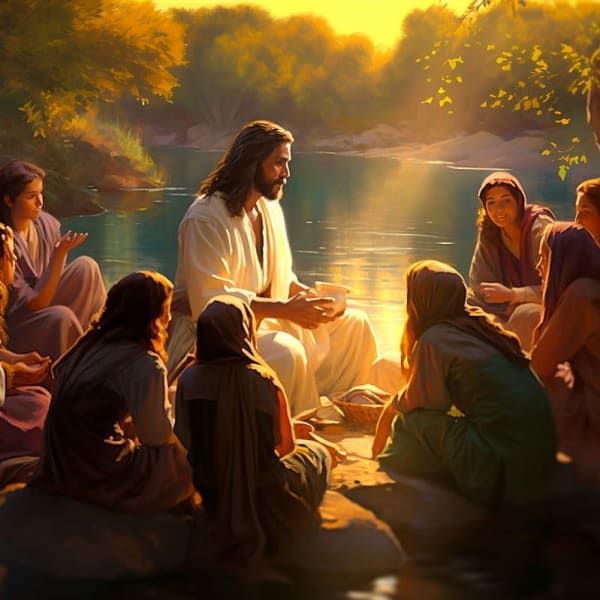
The new women's group traveled behind the apostles during their journeys. When the group stopped for discussions, the women sat together in front of the speaker. These women made it easier for female believers to talk with Jesus or the apostles by going through Susanna first.
At Magdala, the women proved especially helpful by being able to enter places where Jesus' male followers could not go. Through their work, Mary Magdalene was converted to the kingdom. She had fallen into a bad situation due to life's misfortunes, but Martha and Rachel showed her that the kingdom welcomed everyone. Mary became one of the most effective teachers among the women and continued to serve faithfully for the rest of Jesus' life.
-
3. Sabbath at Tiberias
Andrew put the women in charge of Sabbath services since they could not be held in the new synagogue. Joanna led the meeting in Herod's palace banquet room and read scriptures about women's roles in religious life. She mentioned important women from Jewish history like Miriam, Deborah, and Esther.
Later that evening, Jesus gave an important talk about magic and superstition. He explained that stars do not control human lives, spirits of the dead do not communicate with the living, and charms cannot heal diseases. Jesus taught that divination, fortune-telling, dream interpretation, and other superstitious practices had no place in the gospel of the kingdom.
-
4. Sending the Apostles Out Two and Two
The next evening, Jesus gathered all his followers and said the harvest was plentiful but the workers were few. He decided to send the older apostles out in pairs to quickly cover all of Galilee. The pairs included Andrew and Peter, James and John Zebedee, Philip and Nathaniel, Thomas and Matthew, James and Judas Alpheus, and Simon Zelotes and Judas Iscariot.
Jesus told them not to go to gentile cities or Samaria but to focus on "the lost sheep of the house of Israel." He warned them they would face opposition but should not fear those who could only harm their bodies. He reminded them that God values them highly, saying even sparrows are not forgotten by God and the very hairs on their heads are numbered.
-
5. What Must I Do to Be Saved?
One evening in Shunem, after John's apostles had returned to Hebron and Jesus' apostles were sent out in pairs, Rachel asked Jesus what women should say when asked about salvation. Jesus said to tell people to believe the gospel of the kingdom and accept divine forgiveness.
Jesus explained that salvation is God's gift revealed through his Sons. By faith, people become children of God and are justified. He quoted scriptures about God's righteousness and salvation, saying faith makes people aware of salvation. The women were happy to hear they were included in these plans for establishing the kingdom.
-
6. The Evening Lessons
During evening discussions with the younger evangelists and the women's corps, Jesus talked about many important topics. These included God's love, dreams, humility, music, service, pride, forgiveness, peace, evil speaking, temptation, doubts, and worship. Without the older apostles present, these younger followers could more freely discuss these teachings with Jesus.
Jesus would spend two or three days with each group of twelve evangelists before moving on to another group. David's messengers kept all the groups informed about each other's progress. On Friday, March 4, all the apostles, evangelists, and the women's corps gathered at Nazareth to meet Jesus, as had been arranged before they separated.
-
7. The Sojourn at Nazareth
On Friday afternoon, Jesus walked around Nazareth unnoticed, visiting his childhood hill and the synagogue where he had attended school. He felt strong emotions seeing these familiar places. Thomas had arranged for Jesus to speak at the synagogue on Sabbath morning.
The people of Nazareth were not known for being religious, and many resented that Jesus had moved to Capernaum without including Nazareth in his earlier tours. Some of his enemies had hired troublemakers to cause problems during his visit. Few of Jesus' old friends remained in town, and the younger generation was jealous of his fame.
-
8. The Sabbath Service
On Sabbath morning, many people came to the synagogue to hear Jesus speak. Some of Jesus' followers had to remain outside because there was no room. Jesus had often spoken in this synagogue as a young man, but no one remembered that he had donated the manuscript of sacred writings that was handed to him to read from.
The service followed the traditional format with prayers and readings. Jesus read from both Deuteronomy and Isaiah before sitting down to speak about "The Sons and Daughters of God." His gracious manner impressed many people. After the formal service ended, Jesus stayed to answer questions, as was customary.
-
9. The Nazareth Rejection
As people pressed around Jesus in the synagogue, some began to ask rude questions. Jesus responded calmly, reminding them of the saying that "a prophet is not without honor save in his own country." He pointed out that he could not choose where God's works would happen.
The situation became worse when Simon Zelotes and some of Jesus' supporters confronted his enemies. A mob formed and dragged Jesus to a nearby cliff, planning to push him off. When they reached the edge, Jesus turned to face them, folded his arms, and said nothing. Amazingly, the crowd parted and let him pass through unharmed. Jesus and his disciples then left Nazareth and headed to Capernaum, learning that the kingdom would come through much disappointment.