Discover The Urantia Book \Papers\Advanced \Shamanism – Medicine Men and Priests

Paper 90 Overview: Shamanism—Medicine Men and Priests
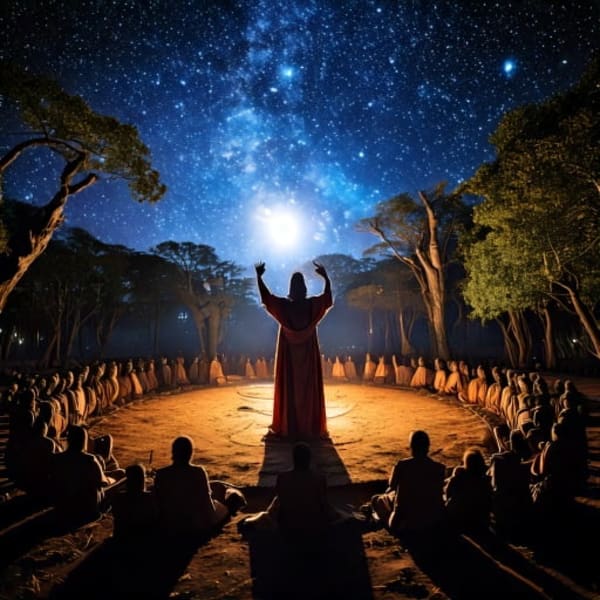
Shamanism blended medicine, magic, and religion. Shamans claimed spirit contact, healing power, and tribal leadership, shaping early spiritual practices and leading to more formal priesthoods and belief systems.
Reading Level:
Summary
The evolutionary trajectory of religious practice progressed through distinct phases of development: from primitive placation, avoidance, and exorcism, through coercion and conciliation, to more sophisticated concepts of sacrifice, atonement, and redemption. This progression reflects an increasingly complex conceptualization of supermaterial realms, necessitating specialized intermediaries—medicine men, shamans, and eventually priests—who claimed unique access to divine forces. This institutionalization of religious mediation marks a critical transitional phase in religious evolution, wherein worship becomes predominantly secondhand, requiring authorized interpreters between the devotee and the divine, a pattern that continues to characterize most organized religious systems on Urantia today.
The fundamental trajectory of religious development begins with primitive fear-based responses to the unknown and culminates in the profound realization of divine love permeating the universe. Between these polarities lies the extensive period of shamanistic intermediation, where self-appointed or culturally designated individuals positioned themselves as essential intercessors between humanity and divinity. The shamans, with their claims of exclusive access to supernatural realms, established elaborate systems of ritual and interpretation that simultaneously provided psychological security and imposed constraints on cultural and intellectual development. This mediatory phase, while preserving certain valuable traditions and providing social cohesion, ultimately required transcendence for spiritual advancement toward direct personal relationship with the Universal Father.
Introduction
The evolution of religious observances proceeded through sequential stages of sophistication, beginning with elemental responses of placation, avoidance, and exorcism, advancing through coercion and conciliation, and ultimately developing into more theologically complex systems involving sacrifice, atonement, and redemption. As human conception of supernatural realms grew increasingly intricate, ritualistic responses correspondingly expanded in complexity, necessitating specialized practitioners—medicine men, shamans, and priests—who could navigate these elaborate ceremonial requirements and ostensibly communicate with divine entities. This progressive ritualization fundamentally transformed the nature of religious experience from direct encounter to mediated engagement with the supernatural.
In primitive society's evolving worldview, the spirit realm became perceived as fundamentally inaccessible to ordinary individuals, responding only to exceptional persons possessing specialized knowledge or inherent spiritual aptitude. This conceptual shift fundamentally altered religious experience, transforming it from a direct, personal engagement with the divine into a secondhand phenomenon requiring specialized intermediaries. Most organized religious systems on Urantia currently operate at this evolutionary level, wherein religious interpreters—whether shamans, priests, ministers, or other designated authorities—position themselves between worshippers and the objects of devotion. This intermediary phase represents the lengthy developmental period between primitive fear-based religion and the mature recognition of the Universal Father's limitless affection for his cosmic children, a transition from terror of the unknown to comprehension of divine love.
1. The First Shamans—The Medicine Men
The shaman occupied the preeminent position among medicine men, functioning as the ceremonial fetishman and centralizing figure for all practices of evolutionary religion. In numerous societies, the shaman's authority surpassed even that of the war chief, marking the nascent dominance of ecclesiastical influence over governmental affairs. This religious authority figure evolved through various manifestations, with some tribal groups recognizing both the earlier shaman-medicine men who functioned primarily as seers and the later-emerging shaman-priests with more formalized religious responsibilities. The significant cultural influence of shamans was reinforced through institutionalization, with the shamanistic office frequently becoming hereditary, establishing dynastic lineages of religious specialists who maintained power across generations.
The qualification criteria for shamanic roles often centered on physical or psychological abnormalities, which primitive societies interpreted as manifestations of spirit possession or divine selection. Epileptic individuals frequently became medicine men, while hysterical women often served as powerful shamanesses, with these neurological conditions interpreted as facilitating supernatural communication through trances, cataleptic fits, or other altered states of consciousness. While many shamans genuinely believed in their spiritual possession, the profession also attracted deliberate charlatans who recognized the potential for power and influence. The formalization of shamanistic practice eventually established rigorous requirements, including decade-long apprenticeships involving significant hardship and self-denial. Shamans developed distinctive professional attire and behaviors, employing various techniques, including pharmacological substances, hypnotic induction, ventriloquism, and sleight-of-hand demonstrations, to establish their authority through mystification of natural phenomena.
The evolutionary selection process within shamanism inherently favored individuals possessing both intelligence and deceptive capabilities over those with genuine conviction but limited charismatic appeal. When shamans failed in their spiritual endeavors or healing practices, they faced significant consequences, demotion or even execution, unless they could produce convincing explanations for their failures. This existential pressure ensured that sincere but unsuccessful practitioners were systematically eliminated, while those demonstrating cleverness, foresight, and political acumen survived and prospered. This pattern of selection ultimately transferred tribal leadership from traditional authorities based on strength or age to a new class of individuals characterized by cunning, psychological insight, and strategic foresight, fundamentally altering the power dynamics within primitive societies.
2. Shamanistic Practices
Spirit conjuring constituted an intricate and meticulously prescribed procedure comparable to contemporary religious rituals conducted in ancient liturgical languages. Primitive humanity actively sought superhuman guidance and revelation, genuinely believing in the shamans' capacity to receive divine communication. These practitioners leveraged powerful psychological mechanisms, particularly the suggestibility of believers, though predominantly through negative rather than positive suggestion, a distinction that would only be reversed in relatively recent times. Shamans specialized in various functional domains, including meteorological manipulation, therapeutic healing, and forensic investigation. However, their fundamental societal purpose transcended specific applications to encompass the comprehensive understanding and control of existential hazards confronting primitive societies.
The demarcation between acceptable and unacceptable supernatural practices manifested through terminological distinctions, with practices labeled "black art" when performed by unauthorized practitioners but reclassified as "white art" when conducted by recognized authorities such as priests or shamans. This categorization evolved chronologically, eventually classifying all purported supernatural interactions as either witchcraft or shamancraft, with the former increasingly associated with demonic influences, establishing the conceptual foundation for subsequent religious persecutions. Shamans developed elaborate systems of divination, including casting lots as revelatory mechanisms, interpreting celestial configurations through primitive astrology, analyzing dreams, and identifying portentous signs in natural phenomena. Weather manipulation practitioners demonstrated remarkable cultural persistence despite frequent failures, while astrological practices repeatedly resurfaced despite official prohibition. Periodically, authentic prophetic voices emerged to challenge shamanistic authority, though the institution demonstrated remarkable resilience across millennia and diverse cultures.
Shamans systematically consolidated their societal influence through strategic insertion into critical life transitions and communal functions. They established themselves as essential participants in birth ceremonies, naming rituals, circumcision practices, and funerary proceedings, claiming authority to announce the successful transition of the deceased to the spirit realm. This ceremonial involvement yielded substantial material benefits, with shamans accumulating significant wealth through ostensible offerings to spirits, sometimes amassing resources equivalent to half a community's possessions. The shamanistic class established itself as the original aristocracy, exempt from ordinary tribal restrictions and frequently maintaining polygamous households despite their often questionable moral character. They maintained hierarchical control by designating competitors as practitioners of illegitimate witchcraft or sorcery, strategically eliminating threats to their authority. Despite the predominantly fraudulent nature of shamanism, its cultural persistence reflected primitive society's profound valuation of wisdom and knowledge, even when imperfectly represented.
3. The Shamanic Theory of Disease and Death
The primitive worldview posited a direct responsiveness of both human beings and their material environment to capricious spiritual forces. Unlike modern approaches that address material challenges through rational manipulation of physical laws, primitive humans sought to influence the supernatural entities they believed controlled every aspect of existence. This fundamental difference in cosmological understanding explains the otherwise inexplicable elements of ancient religious practices, which represented strategic attempts to manage the material world through supernatural intervention rather than direct physical action. The elaborate ceremonial systems primarily focused on securing health and longevity, explaining why shamans simultaneously functioned as religious authorities and medical practitioners within primitive societies.
The evolving human understanding of disease and death progressed through five distinct theoretical frameworks, each representing a stage in the development of causal comprehension. The earliest explanation attributed illness to direct spiritual intervention, specifically ghosts extracting the soul from the physical body, a belief that inadvertently provided primitive quarantine by isolating the afflicted. The second framework acknowledged obvious physical causality in cases of violence or animal attacks, though still attributing complications or delayed healing to spiritual influences. The third theory implicated magical practices by enemies, particularly through bewitchment or malevolent ritual targeting, leading to formal inquests that examined evidence following unexplained deaths. The fourth conceptual framework interpreted illness as divine punishment for taboo violations or moral transgressions, a perspective that persists in numerous contemporary religious frameworks. The final stage recognized natural causation through understanding the interrelationship of physical forces, matter, and biological processes—a scientific perspective that progressively liberated humanity from supernatural explanations of suffering.
This evolutionary progression of disease theories illustrates a fundamental pattern in human cognitive development: the initial framework of supernatural fear serves as conceptual scaffolding for developing rudimentary understanding of divine principles, while subsequent scientific advancement systematically dismantles these preliminary constructs once they have fulfilled their developmental purpose. The progression from ghost-based explanations to recognition of natural causality demonstrates how evolving comprehension of reality simultaneously builds upon and transcends earlier conceptualizations. Remarkably, this pattern operates through natural evolutionary mechanisms while achieving teleological ends, instilling appropriate reverence for higher reality while simultaneously establishing the intellectual foundations that will eventually transform fear-based religious concepts into more mature spiritual understanding based on love rather than terror.
4. Medicine Under the Shamans
The entire existence of primitive humanity functioned as a comprehensive prophylactic system, with religious practices constituting methodical disease prevention strategies. Despite the fundamental errors in their theoretical foundations, ancient peoples implemented their beliefs with remarkable consistency and dedication, generating therapeutic benefits through the potent psychological force of absolute conviction. The unwavering faith required for healing under shamanistic ministrations bears striking similarity to the psychological dynamics underlying certain contemporary non-scientific healing approaches, demonstrating the persistent efficacy of belief as a therapeutic component across vastly different cultural and historical contexts.
The evolution of medical practice manifested significant humanitarian advancement as shamanic traditions gradually transformed the fearful avoidance of the afflicted into formalized therapeutic engagement by designated healers. Early diagnostic methodologies included examination of animal entrails, while the shamanic therapeutic repertoire encompassed various approaches: ritualistic vocalizations, physical manipulations, respiratory interventions, and eventually primitive surgical procedures, including cranial trephination to release presumed malevolent spirits. The development of therapeutic methodology progressed through stages of manipulative practices intended to expel spiritual entities, application of potent botanical substances, and utilization of various physiological intervention,s including hydrotherapy, thermotherapy, and bloodletting. The identification of specific plant remedies for animal-caused afflictions represented an early ethnopharmacological system that recognized relationships between natural substances and specific conditions, while practices such as fasting, controlled dieting, and counterirritants demonstrated empirical recognition of physiological principles despite erroneous theoretical frameworks.
The Greek civilization pioneered the development of genuinely rational medical methodologies, drawing upon existing knowledge from Egyptian and Mesopotamian traditions while transforming the conceptual framework from supernatural to natural causation. Ancient medicinal discoveries included significant therapeutic agents—oils, wines, opium, and various botanical extracts—that maintained their efficacy regardless of the theoretical explanations for their functioning. Interestingly, many effective remedies lost their perceived potency when their formulations became widely known, highlighting how secrecy and mystery enhanced therapeutic outcomes through psychological mechanisms even when pharmacological benefits remained constant. This phenomenon illustrates a fundamental principle distinguishing superstitious practices from scientific approaches: while fraudulent systems require secrecy and obfuscation to maintain their authority, genuine knowledge flourishes through open examination and comprehensive understanding, embracing rather than fearing the illumination of scientific investigation.
5. Priests and Rituals
The fundamental operative principle underlying ritual was the requirement for flawless performance. Primitive practitioners believed that ceremonial efficacy depended entirely on precise execution rather than spiritual intention or moral orientation. Any deviation from prescribed procedures was believed to provoke divine wrath rather than blessing, creating tremendous pressure for exactitude in religious practice. This emphasis on technical perfection inevitably necessitated the development of specialized religious practitioners trained specifically in ritualistic precision. As human cognitive evolution proceeded, the original shamanistic practitioners gradually transformed into formalized priesthoods responsible for directing increasingly complex ceremonial systems. This ritualistic elaboration, while serving certain social functions, ultimately imposed significant constraints on cultural advancement and intellectual development across millennia of human civilization.
Ritual functioned as a mechanism for sanctifying customary practices, simultaneously creating and preserving mythological narratives while contributing to the intergenerational transmission of social and religious traditions. The developmental trajectory of ritual began with individual practices before expanding to communal expressions, eventually incorporating specialized terminology, pilgrimage traditions, purification ceremonies, and elaborate initiation rites for exclusive societies. The priestly hierarchy evolved through progressive specialization, beginning with shamanic practitioners and differentiating into various functional roles—oracles, diviners, singers, dancers, meteorological specialists, relic guardians, and temple custodians—before ultimately establishing themselves as comprehensive directors of religious observance. The gradual institutionalization of priesthood established hereditary religious castes that claimed exclusive authority as intermediaries between humanity and divinity, often conducting ceremonies in archaic languages and employing mystification techniques to enhance their perceived authority.
The historical impact of priestly institutions presents a complex legacy of both constraint and contribution to human advancement. While priesthoods frequently impeded scientific development and spiritual progress through resistance to innovation and enforcement of dogmatic limitations, they simultaneously contributed to civilizational stability and cultural preservation during turbulent historical periods. Many contemporary priests have transcended purely ritualistic functions to engage with theological questions regarding divine nature and purpose, representing intellectual advancement beyond ceremonial formalism. While acknowledging the historical burden that ritualistic priesthoods often imposed on social and intellectual development, it is equally important to recognize that authentic religious leaders have consistently provided invaluable guidance toward higher realities and genuine spiritual advancement, demonstrating that true spiritual authority facilitates rather than obstructs the human quest for divine connection.
UB Reference
Read the full Urantia Book paper using this link:
Paper 90 - Shamanism—Medicine Men and Priests