Discover The Urantia Book \Papers\Advanced \The Second Garden

Paper 76 Overview: The Second Garden
After the default, Adam and Eve moved to the Second Garden. Though diminished, they continued to uplift civilization, raise their family, and spread the violet race’s influence throughout Urantia’s evolving cultures.
Reading Level:
Summary
In the aftermath of their default in Eden, Adam and Eve embarked on an eastward migration, establishing their second garden in Mesopotamia between the Tigris and Euphrates rivers. This consequential transition marked their descent from semidivine Material Sons to mortal status, yet they persevered in their mission to elevate human civilization despite the profound spiritual and cultural setbacks resulting from their earlier transgression. The second garden became the nucleus of Adamic influence from which the violet race would spread its genetic and cultural heritage throughout the evolving races of Urantia.
The narrative of the second garden encompasses several significant developments, including the tragic conflict between Cain and Abel, the establishment of Adamic administrative and religious systems through their children, and the ultimate physical deaths and spiritual resurrections of Adam and Eve. Despite their reduced circumstances, the Adamic pair demonstrated remarkable resilience in establishing new cultural paradigms, administrative structures, and religious practices that would profoundly influence human development. Their eventual resurrection and advancement to the status of ascendant citizens on Jerusem illustrates the redemptive arc of their narrative, from Material Sons of perfection to fallible mortals, and finally to ascendant beings whose contributions to planetary progress, though altered from the divine plan, remained substantial and enduring.
Introduction
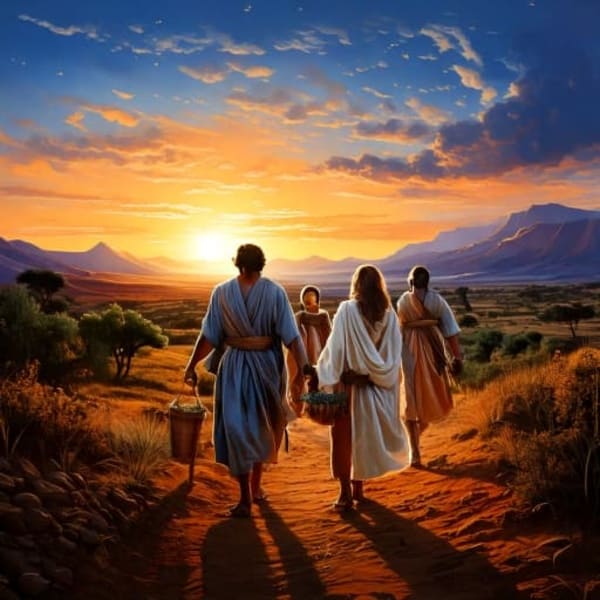
When Adam elected to leave the first garden to the Nodites unopposed, he and his followers could not go west, for the Edenites had no boats suitable for such a marine adventure. They could not go north; the northern Nodites were already on the march toward Eden. They feared to go south; the hills of that region were infested with hostile tribes. The only way open was to the east, and so they journeyed eastward toward the then pleasant regions between the Tigris and Euphrates rivers. And many of those who were left behind later journeyed eastward to join the Adamites in their new valley home.
Cain and Sansa were both born before the Adamic caravan had reached its destination between the rivers in Mesopotamia. Laotta, the mother of Sansa, perished at the birth of her daughter; Eve suffered much but survived, owing to superior strength. Eve took Sansa, the child of Laotta, to her bosom, and she was reared along with Cain. Sansa grew up to be a woman of great ability. She became the wife of Sargan, the chief of the northern blue races, and contributed to the advancement of the blue men of those times.
1. The Edenites Enter Mesopotamia
The Adamic caravan's journey to the Euphrates River consumed nearly a full year, followed by a six-week encampment on the western plains while they awaited the subsidence of flood waters. Upon crossing to the region between the rivers, destined to become their second garden, they discovered that the native inhabitants had hastily fled to the eastern mountains upon learning of Adam's approach. This territory had been identified in Van and Amadon's original survey as one of three potential sites for the Garden of Eden, possessing favorable natural defenses enhanced by the proximity of the Tigris and Euphrates rivers to the north, which enabled the construction of a fifty-six mile defensive wall to protect the southern boundary.
The stark contrast between their new circumstances and the paradisiacal conditions of the first garden was immediately apparent to the Adamites. As Adam had observed, "the ground had been cursed," necessitating arduous labor to cultivate unprepared soil and confront the natural adversities of mortal existence. Unlike the first garden, which had been partially prepared for their arrival, the second garden required creation through diligent physical exertion, emblematic of their new status and the proverbial earning of sustenance "by the sweat of their faces." This agricultural struggle represented a profound shift from their previous semidivine existence to the challenging reality of human survival in a world beset by evolutionary limitations.
2. Cain and Abel
Less than two years after Cain's birth, Abel became the first child born to Adam and Eve in the second garden. When Abel reached twelve years of age, he chose the vocation of herder, while Cain gravitated toward agriculture—a vocational divergence that would catalyze a fateful fraternal conflict. Following the customary practice of presenting offerings to the priesthood from their respective fields of labor, the brothers found themselves in escalating competition, with Abel's animal sacrifices receiving preferential recognition over Cain's agricultural offerings. Abel exacerbated tensions by taunting his older brother about this perceived divine favoritism.
The tragic culmination of this fraternal animosity was deeply rooted in multiple factors: not only the religious controversy concerning appropriate sacrifices but also the complex hereditary distinction between the brothers. Cain, born of Adam and the Nodite Laotta, lacked the pure violet heredity possessed by Abel, who was conceived by both Adam and Eve. While Adam had indeed discouraged animal sacrifices in the first Eden, providing Cain with legitimate theological grounds for his position, the Nodite priests who organized religious practices in the second garden had reverted to pre-Adamic traditions favoring animal offerings. Additionally, Cain's natural bellicose tendencies, inherited from his Nodite ancestry, made him particularly susceptible to rage when confronted with Abel's persistent taunting about his mixed lineage. The lethal confrontation occurred when the brothers were eighteen and twenty years old, with Cain's accumulated resentment erupting into violence that claimed Abel's life.
3. Life in Mesopotamia
The consequences of the default became increasingly apparent as Adam and Eve established their new life in Mesopotamia. They deeply mourned the loss of Eden's serene beauty and the absence of their children who had been transported to Edentia, yet they bore their diminished estate with remarkable dignity and fortitude. Adam demonstrated foresight by devoting substantial time to training his children and associates in civil administration, educational methods, and religious devotions—preparations that would prevent societal collapse following his eventual death and establish enduring cultural patterns among his descendants.
The Adamic leadership structure that emerged was bifurcated between civil and religious authorities. The civil rulers descended hereditarily from the sons of the first garden, with Adam's firstborn son Adamson establishing a secondary violet race center north of the second garden, while Eveson, Adam's second son, served as his father's principal administrative assistant. The religious leadership originated with Seth, the eldest surviving son born in the second garden, who instituted a tripartite priesthood encompassing spiritual guidance, medical care, and education. The Adamic caravan had transported seeds, bulbs, and domesticated animals from Eden, providing considerable agricultural and cultural advantages over surrounding tribes. Their diet underwent significant transformation, with Adam and Eve consuming flesh for the first time during their journey to Mesopotamia, though neither they nor their first-generation children integrated meat into their regular diet. The Adamites established remarkable cultural achievements, creating the third alphabet and advancing the arts of writing, metalworking, pottery, weaving, and architecture to levels that would remain unsurpassed for millennia.
4. The Violet Race
Adam and Eve were the progenitors of the violet race, the ninth human race to emerge on Urantia, characterized by distinctive blue eyes, fair complexions, and hair coloration ranging through yellow, red, and brown. Unlike Eve, who experienced no pain in childbirth, as was typical of the early evolutionary races, the mixed races resulting from unions between evolutionary humans and Adamites later endured the severe pains of childbirth—a biological consequence of their hybridized genetics. The original Adamic pair possessed a dual energy system, subsisting on both physical food and light, supplemented by superphysical energies unavailable on Urantia, but their offspring inherited only the conventional human circulatory system dependent entirely on blood sustenance.
Adam and Eve's superior sensory capacities enabled them to perceive midwayers, angelic hosts, Melchizedeks, and even the fallen Prince Caligastia, abilities that diminished progressively through subsequent generations. Their bodily cells manifested significantly greater resistance to disease than those of the planetary natives, explaining why Urantia peoples must expend such considerable scientific effort to combat physical disorders. Recognizing the value of his genetic contribution, Adam implemented a deliberate program to benefit humanity after his death by establishing a commission headed by Eve to select 1,682 superior women from surrounding tribes who were impregnated with the Adamic life plasm. From this initiative, 1,570 superior individuals were born who carried Adamic genetics, constituting the early foundations of the mighty Andite race. These children were born and raised within their mothers' tribal environments, disseminating Adamic genetics more widely than would have been possible through the more restricted model of the first garden.
5. Death of Adam and Eve
After establishing themselves in the second garden, Adam and Eve received confirmation that their repentance was acceptable and that, while subject to mortal death, they would qualify for admission to the ranks of sleeping survivors awaiting resurrection. Unlike their previous status on Jerusem and in the first garden, where they functioned without Thought Adjusters, their reduction to mortal status and sincere repentance qualified them for Adjuster indwelling. This knowledge provided significant consolation throughout their remaining years, assuring them that despite their failure as Material Sons, the ascendant path to Paradise remained accessible to them as universe citizens.
Adam was cognizant of the dispensational resurrection that coincided with his arrival on Urantia and anticipated that he and Eve would likely be repersonalized with the advent of the next order of sonship. However, he did not anticipate the imminent appearance of Michael on Urantia, expecting instead the arrival of an Avonal Son. A mysterious personal message received from Michael contained veiled references to their potential special resurrection, which greatly encouraged them though they could not fully comprehend its implications. Adam survived for 530 years before succumbing to the natural deterioration of physical systems, while Eve preceded him in death by nineteen years due to cardiac weakness. They were interred beneath the temple of divine service that had been constructed according to their specifications shortly after the completion of the colony's defensive wall, establishing the precedent for burying notable individuals beneath places of worship.
6. Survival of Adam and Eve
Adam and Eve entered the sleep of death with unwavering faith in the Melchizedeks' assurances regarding their eventual resurrection on the mansion worlds. Their period of unconsciousness proved remarkably brief; on the third day following Adam's death and second day after his ceremonial burial, Lanaforge's orders, supported by the Most High of Edentia and endorsed by the Union of Days on Salvington acting for Michael, were transmitted to Gabriel, initiating a special roll call of distinguished survivors from the Adamic default. In accordance with this dispensational mandate, the twenty-sixth in the Urantia series, Adam and Eve were repersonalized in the resurrection halls of the mansion worlds alongside 1,316 of their associates from the first garden.
Their progression through the ascension worlds was remarkably swift, culminating in their restoration to citizenship on Jerusem and returning to their planet of origin not as Material Sons but as ascendant mortals. They were immediately integrated into Urantia service on the system capital and subsequently appointed to the twenty-four counselors constituting Urantia's advisory body. Despite the challenges, tragedies, and ultimate default that characterized their planetary mission, Adam and Eve made substantial contributions to human civilization and biological advancement. Although their advanced cultural legacy could not survive the dilution and eventual submergence of their genetic influence, their impact on human development remained significant. As Solonia observes in the concluding philosophical reflection, "It is the people who make a civilization; civilization does not make the people," a truism exemplified by the Adamic experience on Urantia.