Discover The Urantia Book \Papers\Advanced \The Garden of Eden

Paper 73 Overview: The Garden of Eden
The Garden of Eden was a cultural and spiritual center prepared for Adam and Eve. It was designed to uplift Urantia through enhanced genetics, education, and divine fellowship with the native peoples.
Reading Level:
Summary
Paper 73 details the establishment of the Garden of Eden as the reception site for Adam and Eve, the Material Son and Daughter dispatched to Urantia as biologic uplifters. Approximately forty thousand years ago, the Life Carriers determined that human evolutionary development had reached its biological apex, prompting them to petition the Most Highs of Edentia for a biologic uplift mission. Following inspection by Tabamantia, sovereign supervisor of decimal worlds, Adam and Eve arrived less than a century later to face the formidable task of rehabilitating a planet compromised by the Caligastia rebellion and subsequent spiritual isolation.
The planning, site selection, and construction of the Garden under Van and Amadon's leadership are chronicled, highlighting the peninsula on the eastern Mediterranean shore that served as Eden’s location. This remarkable undertaking involved over three thousand volunteers and nearly ten thousand loyal midway creatures who worked to create an unprecedented display of architectural and horticultural splendor. The garden featured the transplanted tree of life, a non-mythical botanical entity from Edentia that sustained the Material Son and Daughter's physical existence. Ultimately, the Garden met its fate through natural geological processes approximately four thousand years after Adam's departure, when volcanic activity and tectonic shifts submerged the entire peninsula beneath the Mediterranean waters—an event providentially timed to coincide with the violet race's readiness to undertake their intended mission of planetary rehabilitation beyond the confines of Eden.
Introduction
The cultural decadence and spiritual poverty resulting from the Caligastia rebellion and subsequent disaffection of Caligastia and Daligastia had minimal impact on the biological evolution of the Urantia races. Around forty thousand years ago, the Life Carriers noted that planetary biologic development was approaching its apex, prompting them to join with the Melchizedek receivers in petitioning the Most Highs of Edentia for biologic uplifters, a Material Son and Daughter. This request was directed to Edentia because the Most Highs had exercised direct jurisdiction over many Urantian affairs since Caligastia's downfall and the temporary suspension of authority on Jerusem.
Following this petition, Tabamantia, the sovereign supervisor of the decimal or experimental worlds, conducted a planetary inspection and subsequently recommended that Urantia be granted Material Sons. Within approximately one hundred years from this inspection, Adam and Eve, a Material Son and Daughter from the local system, arrived on Urantia and commenced their challenging mission of untangling the complex affairs of a rebellion-scarred planet operating under spiritual isolation. Their task would prove to be extraordinarily difficult given the regressed state of the world they encountered.
1. The Nodites and the Amadonites
On a normatively developing planet, the arrival of a Material Son traditionally heralds the dawn of a golden age of invention, material progress, and intellectual enlightenment. Urantia's post-Adamic era should have been characterized by unprecedented scientific advancement; however, despite the physical fitness of the planetary races, the tribes languished in savage and morally stagnant conditions. Ten thousand years after the rebellion, virtually all the advancements made during the Prince's administration had been obliterated, leaving the world's inhabitants scarcely better off than if Caligastia had never arrived. Only among the Nodites and Amadonites did the traditions of Dalamatia and the culture of the Planetary Prince persist as tenuous threads of advanced civilization.
The Nodites were descendants of the rebel members of the Prince's staff, deriving their name from their first leader, Nod, who had formerly chaired the Dalamatia commission on industry and trade. The Amadonites, conversely, were descendants of those Andonites who chose to remain loyal with Van and Amadon during the rebellion. While "Amadonite" functioned primarily as a cultural and religious designation rather than a racial term (as they were essentially Andonites), "Nodite" denoted both a cultural affiliation and a distinct racial category. The traditional enmity between these groups frequently complicated collaborative efforts, including their later work in Eden.
Following Dalamatia's destruction, the Nodites fragmented into three major geographic divisions: a central group near the Persian Gulf, an eastern contingent in Elam, and a western group along the northeastern Mediterranean coast. Through intermarriage with Sangik races, the Nodites produced capable progeny, and some rebellious Dalamatians eventually joined Van's loyal followers north of Mesopotamia, where they intermingled with the Amadonites to become the "mighty men of old." Prior to Adam and Eve's arrival, these two groups, Nodites and Amadonites, represented the most advanced and culturally sophisticated races on the planet.
2. Planning for the Garden
For nearly a century preceding Tabamantia's inspection, Van and his associates had been disseminating from their highland headquarters of world ethics and culture the prophetic message of an imminent divine Son, a racial uplifter who would serve as the worthy successor to the traitorous Caligastia. Although the majority of the world's inhabitants displayed minimal interest in these predictions, those in direct contact with Van and Amadon regarded such teachings with seriousness and began formulating concrete plans for the anticipated Son's reception. Van shared his pre-Urantian knowledge of the Material Sons of Jerusem with his closest associates, and eighty-three years before Adam and Eve's arrival, proposed that they dedicate themselves to both proclaiming the advent and preparing a suitable garden home.
From their highland headquarters and sixty-one widely dispersed settlements, Van and Amadon assembled a corps exceeding three thousand enthusiastic volunteers who solemnly dedicated themselves to preparing for the promised Son. Van organized these volunteers into one hundred companies, each under a captain with an associate serving as a liaison officer on Van's personal staff, while Amadon served as Van's direct associate. These commissions earnestly commenced preliminary preparations, with a dedicated committee on location undertaking the critical task of finding the ideal site for the Garden. Despite Caligastia and Daligastia's systematic attempts to frustrate and impede the preparatory work through various evil machinations, their destructive efforts were largely neutralized by the tireless labor of nearly ten thousand loyal midway creatures who worked diligently to advance the noble enterprise. This remarkable collaboration between mortal volunteers and superhuman beings ensured the project's progression despite formidable spiritual opposition.
3. The Garden Site
The location committee conducted an exhaustive three-year search before submitting their report identifying three viable sites: an island in the Persian Gulf; a river location that would subsequently become the second garden after the first's destruction; and a long, narrow peninsula, almost an island, extending westward from the eastern Mediterranean coastline. The committee endorsed the third option with near unanimity, and two subsequent years were devoted to transferring the world's cultural headquarters, including the precious tree of life, to this Mediterranean peninsula. The transition was remarkably peaceful, with all but a single group of the peninsula's original inhabitants voluntarily vacating upon the arrival of Van and his company.
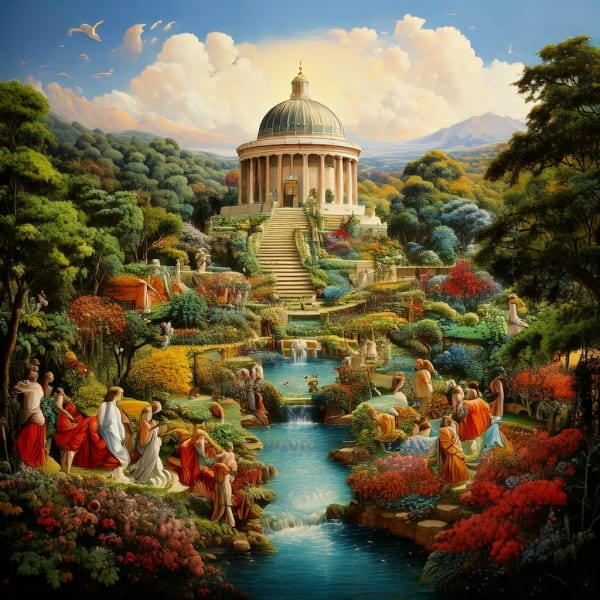
The Mediterranean peninsula possessed exceptional climatological advantages, featuring a salubrious climate and equable temperatures maintained by the surrounding mountain ranges and its near-island geography. While abundant rainfall occurred in the adjacent highlands, precipitation within Eden proper was rare; instead, nightly mist would rise from an extensive network of artificial irrigation channels to refresh the Garden's vegetation. The peninsula's coastline was substantially elevated above sea level, and the narrow neck connecting it to the mainland measured only twenty-seven miles across at its narrowest point. A significant river originating in the peninsula's higher elevations flowed eastward through this neck, continuing across Mesopotamia's lowlands to the distant sea.
This primary waterway was fed by four tributaries originating in the coastal hills of the Edenic peninsula. These became the famed "four heads" of the river that "went out of Eden," later conflated with rivers surrounding the second garden. The surrounding mountains contained abundant precious stones and metals, though these resources received minimal attention as the garden's primary objectives centered on horticultural excellence and agricultural innovation. The selected site represented perhaps the most beautiful location of its kind globally, with an ideal climate that enhanced its suitability as a botanic paradise where the finest elements of Urantian civilization could converge.
4. Establishing the Garden
When Material Sons, serving as biological uplifters, embark on their missions to evolutionary worlds, their designated habitations are frequently termed Gardens of Eden owing to their resemblance to the botanical magnificence of Edentia, the constellation capital. Cognizant of these traditions, Van designated the entire peninsula for garden development, reserving the adjacent mainland for pastoral and agricultural activities. In accordance with the divine concept of the garden as a sanctuary of peace and beauty, only avian species and various domesticated animals were permitted within its boundaries, with a strict prohibition against animal slaughter inside the garden perimeter. All meat consumed by the Garden workers throughout the construction period was sourced exclusively from herds maintained under watchful supervision on the mainland.
The initial construction phase focused on erecting a substantial brick wall across the peninsula's neck to secure the territory, after which the comprehensive work of landscape beautification and residential construction could proceed without interruption. An innovative zoological garden was established in the space between the main wall and a secondary, smaller wall; this intervening area, populated with diverse wild fauna, served dual purposes as both educational exhibition and supplementary defensive barrier. The menagerie was methodically organized into twelve grand divisions with walled pathways connecting these zoological sections to the Garden's twelve gates, while the central area accommodated the river and adjacent pastures. Throughout the Garden's preparation, exclusively volunteer laborers were employed; no compensated workers were ever utilized in this sacred endeavor.
These dedicated volunteers cultivated the Garden's vegetation and tended livestock for their sustenance, supplemented by food contributions from sympathetic believers in surrounding regions. This monumental undertaking reached successful completion despite the numerous difficulties associated with the chaotic global conditions of that tumultuous era. However, a significant disappointment occurred when Van, uncertain of the arrival timeline for the expected Son and Daughter, suggested training the younger generation to continue the enterprise—a proposal perceived by some as demonstrating a lack of faith, resulting in numerous desertions. Nevertheless, Van persisted with his contingency planning, filling vacated positions with younger volunteers committed to the Garden's completion.
5. The Garden Home
At the heart of the Edenic peninsula stood an exquisite stone temple dedicated to the Universal Father, serving as the sacred focal point of the Garden. The administrative headquarters was strategically positioned to the north, while homes for workers and their families were constructed to the south. Land to the west was reserved for the proposed educational institutions of the expected Son, and to the "east of Eden" were erected the residential structures intended for the promised Son and his immediate progeny. Eden's architectural plans were remarkably ambitious, providing for one million human inhabitants with appropriate housing and abundant land allocation. By the time of Adam's arrival, though the Garden had reached only one-quarter completion, it already boasted thousands of miles of irrigation canals and over twelve thousand miles of paved paths and roads.
The Garden featured slightly more than five thousand brick structures distributed across various sectors, with a maximum of seven houses constituting any single cluster within the park. Both the infrastructure and horticultural elements reflected exceptional attention to detail and aesthetic sensibility; though functionally straightforward, the buildings exhibited artistic sophistication, while the roads and paths demonstrated sound engineering principles complemented by exquisite landscaping. The sanitation arrangements within the Garden significantly surpassed any previous Urantian implementations, with drinking water purity maintained through strict adherence to carefully designed sanitary regulations. Initially, problems arose from neglect of these protocols, but Van gradually impressed upon his associates the critical importance of protecting the Garden's water supply.
Before the establishment of a formal sewage disposal system, the Edenites practiced meticulous burial of waste materials. Later, a sophisticated covered brick-conduit disposal system was constructed beneath the walls, discharging nearly a mile beyond the Garden's outer perimeter. By the time of Adam's arrival, most indigenous plants from that region had been successfully cultivated in Eden, with many fruits, cereals, and nuts having undergone significant improvement, though numerous valuable food plant varieties were subsequently lost to global agriculture after Eden's demise. Approximately five percent of the Garden was under intensive artificial cultivation, with an additional fifteen percent partially cultivated, while the remainder was preserved in its natural state awaiting Adam's guidance regarding final landscaping decisions.
6. The Tree of Life
In the central courtyard of the Garden temple, Van planted the long-safeguarded tree of life, whose leaves were reputed to possess healing properties for nations and whose fruit had sustained his extraordinarily extended existence on Urantia. Van comprehended that Adam and Eve would likewise depend on this Edentian gift for their physical maintenance after materialization in corporeal form on Urantia. Unlike Material Sons residing on system capitals who do not require the tree of life for sustenance, those undertaking planetary assignments become dependent on this remarkable organism for their continued physical existence during their sojourn in material form.
The "tree of the knowledge of good and evil" may represent a metaphorical construct encompassing multiple human experiences, but the tree of life was an authentic botanical entity that maintained a physical presence on Urantia for an extended period. When the Most Highs of Edentia confirmed Caligastia's appointment as Planetary Prince of Urantia and approved his staff of one hundred Jerusem citizens, they dispatched to the planet, via Melchizedek transport, an Edentian shrub that developed into Urantia's tree of life. This unusual form of non-intelligent life, indigenous to constellation headquarters spheres and present on the administrative worlds of local and superuniverses as well as on Havona spheres (though absent from system capitals), stored certain space-energies that counteracted age-inducing elements in animal physiology. The fruit functioned analogously to a superchemical storage battery, mysteriously releasing universal life-extension forces when consumed. This exceptional nutrition proved entirely ineffectual for ordinary evolutionary beings on Urantia but provided critical sustenance to Caligastia's one hundred materialized staff members and the modified Andonites who had contributed life plasm to the Prince's staff in exchange for receiving the life complement enabling them to utilize the tree's fruit for indefinite extension of their otherwise mortal existence.
During the Prince's administration, the tree grew from the ground in the central circular courtyard of the Father's temple. Following the rebellion's outbreak, Van and his associates regenerated it from the central core in their temporary encampment before relocating it to their highland retreat, where it served both Van and Amadon for over 150,000 years. When preparing the Garden for Adam and Eve, they transplanted the Edentian shrub to Eden, where it again grew in a central circular courtyard of another temple dedicated to the Father. Upon the collapse of Adam's mission, he and his family were prohibited from removing the tree's core from the Garden. The invading Nodites were informed they would become "as gods" by consuming its fruit, but despite finding it unguarded and partaking freely for years, they experienced no benefits due to their fully material mortal constitution. During one of their internal conflicts, both the temple and tree were destroyed by fire, leaving only the stone wall intact until the Garden's eventual submersion.
7. The Fate of Eden
Following Adam's departure from the original garden, the territory was successively occupied by various groups including the Nodites, Cutites, and Suntites, eventually becoming the stronghold of northern Nodites who actively opposed collaboration with the Adamites. These inferior Nodites dominated the peninsula for approximately four millennia after Adam's exit until geological catastrophe transformed the region. Intense volcanic activity, coupled with the submersion of the Sicilian land bridge connecting to Africa, triggered the subsidence of the eastern Mediterranean seabed, which consequently pulled the entire Edenic peninsula beneath the waters. Concurrent with this submersion, the eastern Mediterranean coastline experienced significant elevation. Importantly, this was not a sudden cataclysm but rather a gradual process extending over several centuries until the peninsula completely disappeared beneath the waves.
The Garden's disappearance should not be interpreted as a consequence of divine plan failure or attributed to Adam and Eve's missteps; rather, it represented a natural geological occurrence. Significantly, the timing of Eden's submersion appears providentially aligned with the accumulation of sufficient violet race population reserves to initiate global rehabilitation efforts. The Melchizedeks had counseled Adam to postpone his program of racial enhancement and admixture until his own family numbered at least half a million members. The Garden was never intended as the permanent domicile of the Adamites; instead, they were to function as emissaries of a new evolutionary paradigm throughout the world, mobilizing for unselfish service to the planet's underdeveloped races.
The Melchizedek instructions directed Adam to establish racial, continental, and divisional headquarters under the leadership of his immediate offspring. At the same time, he and Eve would divide their time among these various global capitals as advisors and coordinators of a comprehensive worldwide ministry encompassing biological advancement, intellectual development, and moral rehabilitation. This strategic dispersal would have maximized the influence of Adamic culture across the planet, accelerating the spiritual and material progress of all Urantia's peoples through direct contact with the superior violet race.