Discover The Urantia Book \Papers\Advanced \The Marine-Life Era on Urantia

Paper 59 Overview: The Marine-Life Era on Urantia
Urantia’s marine-life era spanned millions of years. Primitive organisms evolved into complex sea creatures, laying the foundation for land life, all under the steady influence of evolutionary and celestial guidance.
Reading Level:
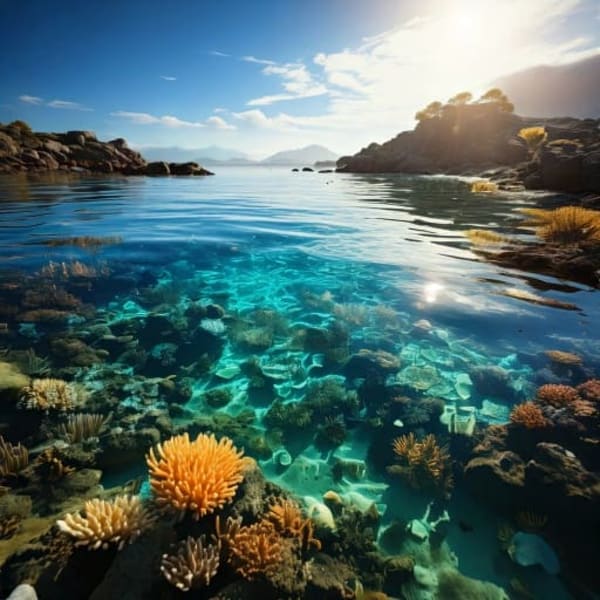
Table of Contents
-
Summary
The chronological history of Urantia encompasses approximately one billion years, stratified into five principal eras that delineate the planet's evolutionary development. The marine-life era, covering 250 million years and corresponding to what earth scientists designate as the Paleozoic period, represents a crucial quarter of planetary history when the foundations of biological diversity were established in the primordial oceans. This era is further subdivided into six distinct periods, each characterized by specific geological transformations and biological advancements that systematically prepared the planet for the eventual emergence of land-dwelling organisms.
The narrative of marine life begins with the proliferation of primitive vegetation across sea bottoms, continental shelves, and shallow coastal basins, followed by the evolutionary development of elementary animal organisms from antecedent plant life. These nascent animal forms gradually populated the extensive continental coastlines, eventually spreading throughout the numerous inland seas. Although the fossil record from this era is incomplete due to the absence of hard shells in many early organisms, the geological strata nonetheless commenced the systematic documentation of life's progression that would continue through subsequent ages. North America possesses an exceptionally comprehensive collection of marine-era fossils, with clearly demarcated boundaries between these deposits and the eroded remnants of preceding geological epochs.
-
Introduction
We reckon the history of Urantia as beginning about one billion years ago and extending through five major eras: the prelife era extending over the initial four hundred and fifty million years from about the time the planet attained its present size to the time of life establishment; the life-dawn era extending over the next one hundred and fifty million years; the marine-life era covering the next two hundred and fifty million years; the early land-life era extending over the next one hundred million years; and the mammalian era occupying the last fifty million years. The marine-life era thus covers about one quarter of your planetary history and can be subdivided into six long periods, each characterized by certain well-defined developments in both the geologic realms and the biologic domains.
As this era begins, the sea bottoms, the extensive continental shelves, and the numerous shallow near-shore basins are covered with prolific vegetation. The more simple and primitive forms of animal life have already developed from preceding vegetable organisms, and the early animal organisms have gradually made their way along the extensive coastlines of the various land masses until the many inland seas are teeming with primitive marine life. Since so few of these early organisms had shells, not many have been preserved as fossils. Nevertheless the stage is set for the opening chapters of that great "stone book" of the life-record preservation which was so methodically laid down during the succeeding ages. The continent of North America is wonderfully rich in the fossil-bearing deposits of the entire marine-life era. The very first and oldest layers are separated from the later strata of the preceding period by extensive erosion deposits which clearly segregate these two stages of planetary development.
-
1. Early Marine Life in the Shallow Seas: The Trilobite Age
By the dawn of this period, life was confined to the various inland seas and the oceanic shore line, as no form of land organism had yet evolved. Primitive marine animals were well established and prepared for the next evolutionary development, with amebas representing typical survivors of this initial stage of animal life, having appeared toward the close of the preceding transition period. Approximately 400 million years ago, marine life—both vegetable and animal—had become fairly well distributed across the entire world as the climate grew warmer and more equable, leading to a general inundation of the seashores of various continents, particularly North and South America. This period witnessed the formation of new oceans and significant enlargement of existing bodies of water.
Vegetation now made its first venture onto land and quickly achieved considerable progress in adapting to a non-marine habitat, though the atmosphere remained inhospitable to land animals due to its high carbon dioxide content. Suddenly and without gradational ancestry, the first multicellular animals appeared in the fossil record. The trilobites evolved and came to dominate the seas so thoroughly that this epoch is rightfully designated as the trilobite age from the perspective of marine life. During the later portion of this time segment, substantial portions of North America and Europe emerged from the sea as earth's crust temporarily stabilized. Mountains and high elevations of land formed along the Atlantic and Pacific coasts, over the West Indies, and in southern Europe, with the entire Caribbean region experiencing significant uplift. The sedimentary deposits of this age fall into four distinct categories: conglomerates formed near shorelines, sandstones created in shallow water with sufficient wave action to prevent mud settling, shales deposited in deeper and more quiet waters, and limestone including the deposits of trilobite shells in deep water.
The trilobite fossils from this period display certain basic uniformities coupled with well-marked variations, reflecting their evolution from the three original life implantations. Those appearing in the Western Hemisphere differed slightly from the Eurasian group and from the Australasian or Australian-Antarctic type. Around 370 million years ago, North and South America experienced an almost complete submergence, followed by the sinking of Africa and Australia. Five million years later, the seas began retreating before rising land. All these phenomena of land sinking and rising occurred gradually over millions of years without dramatic geological events. The trilobite-bearing strata from this epoch are visible throughout all continents except central Asia. In mountainous regions, these rock layers have often been tilted and distorted due to pressure and folding, which has in many places transformed the original character of these deposits—sandstone converted to quartz, shale changed to slate, and limestone metamorphosed into marble.
-
2. The First Continental Flood Stage: The Invertebrate-Animal Age
The periodic phenomena of land elevation and land sinking characteristic of these times were all gradual and nonspectacular, accompanied by minimal volcanic activity. Throughout all these successive land fluctuations, the Asiatic mother continent experienced a unique geological history, undergoing many inundations but not developing the uniform rock deposits discoverable on other continents. In recent geological ages, Asia has demonstrated remarkable stability compared to other land masses. Around 350 million years ago, a great flood period commenced affecting all continents except central Asia, with land masses repeatedly submerged under water while only coastal highlands remained above these shallow but widespread oscillatory inland seas. Three major inundations characterized this period, but before it concluded, the continents again rose, with total land emergence exceeding current levels by fifteen percent. The Caribbean region was particularly elevated during this time, though the period is not well differentiated in Europe due to less pronounced land fluctuations and more persistent volcanic activity.
Approximately 340 million years ago, another extensive land submergence occurred with the exception of Asia and Australia, resulting in a general commingling of the world's oceanic waters. This era is notable as a great limestone age, with much of its stone being deposited by lime-secreting algae. A few million years later, large portions of the American continents and Europe began emerging from the water. In the Western Hemisphere, only an arm of the Pacific Ocean remained over Mexico and the present Rocky Mountain regions, though near the close of this epoch, both Atlantic and Pacific coasts began sinking again. This period witnessed significant evolutionary advancements in marine life. Lime-secreting algae became widespread, with thousands of species of early coral ancestors developing alongside abundant sea worms and numerous varieties of jellyfish that have since become extinct. Corals and more sophisticated sponge types evolved, while cephalopods achieved advanced development and have survived as the modern pearly nautilus, octopus, cuttlefish, and squid. Various shell animals also flourished in these ancient seas, including single-shelled gastropods such as drills, periwinkles, and snails, alongside bivalve species that have endured through intervening millions of years, encompassing mussels, clams, oysters, and scallops.
By the conclusion of this period, the world had grown quieter and more peaceful, with a mild and equable climate allowing land plants to migrate progressively farther from shorelines. Though life patterns were well developed, few plant fossils from this time have been preserved. This era marked the pinnacle of individual animal organismal evolution, though many foundational transitions, such as the shift from plant to animal life, had occurred earlier. The marine fauna evolved to a point where every type of life below the vertebrate scale was represented in the fossil record of rocks deposited during this period. However, all these animals remained exclusively marine organisms, as no land animals had yet appeared except for a few types of worms that burrowed along seashores. Terrestrial plants had not yet spread across the continents because the atmosphere still contained excessive carbon dioxide levels that precluded the existence of air-breathing organisms. Fundamentally, all animals except certain primitive types depended directly or indirectly on plant life for their existence.
-
3. The Second Great Flood Stage: The Coral Period—The Brachiopod Age
Three hundred million years ago witnessed the commencement of another extensive period of land submergence as the ancient Silurian seas encroached southward and northward, preparing to engulf most of Europe and North America. The land was not elevated significantly above sea level, resulting in minimal deposition occurring around shorelines. The seas teemed with lime-shelled life forms, and the continual settling of these shells onto the sea floor gradually constructed remarkably thick layers of limestone. This represents the first widespread limestone deposit, currently covering virtually all of Europe and North America, though it surfaces in only a few locations. The average thickness of this ancient rock stratum approaches one thousand feet, though many of these deposits have subsequently experienced considerable deformation through tilting, upheavals, and faulting, with some transformed into quartz, shale, and marble through geological processes.
Minimal evidence of fire rocks or lava is found in the stone layers from this period, with the notable exceptions being the great volcanoes of southern Europe, eastern Maine, and the lava flows of Quebec. Volcanic activity had largely subsided during this time, which represented the zenith of great water deposition with little concurrent mountain formation. Two hundred and ninety million years ago, the seas had substantially withdrawn from the continents while the bottoms of surrounding oceans were sinking. The land masses experienced minimal changes until they were again submerged, but early mountain movements were beginning across all continents. The most significant of these crustal upheavals were the Himalayas of Asia and the great Caledonian Mountains, extending from Ireland through Scotland to Spitzbergen. Within the deposits from this age are found much of the gas, oil, zinc, and lead resources still utilized today, with the gas and oil derived from enormous collections of vegetable and animal matter carried down during previous land submergence, while mineral deposits represent sedimentation from sluggish bodies of water.
As the oceanic climate maintained its mild and uniform character, warm seas bathed even the shores of polar lands, allowing marine fossils to form in these deposits right up to the North Pole. Gastropods, brachiopods, sponges, and reef-making corals continued to multiply, while the close of this epoch witnessed the second advance of the Silurian seas with another commingling of southern and northern ocean waters. The cephalopods dominated marine life during this period, while associated life forms progressively developed and differentiated. Two hundred and eighty million years ago, the continents had largely emerged from the second Silurian inundation, with rock deposits from this submergence known in North America as Niagara limestone—the stratum over which Niagara Falls now flows. This layer extends from the eastern mountains to the Mississippi valley but does not continue westward except in southern regions. Several layers extend over Canada, portions of South America, Australia, and most of Europe, with an average thickness of approximately six hundred feet.
-
4. The Great Land-Emergence Stage: The Vegetative Land-Life Period: The Age of Fishes
Throughout the agelong struggle between land and water, periods of oceanic dominance had prevailed, but the pendulum was swinging toward terrestrial ascendancy as continental drift had not yet progressed to the point of irreversible separation. As land emerged from the final Silurian inundation, a significant transition in world development and life evolution commenced—the dawn of a new age when the formerly barren and unattractive landscape gradually became clothed with luxuriant vegetation, heralding the imminent appearance of magnificent forests. Marine life during this epoch exhibited remarkable diversity due to early species segregation, though later periods would witness free commingling and association of these various types. Brachiopods reached their evolutionary apex before being succeeded by arthropods, while barnacles made their initial appearance in the fossil record.
The most momentous biological development of this period was the sudden emergence of the fish family, establishing this as the quintessential age of fishes—that phase of world history distinguished by vertebrate animal types. Two hundred and seventy million years ago, the continents stood completely above water, marking one of the most significant land-emergence epochs in earth's geological chronicle. Within five million years, however, the land areas of North and South America, Europe, Africa, northern Asia, and Australia experienced brief inundation, with North American submergence becoming nearly complete in certain regions. The resulting limestone layers from this Devonian flooding range from 500 to 5,000 feet in thickness. These various Devonian seas extended first in one direction and then another, with the immense arctic North American inland sea establishing an outlet to the Pacific Ocean through northern California.
The earth was being rapidly transformed by the expansion of new orders of land vegetation. Prior to this period, few plants grew on land except around water margins. Now, suddenly, the prolific fern family appeared and quickly spread across the face of the rapidly rising land throughout the world. Tree types measuring two feet in diameter and forty feet in height soon developed, though their foliage remained rudimentary compared to modern leaves. Smaller plants existed but left few fossils, typically having been destroyed by previously appearing bacteria. As land continued to rise, North America became connected with Europe via land bridges extending to Greenland, which today preserves the remains of these early land plants beneath its ice mantle. The elevation of the continents progressed steadily, with the atmosphere becoming increasingly enriched with oxygen. Earth became covered by vast forests of ferns reaching one hundred feet in height alongside peculiar trees of that silent era—a forestland without sounds, not even rustling leaves, as these primitive trees lacked foliage as we understand it today.
-
5. The Crustal-Shifting Stage: The Fern-Forest Carboniferous Period: The Age of Frogs
The appearance of fish during the preceding period represents the apex of marine-life evolution, from which point onward the evolution of terrestrial life assumed progressively greater importance. This period begins with environmental conditions nearly ideally configured for the emergence of the first land animals. Approximately 220 million years ago, many continental land areas, including most of North America, stood above water and were overrun by luxurious vegetation, particularly the flourishing fern family. Atmospheric carbon dioxide remained present but in diminishing concentrations, setting the stage for increasing plant proliferation and the subsequent evolutionary developments of land-dwelling creatures.
Shortly thereafter, central North America experienced inundation, creating two extensive inland seas that eventually united, commingling their diverse life forms. This union of marine fauna marked the beginning of the rapid worldwide decline of marine life and the corresponding ascendance of the subsequent land-life period. Around 210 million years ago, warm-water arctic seas covered most of North America and Europe, while south polar waters inundated South America and Australia. Africa and Asia remained significantly elevated during this time. Within this dynamic environment, a new evolutionary development suddenly materialized—the first land animals appeared, comprising numerous species capable of surviving both in water and on land. These air-breathing amphibians evolved from arthropods whose swim bladders had gradually transformed into primitive lungs, allowing them to venture beyond their aquatic habitats.
From the briny waters of ancient seas, creatures such as snails, scorpions, and frogs crawled out upon the land, establishing the first terrestrial animal populations. Frogs continue to exhibit this evolutionary heritage, still laying their eggs in water where their young initially exist as small fish-like tadpoles before metamorphosing into their adult form. Contemporaneously, insects made their first appearance and rapidly proliferated across the continents alongside spiders, scorpions, cockroaches, crickets, and locusts. Some dragonfly species reached impressive dimensions, measuring thirty inches across their wingspan. Over one thousand species of cockroaches evolved during this period, with some specimens growing to four inches in length. The land experienced periodic elevation and subsidence due to shifting sea levels, and this crustal instability, combined with the prolific vegetation of coastal swamps, contributed to the formation of extensive coal deposits that have led geologists to designate this period as the Carboniferous. The presence of roots from trees that grew in clay underlying modern coal beds demonstrates that coal formed precisely in its current locations, representing water-preserved and pressure-modified remains of dense vegetation that flourished in ancient bogs and swamp shores.
-
6. The Climatic Transition Stage: The Seed-Plant Period: The Age of Biologic Tribulation
This period marks the culmination of pivotal evolutionary development in marine life and the commencement of the transition phase leading toward subsequent ages dominated by land animals. This era was characterized by profound life impoverishment, as thousands of marine species perished while terrestrial life had barely established a foothold. It truly represents an age of biological tribulation, when life nearly vanished from both the planet's surface and oceanic depths. The magnitude of this extinction event is starkly illustrated by comparing species counts: at the beginning of the long marine-life era, over one hundred thousand species of living organisms inhabited earth, but by the conclusion of this transition period, fewer than five hundred had survived. The peculiar characteristics of this new period stemmed not primarily from cooling of the earth's crust or an extended absence of volcanic activity, but rather from an unusual combination of commonplace and pre-existing influences—specifically the restriction of seas and increasing elevation of enormous land masses.
The mild marine climate of previous epochs was rapidly disappearing, replaced by the harsher continental weather patterns that would characterize subsequent eras. Approximately 170 million years ago, significant evolutionary changes and adjustments were occurring across the entire planetary surface as land rose while ocean beds subsided. Isolated mountain ridges appeared throughout the world, with eastern North America standing particularly high above sea level while the western regions experienced gradual elevation. The continents became covered by numerous large and small salt lakes alongside inland seas connected to oceans by narrow straits. The strata from this transition period vary in thickness from 1,000 to 7,000 feet. Earth's crust folded extensively during these land elevations, marking a time of continental emergence except for the disappearance of certain land bridges, including those that had long connected South America with Africa and North America with Europe.
Gradually, the inland lakes and seas began drying up across the world, while isolated mountain and regional glaciers commenced formation, particularly in the Southern Hemisphere. Two novel climatic factors emerged, glaciation and aridity, with many of earth's higher regions becoming arid and barren. Throughout these times of climatic transformation, land plants underwent substantial changes, with seed plants first appearing and providing an improved food supply for the subsequently increasing land-animal populations. Insects experienced radical adaptations, developing resting stages to survive winter conditions and drought periods. Among land animals, frogs—having reached their zenith in the preceding age—began declining rapidly, though they survived by adapting to extended stays in drying pools and ponds during these challenging times. By 160 million years ago, the land was predominantly covered with vegetation adapted to support terrestrial animal life, and the atmosphere had achieved an ideal composition for animal respiration. This marked the conclusion of the period of marine-life curtailment and those testing times of biological adversity which eliminated all forms of life except those possessing sufficient survival value to serve as progenitors for the more rapidly developing and highly differentiated organisms of ensuing ages of planetary evolution.
Table of Contents
UB Reference
-
Read the full Urantia Book paper using this link:
Paper 59 - The Marine-Life Era on Urantia