Discover The Urantia Book \Papers\Advanced \Final Appearances and Ascension

Paper 193 Overview: Final Appearances and Ascension
After final appearances, Jesus commissioned the apostles to preach the gospel worldwide. His farewell emphasized love, forgiveness, and the assurance of spiritual power through the coming of the Spirit of Truth.
Reading Level:
Summary
The culminating phase of Jesus' post-resurrection ministry encompasses his final morontia manifestations from his sixteenth appearance to Jerusalem believers through his ascension from Mount Olivet. Throughout these appearances, Jesus consistently reinforced his primary message regarding the fatherhood of God and the brotherhood of man, emphasizing that his resurrection did not alter the fundamental gospel of the kingdom but rather confirmed its spiritual potency. He systematically instructed his followers in multiple locations (Jerusalem, Sychar, Tyre, and finally on Olivet) about their forthcoming mission to disseminate his teachings throughout the world, consistently promising the imminent bestowal of the Spirit of Truth to guide and empower them in this endeavor.
The narrative culminates in Jesus' ascension and the subsequent organizational efforts of his followers, highlighting a pivotal transition from the physical presence of the Master to the spiritual community guided by his teachings. Jesus offered profound insights into the causes of Judas's spiritual failure as a cautionary lesson about the perils of isolation and emotional self-containment, juxtaposing this tragedy against the communal solidarity he sought to instill in his disciples. This definitive conclusion to Jesus' earthly bestowal not only marked his return to universal sovereignty but established the foundation for the apostolic era that would follow, as his followers prepared to receive the spiritual empowerment he had promised and to undertake the global dissemination of his message.
Introduction
The sixteenth morontia manifestation of Jesus occurred on Friday evening, May 5, in Nicodemus' courtyard, where approximately fifty Jerusalem believers had gathered for their first attempt at communal assembly since the resurrection. Jesus appeared suddenly and immediately began instructing them, gently reproving their disbelief despite his previous predictions regarding his death and resurrection. He emphasized that their failure stemmed from hearing his words without comprehending their spiritual significance, urging them to avoid repeating this error as they received his continued teaching.
Jesus articulated that his singular purpose throughout his bestowal had been to reveal the Father in heaven to his earthly children, demonstrating that God is a loving Father and humans are his spiritual offspring. He admonished his followers to proclaim this gospel of the kingdom, the reality of divine fatherhood and human sonship, clarifying that his resurrection had not altered this fundamental message. Jesus emphasized that the world's greatest need was to know that individuals are God's children who can personally experience this ennobling truth through faith, instructing them to preach divine love and human service. Before departing, he commissioned them to spread this message universally, promising the Spirit of Truth to guide them into expanded understanding and his continued presence, stating, "I am with you always, and my peace I leave with you."
1. The Appearance at Sychar
On Sabbath afternoon, May 13, Jesus made his seventeenth morontia appearance to Nalda and approximately seventy-five Samaritan believers at their customary meeting place near Jacob's well in Sychar. After the group had concluded their discussion about reports of Jesus' resurrection, he suddenly appeared before them, declaring: "Peace be upon you." He immediately established the spiritual framework for his message, asserting that knowledge of his status as "the resurrection and the life" would benefit them only if they had experienced spiritual rebirth, thereby possessing eternal life through faith. Jesus emphasized that his gospel taught that all individuals are divine children, and that they would never perish if they embraced their divine sonship through faith.
Jesus articulated a transformative theological insight regarding worship, stating that the time had come when worship would occur neither on Gerizim nor in Jerusalem, but wherever people existed, "in spirit and in truth." He illuminated the relationship between salvation and service, explaining that while salvation remains God's freely given gift received through faith, acceptance of divine fatherhood necessarily entails embracing human brotherhood. This spiritual kinship requires not merely treating others as neighbors but serving them as family members, with the same devotion Jesus had demonstrated toward them. He concluded his message by commissioning them to spread this good news to every race, tribe, and nation, promising his spirit would precede them and his presence would accompany them. Following this appearance, the astonished Samaritans quickly disseminated the news throughout neighboring communities, significantly advancing the regional acceptance of Jesus' teachings.
2. The Phoenician Appearance
Jesus manifested his eighteenth morontia appearance at Tyre on Tuesday evening, May 16, materializing as a gathering of believers was concluding. Beginning with his characteristic greeting, "Peace be upon you," he articulated the existential significance of his resurrection, explaining that their joy in recognizing the Son of Man's triumph over death stemmed from its implication for their own immortality. However, he immediately qualified this understanding by emphasizing that such survival depended upon prior spiritual rebirth through truth-seeking and God-finding experience. Jesus drew a crucial distinction between the fact of resurrection and the gospel itself, clarifying that resurrection was a consequence of faith rather than its central message, and that the "bread of life" and "water thereof" were reserved for those who genuinely hungered for righteousness.
Jesus proceeded to explain his mission in cosmic context, explaining that his Father had sent him to reveal salvation through divine sonship, and that he was now commissioning them to propagate this same transformative message. He delineated with remarkable specificity the spiritual fruits that authentic believers would manifest: loving service, unselfish devotion, courageous loyalty, sincere fairness, enlightened honesty, undying hope, confiding trust, merciful ministry, unfailing goodness, forgiving tolerance, and enduring peace. With agricultural metaphoric precision, Jesus warned that those professing belief without manifesting these qualities were spiritually dead branches that would eventually be removed, while encouraging genuine believers to yield increasingly abundant spiritual fruit as they progressed through the kingdom. After promising his continued spiritual presence and bestowing his peace upon them, he vanished, leaving a profound impression upon those who recognized him from his previous physical ministry in the region.
3. Last Appearance in Jerusalem
Early Thursday morning, May 18, Jesus made his final earthly appearance as a morontia personality to the eleven apostles as they prepared for breakfast in Mary Mark's upper chamber. With characteristic directness, he instructed them to remain in Jerusalem until he sent the Spirit of Truth, which would empower them for their worldwide mission. When Simon Zelotes inquired whether Jesus would now restore the kingdom, revealing his persistent attachment to materialistic messianic expectations, Jesus gently redirected him toward spiritual understanding, explaining that they would soon receive spiritual empowerment and be commissioned as global ambassadors of the gospel. In this pivotal moment, Jesus intentionally shifted their focus from temporal political aspirations to universal spiritual mission.
Jesus then addressed the interpersonal dynamics among his apostles, noting that Judas was absent because "his love grew cold, and because he refused to trust you, his loyal brethren." Drawing from Hebrew scripture, he emphasized the psychological and spiritual dangers of isolation, citing texts about human companionship and friendship. He reminded them that even during his own communion with the Father, he had maintained human connection, typically keeping two or three apostles nearby.
This observation served as both retrospective explanation and prospective instruction, highlighting the essential role of community in spiritual resilience. With profound awareness of the challenges they would face after his departure, Jesus urged them to trust and confide in one another, acknowledging the inevitable difficulties of their coming separation. Following these words, he led them silently to the Mount of Olives for his final farewell, the solemnity of the moment reflected in their wordless journey from the upper chamber to the mount.
4. Causes of Judas's Downfall
In the initial portion of Jesus' farewell address to his apostles, he referenced Judas's tragic fate as a solemn cautionary narrative regarding the spiritual perils of social and fraternal isolation. The narrative provides a retrospective psychological analysis of Judas's spiritual deterioration, identifying his primary downfall as his markedly isolated personality structure; a deliberate self-separation from normative social bonds and persistent refusal to confide in his fellow apostles. This isolationist tendency, while problematic, might not have proven spiritually fatal had it existed in isolation; however, Judas compounded this fundamental character flaw by simultaneously failing to cultivate spiritual growth through love and faith, while actively nurturing psychological toxins including resentment, vindictiveness, and an obsessive desire for retaliation against perceived slights and disappointments.
This unfortunate constellation of psychological and spiritual deficiencies created a self-reinforcing cycle of deterioration that ultimately destroyed an otherwise well-intentioned individual who failed to overcome these internal challenges through the transformative spiritual resources of love, faith, and trust. The narrative provides a compelling comparative analysis by contrasting Judas with Thomas and Nathaniel, who initially demonstrated similar tendencies toward suspicion and excessive individualism, yet progressively developed greater love for Jesus and their fellow apostles, growing in spiritual grace and interpersonal trust. Unlike his colleagues, Judas consistently rejected opportunities for vulnerable communion with his spiritual brothers, instead seeking emotional catharsis through interactions with spiritually unsympathetic relatives or acquaintances who were indifferent or actively hostile to the kingdom's values and objectives.
The paper methodically categorizes Judas's specific character deficiencies that contributed to his spiritual collapse: his tendencies toward isolation and introversion; his inability to process thwarting or disappointment constructively; his lack of philosophical resilience in the face of life's inevitable setbacks; his habitual grudge-holding and revenge fantasies; his profound dishonesty in confronting life's realities; and perhaps most significantly, his persistent refusal to discuss personal struggles with Jesus or his spiritual companions who genuinely loved him. The cumulative effect of these unaddressed psychological patterns led to multiplying griefs, escalating sorrows, augmenting anxieties, and deepening despair. The analysis concludes with a sobering summation of Judas's spiritual deterioration across multiple dimensions: personality isolation, suspicious mindset, vengeful temperament, emotional coldness, unforgiving attitudes, spiritual arrogance, and selfish ambition, ultimately leaving him friendless even in death.
5. The Master's Ascension
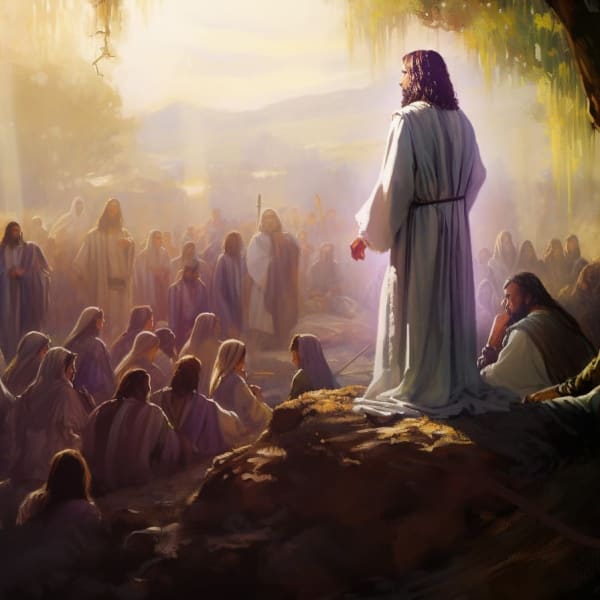
At approximately seven-thirty on Thursday morning, May 18, Jesus arrived with his eleven silent and somewhat bewildered apostles on the western slope of Mount Olivet. They positioned themselves about two-thirds up the mountainside, where they could gaze across Jerusalem and down upon Gethsemane, a location that provided profound visual symmetry with the beginning of Jesus' passion experience. As the Master prepared for his final earthly farewell, the apostles, without explicit instruction, instinctively arranged themselves in a circle around him and knelt, creating a moment of spontaneous reverence that acknowledged the solemnity of this culminating event in Jesus' bestowal mission.
With characteristic clarity and purposefulness, Jesus delivered his final commissioning address, instructing the apostles to remain in Jerusalem until they received spiritual empowerment through the promised Spirit of Truth. He explicitly articulated the transition that was about to occur, stating, "I am about to ascend to my Father, and soon, very soon, will we send into this world of my sojourn the Spirit of Truth." This statement established a precise theological continuity between his departure and the coming spiritual dispensation that would empower their ministry. Jesus then outlined their evangelical mission parameters, directing them to begin proclaiming the gospel first in Jerusalem before expanding to "the uttermost parts of the world." In his final earthly exhortation, he encapsulated the essence of his teaching through parallel imperatives: "Love men with the love wherewith I have loved you and serve your fellow mortals even as I have served you." He concluded by affirming his continued spiritual presence, declaring, "My love overshadows you, my spirit will dwell with you, and my peace shall abide upon you."
Following these profound words, the morontia Master vanished from their sight in a manner consistent with his previous post-resurrection disappearances, completing the earthly phase of his universal bestowal mission. The narrative provides specific cosmological context for this ascension, explaining that Jesus proceeded to Edentia via Jerusem, where the Most Highs, under the Paradise Son's observation, facilitated his transition from morontia status to his restored position of Paradise sonship and supreme sovereignty on Salvington. This cosmic progression occurred at precisely seven forty-five that morning, as the morontia Jesus disappeared from the apostles' observation to "begin the ascent to the right hand of his Father," where he would receive formal confirmation of his completed sovereignty over the universe of Nebadon. This cosmological explanation places Jesus' ascension within the broader architectural framework of the universe, connecting his earthly ministry to his universal administrative function.
6. Peter Calls a Meeting
Following Peter's directive and in accordance with Jesus' instructions, John Mark and other disciples summoned the leading followers of the Master to convene at Mary Mark's residence. By ten-thirty that morning, approximately one hundred and twenty of Jesus' foremost Jerusalem disciples had assembled to receive Peter's report regarding the Master's farewell message and ascension. This gathering had special significance in its composition, as Mary the mother of Jesus was present, having returned to Jerusalem with John Zebedee when the apostles had come back from Galilee; also in attendance was James, Jesus' brother, marking this as the first formal conference of Jesus' disciples convened after the conclusion of his planetary incarnation.
Peter assumed leadership responsibility, delivering a profoundly moving account of their final interaction with the Master and providing an emotionally charged description of Jesus' farewell and ascension disappearance. The narrative notes that this gathering possessed a unique quality unlike any previous assembly, indicating the transformative impact of Peter's testimony on the collective consciousness of the early believing community. After speaking for just under an hour, Peter transitioned to administrative matters, explaining that the apostles had determined to select a replacement for Judas Iscariot and announcing a brief recess to finalize their decision between the two candidates who had been proposed: Matthias and Justus.
The eleven apostles then withdrew to a private location where they implemented a selection method that reflected both their cultural heritage and their transitional theological understanding, agreeing to cast lots to determine divine preference for Judas's successor. When the lot fell to Matthias, they formally inducted him into apostolic office and designated him treasurer, though the narrative observes that he would have minimal significance in the subsequent activities of the apostolic leadership. Following this administrative action, the apostles returned to the assembled believers and announced Matthias's selection, after which Peter called upon all present to engage in focused prayer in preparation for receiving "the gift of the spirit which the Master had promised to send." This concluding instruction established direct continuity between Jesus' ascension and the imminent spiritual empowerment that would transform this small band of bewildered followers into effective ambassadors of the kingdom.
UB Reference
Read the full Urantia Book paper using this link:
Paper 193 - Final Appearances and Ascension