Discover The Urantia Book \Papers\Advanced \Appearances in Galilee

Paper 192 Overview: Appearances in Galilee
In Galilee, Jesus continued to strengthen the apostles’ understanding of the kingdom. He emphasized spiritual living, faithful service, and prepared them for leadership after his final departure.
Reading Level:
Summary
Jesus' post-resurrection appearances in Galilee served as crucial transitional moments between his pre-crucifixion ministry and the apostles' forthcoming mission. Beginning with his thirteenth morontia manifestation at the lakeshore and culminating in a gathering of over five hundred believers, these strategic appearances provided continuity and purpose during a period of uncertainty. The narrative captures how the apostles gradually moved from confusion to renewed conviction through their encounters with the risen Master.
Throughout these Galilean appearances, Jesus methodically prepared his ambassadors for their future work by addressing their individual strengths and weaknesses through intimate conversations conducted two by two. He symbolically recommissioned them on the Mount of Ordination and validated Peter's emerging leadership before a large assembly. These encounters confirmed the reality of Jesus' resurrection while transforming the apostles' understanding of their mission. A subtle but consequential transition began during this period, as their message shifted from proclaiming the gospel of the kingdom to emphasizing the resurrection of Jesus and anticipating his return, a pivotal development in early Christian thought.
Introduction
By the time the apostles departed Jerusalem for Galilee, the Jewish religious authorities had significantly tempered their opposition, believing the gospel movement had been effectively suppressed. This perception persisted because Jesus appeared exclusively to his followers while the apostles remained in seclusion, leading the Jewish leaders to conclude that the movement posed no further threat. They nevertheless attempted to counter the spreading rumors of Jesus' resurrection by instructing the bribed guards to propagate the story that disciples had removed his body from the tomb during the night.
During this period, Peter naturally assumed leadership of the apostolic corps, though Jesus had never formally conferred such authority upon him. The apostles recognized him as their chief preacher and tacitly endorsed his leadership role through common consent. After their return from Galilee, they formally selected Matthias to replace Judas Iscariot as treasurer. While the apostles tarried in Jerusalem before their departure, Mary, the mother of Jesus, spent considerable time with the women believers at Joseph of Arimathea's residence. John Mark demonstrated his devotion by following the apostles when they left for Galilee, boldly joining their company beyond Bethany despite their initial reluctance to include him.
1. Appearance by the Lake
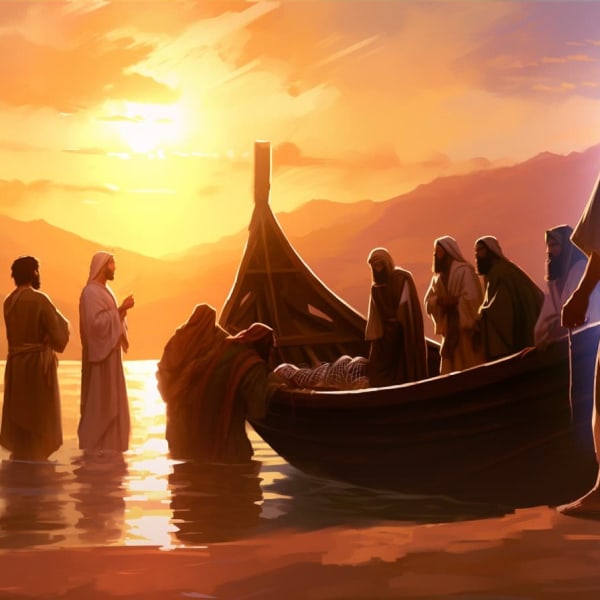
Early Friday morning, April 21, Jesus made his thirteenth morontia manifestation to ten apostles as their boat approached the shore near Bethsaida. After spending the previous day and evening at the Zebedee home, the apostles had embarked on a fishing expedition at Peter's suggestion, yet their overnight labor yielded no catch. As dawn illuminated the landscape, they discerned a figure standing on the beach near a fire, initially mistaking him for John Mark. The apostles did not immediately recognize that this was Jesus, perhaps because he deliberately chose to meet them in familiar surroundings, away from Jerusalem's oppressive atmosphere with its associations of fear and betrayal, facilitating a more natural reconnection in the open environment of their earlier ministry.
When the unidentified figure called out inquiring about their catch, the apostles acknowledged their failure. The stranger then instructed them to cast their net on the right side of the boat, immediately resulting in such an abundant catch that they struggled to draw in the net. John Zebedee, characteristically perceptive, quickly recognized the Master and whispered his insight to Peter. With impetuous devotion, Peter immediately cast himself into the water to reach Jesus more quickly, while his companions followed in the small boat, laboriously hauling their fish-laden net. The narrative explicitly states that this episode involved no miracle; rather, it demonstrated Jesus' foreknowledge of where the fish were located, a subtle distinction emphasizing that Jesus did not unnecessarily employ supernatural means when natural knowledge sufficed.
John Mark, who had risen early and observed the apostles' return, counted eleven men rather than ten and surmised that the unrecognized individual must be the risen Jesus. When the youth approached and knelt before the Master, Jesus addressed him with warm familiarity rather than the formal greeting he had used in Jerusalem. After this recognition, Jesus directed the apostles to bring in their catch and prepare for breakfast, having already kindled a fire with bread at hand. The presence of glowing coals momentarily disturbed Peter, as they vividly recalled the courtyard of Annas where he had disowned the Master, yet he overcame this painful association to kneel and acknowledge Jesus as Lord. The apostles counted 153 large fish in their net, an abundant haul that Jesus had foreknown rather than miraculously produced.
During this intimate lakeside meal, Jesus broke bread and conversed with his followers about their experiences in Galilee, creating a setting reminiscent of their earlier fellowship. He instructed John Mark to sit while he personally served the fish and bread to the youth, modeling servant leadership. This marked the third post-resurrection appearance to the apostles as a group, and its informal nature helped restore their sense of familiar connection with Jesus. After the meal, Jesus spent more than an hour with them, walking along the beach and conversing with them in pairs (but not the same pairs he had originally sent out together). Upon learning that Simon Zelotes had grown despondent and returned home, Jesus directed Peter and Andrew to bring him back, demonstrating his continued concern for each apostle's spiritual welfare.
2. Visiting with the Apostles Two and Two
After the lakeside breakfast, Jesus beckoned to Peter and John to accompany him for a private conversation along the shore. Addressing John first, Jesus posed the profound question, "John, do you love me?" When John affirmed his wholehearted love, Jesus responded with a penetrating admonition to relinquish his characteristic intolerance and learn to love others as Jesus had loved him. This directive challenged John's exclusivist tendencies and emphasized that divine love must transcend personal preferences and prejudices. Jesus articulated the fundamental principle that the love of God impels people toward salvation and serves as the progenitor of all spiritual goodness, the essence of truth and beauty, a cornerstone teaching that would shape John's subsequent ministry and theological perspective.
Turning next to Peter, Jesus asked, "Peter, do you love me?" When Peter emphatically confirmed his devotion, Jesus charged him with the responsibility to "feed my lambs," enjoining him to minister particularly to the weak, poor, and young. This instruction encompassed preaching the gospel without fear or favoritism and serving others as Jesus had served them. Walking farther, Jesus asked Peter a second time about his love, then commanded him to care for the sheep, becoming a true and faithful shepherd who would not betray their confidence or be caught unprepared by the enemy. For the third time, paralleling Peter's threefold denial, Jesus questioned Peter's love, evoking mild grievance at the apparent distrust. When Peter appealed to Jesus' omniscience regarding his sincere devotion, Jesus delivered his most comprehensive commission: "Feed my sheep. Do not forsake the flock. Be an example and an inspiration to all your fellow shepherds."
Peter misinterpreted Jesus' final instruction to "follow after me" as a literal command to physically follow Jesus, prompting him to inquire about John's role in this arrangement. Jesus clarified that his concern should be his own spiritual journey rather than comparing his path with others, stating: "Peter, be not concerned about what your brethren shall do. If I will that John should tarry after you are gone, even until I come back, what is that to you? Only make sure that you follow me." This statement was subsequently misunderstood among the believers as suggesting John would not die before Jesus returned, a misinterpretation that nevertheless helped motivate Simon Zelotes to resume his service to the cause.
Jesus continued these personalized conversations with each pair of apostles. To Andrew, he emphasized the importance of trusting his brethren rather than attempting to bear leadership burdens alone, particularly in relation to supporting James, Jesus' brother in the flesh, during future persecutions. With James, Jesus stressed patience, tolerance, and tranquility of spirit. Addressing Thomas, Jesus directly confronted his persistent doubting, urging him to grow in faith and cease acting childishly despite his theoretical belief. Nathaniel received counsel to maintain devoted service to his brethren with tireless affection, adding friendship to counsel and love to philosophy. Philip was directed toward gentile territories to proclaim the gospel, while Matthew was similarly commissioned to teach all peoples, maintaining an "eye single" to his divine commission without fear of either Jew or gentile. The Alpheus twins received assurance that their seemingly ordinary work remained sacred as faith-sons of God, with the promise of serving on "other and better worlds" after their earthly lives concluded.
3. On the Mount of Ordination
At noon on Saturday, April 22, the eleven apostles assembled by appointment on a hill near Capernaum, where Jesus appeared among them for his fourteenth morontia manifestation. This location held profound significance as the very mount where Jesus had originally appointed them as his apostles and ambassadors of the Father's kingdom on earth. The setting thus provided a powerful symbolic continuity between their initial commission and their renewed charge in the post-resurrection context.
In a deeply moving ceremony, the eleven apostles knelt in a circle around their Master as he repeated the charges and reenacted the ordination scene they had experienced when first appointed for their special work. This recapitulation of their original commissioning served as a vivid reminder of their sacred responsibility and reinforced Jesus' continued authority despite the transformative events of his death and resurrection. One significant difference distinguished this ordination from the first: whereas Jesus' original prayer had been that of a mortal appealing to the Father, his prayer now resonated with the majesty and power of one who spoke with the authority of a universe sovereign, reflecting his advanced morontia status.
This profoundly affecting experience of morontia rededication created an indelible impression on the apostles, who never forgot the spiritual significance of this recommitment to their ambassadorial pledges. After precisely one hour of interaction on the mount, Jesus took an affectionate farewell of his chosen representatives and vanished from their sight. Following this powerful encounter, the apostles did not see Jesus for a full week, leaving them in a state of uncertainty about their immediate course of action. They remained in Bethsaida during this interval, reluctant to resume fishing lest they miss a potential visit from the Master. Meanwhile, Jesus occupied himself with the morontia creatures on earth and attended to the affairs of his own morontia transition, a process of spiritual and existential transformation that remained largely incomprehensible to his mortal followers.
4. The Lakeside Gathering
As accounts of Jesus' appearances proliferated throughout Galilee, increasing numbers of believers journeyed to the Zebedee residence to inquire about the Master's resurrection and seek verification of these remarkable reports. Early in the week, Peter announced a public gathering to be held by the seaside on the following Sabbath afternoon, responding to the growing interest and providing an opportunity for more structured communication of their experiences.
On Saturday, April 29, more than five hundred believers from the environs of Capernaum assembled at Bethsaida to hear Peter deliver his first public sermon since the resurrection. The apostle presented a compelling message that resonated powerfully with his audience, such that few departed doubting the reality of the Master's resurrection. At the climax of his address, Peter made the definitive declaration: "We affirm that Jesus of Nazareth is not dead; we declare that he has risen from the tomb; we proclaim that we have seen him and talked with him." At precisely this moment of affirmation, Jesus appeared in morontia form beside Peter, visible to all assembled, and spoke the benediction: "Peace be upon you, and my peace I leave with you." Following this pronouncement, he vanished from their sight, completing his fifteenth morontia manifestation and providing a dramatic public validation of Peter's testimony.
Based on previous indications during the Mount of Ordination meeting, the apostles understood that they should return to Jerusalem after this public appearance. Accordingly, they departed the following day, Sunday, April 30, teaching and preaching along the Jordan valley during their journey. They did not arrive at the home of the Marks in Jerusalem until late Wednesday, May 3, where they discovered that Elijah Mark, John's father, had died suddenly from a cerebral hemorrhage just hours before their arrival. Despite the somber circumstances, the apostles found comfort in their conviction regarding the resurrection of the dead, and John Mark endeavored to console his mother while inviting the apostles to continue using their home as headquarters. The eleven established the upper chamber as their base until after Pentecost.
The Thursday night following their arrival, the apostles held a significant meeting in the upper chamber where most committed themselves to public proclamation of the "new gospel of the risen Lord." This marked a subtle but profound shift in emphasis from Jesus' original gospel of the kingdom, focused on divine sonship and human brotherhood, toward what would become a proclamation centered on Jesus' resurrection. Despite Nathaniel's opposition to this reorientation of their message, he could not overcome Peter's persuasive eloquence nor the enthusiasm of the disciples, particularly the women believers. Thus began, under Peter's vigorous leadership, the gradual transformation of the religion of Jesus into a new and modified form of religion about Jesus.