Discover The Urantia Book \Papers\Advanced \The Trial Before Pilate

Paper 185 Overview: The Trial Before Pilate
Jesus appeared before Pilate, who found no fault in him but succumbed to public pressure. Jesus’ trial highlighted the cowardice of worldly power and the innocence of spiritual truth.
Reading Level:
Summary
On Friday morning, April 7, 30 CE, Jesus was brought before Pontius Pilate, the Roman procurator governing Judea, Samaria, and Idumea under Syria's supervision. The Master was presented to the Roman governor bound and escorted by temple guards, accompanied by approximately fifty accusers, including the Sanhedrist court (primarily Sadduceans), Judas Iscariot, and the high priest Caiaphas, with the Apostle John present as well. Although Pilate conducted much of the examination within the praetorium halls, the public trial was held outside on the steps to accommodate Jewish religious scruples regarding ceremonial contamination during Passover preparation, revealing their paradoxical adherence to ritual purity while simultaneously orchestrating a judicial murder.
The trial before Pilate represents a profound travesty of justice wherein Jesus was arrested without indictment, accused without evidence, judged without witnesses, punished without a verdict, and condemned to death by a judge who openly proclaimed his innocence. Throughout these proceedings, Pilate made multiple attempts to release Jesus: sending him to Herod, offering him as the customary Passover prisoner release, declaring his innocence, and even symbolically washing his hands of responsibility. However, pressured by the chief priests' threats to his political standing with Caesar and manipulated by their influence over the crowd, Pilate ultimately capitulated to their demands for crucifixion, a decision that would haunt him for the remainder of his life and eventually contribute to his suicide after being deposed from office.
Introduction
At approximately six o'clock on Friday morning, April 7, 30 CE, Jesus was brought before Pilate, the Roman procurator who governed Judea, Samaria, and Idumea under the immediate supervision of the legatus of Syria. Temple guards escorted the bound Master into Pilate's presence, accompanied by about fifty accusers, including the Sanhedrist court (primarily Sadduceans), Judas Iscariot, and the high priest Caiaphas, with the Apostle John also present, while Annas did not appear. Pilate was prepared for this early morning delegation, having been informed the previous evening when he granted permission for Roman soldiers to assist in Jesus' arrest. The trial was arranged to take place in front of the praetorium, an addition to the fortress of Antonia where Pilate and his wife resided when visiting Jerusalem.
Although Pilate conducted much of Jesus' examination within the praetorium halls, the public trial occurred outside on the steps leading to the main entrance as a concession to the Jewish religious leaders, who refused to enter any Gentile building where leaven might be present during Passover preparations. Such an entry would have rendered them ceremonially unclean, preventing their participation in the afternoon feast of thanksgiving and necessitating purification ceremonies after sundown before they could partake of the Passover supper. This scrupulous adherence to ceremonial regulations while simultaneously orchestrating the judicial murder of Jesus revealed a profound moral disconnect. The narrative pointedly observes that such behavior was not unique to these Jewish leaders but represents a recurring pattern in human religious history: meticulous attention to ritual observances while neglecting weightier moral and spiritual obligations.
1. Pontius Pilate
Pontius Pilate's decade-long tenure as procurator of Judea indicated a certain administrative competence that earned Emperor Tiberius' continued confidence. Despite his adequate governance of minor provinces, Pilate was fundamentally characterized by moral cowardice that rendered him unsuitable for the complex task of governing the Jewish population. His critical failure lay in his inability to comprehend the profound religious convictions of the Hebrew people, a faith for which they were willing to die, and the significance of Jerusalem as a spiritual center for millions of Jews dispersed throughout the empire who revered the Sanhedrin as the highest earthly tribunal.
Pilate harbored a deep-seated animosity toward the Jews, which manifested early in his governorship and exacerbated the inherent challenges of administering what was arguably Rome's most problematic province. His administrative miscalculations early in his tenure proved nearly fatal to his career and established a pattern of weakness that Jewish leaders exploited when seeking to influence his decisions. They discovered that threatening insurrection would reliably prompt Pilate's capitulation due to his fear of imperial repercussions. His most significant blunders included failing to respect Jewish prohibitions against images as idolatrous symbols, allowing Roman soldiers to enter Jerusalem with standards bearing Caesar's likeness; later mounting imperial shields on Herod's palace walls despite Jewish protests; and appropriating temple treasury funds to construct an aqueduct, which provoked riots resulting in bloodshed. This historical context explains the Jewish leaders' boldness in dictating terms to Pilate during Jesus' trial and their confidence in threatening to report him to the emperor if he refused their demands.
2. Jesus Appears Before Pilate
When Jesus and his accusers gathered before Pilate's judgment hall, the Roman governor emerged and inquired about the charges against the prisoner. The Sadducees and councilors, having already determined to eliminate Jesus, sought merely Pilate's confirmation of their death sentence without presenting specific accusations. The Sanhedrist court spokesman evasively responded, "If this man were not an evildoer, we should not have delivered him up to you," revealing their reluctance to formulate definite charges despite having deliberated throughout the night regarding Jesus' supposed guilt. Pilate, recognizing their hesitation, suggested they judge Jesus according to their own laws, to which the Sanhedrin clerk replied that they lacked authority to implement capital punishment, thus exposing both their ill will toward Jesus and their disrespect for Roman judicial procedures.
After Pilate insisted on formal written charges, the Jewish leaders reluctantly presented three accusations: that Jesus perverted the nation and stirred rebellion, forbade tribute payment to Caesar, and claimed to be king of the Jews while teaching the establishment of a new kingdom. Although Jesus had neither been properly tried nor legally convicted on any of these charges, Pilate had him brought from the praetorium to hear these accusations repeated in his presence. When Jesus heard these false charges, he remained silent, offering no defense despite Pilate's invitation to answer his accusers. The governor was astonished by the proceedings' manifest unfairness and profoundly impressed by Jesus' dignified bearing, prompting him to take the prisoner inside for private examination. Pilate's emotional state reflected his complex response to the situation: confusion of mind, fear of the Jews, and spiritual stirring at Jesus' majestic countenance, which gazed upon his accusers not with contempt but with genuine compassion and sorrowful affection.
3. The Private Examination by Pilate
Pilate brought Jesus and John Zebedee into a private chamber, leaving the guards outside and inviting the prisoner to sit beside him for questioning. He began by assuring Jesus that he disbelieved the first accusation regarding national perversion and incitement to rebellion, then directly inquired whether Jesus had taught against paying tribute to Caesar. Jesus diplomatically directed Pilate to ask John or any other witness who had heard his teaching, whereupon John testified that Jesus and his apostles paid taxes to both Caesar and the temple. After this exchange, Pilate instructed John to maintain confidentiality about their conversation, a directive John faithfully observed throughout his life.
Pilate then addressed the third accusation, asking Jesus, "Are you the king of the Jews?" Detecting a note of sincere inquiry in Pilate's tone, Jesus responded with remarkable insight by asking whether Pilate posed this question of his own accord or merely repeated others' accusations. The governor reacted with partial indignation, declaring, "Am I a Jew? Your own people and the chief priests delivered you up and asked me to sentence you to death," while expressing his personal skepticism about their charges. Jesus then articulated the spiritual nature of his kingdom, explaining that it was not a worldly dominion. If it were, his disciples would have fought to prevent his arrest. He described his kingdom as a spiritual domain, the brotherhood of those who through faith and love become God's children, available to Gentiles and Jews alike.
When Pilate directly asked, "Then you are a king after all?" Jesus affirmed his royal status but clarified that his kingdom comprised "the faith sons of my Father who is in heaven," adding that his life purpose was to reveal his Father to humanity and bear witness to divine truth. Pilate's famous response, "Truth, what is truth—who knows?" reflected his philosophical skepticism, yet he became convinced that Jesus was merely a harmless visionary rather than a dangerous revolutionary, possibly associating Jesus' self-description with the Stoic concept that "the wise man is king."
4. Jesus Before Herod
Pilate sent Jesus to Herod Antipas, who was in Jerusalem for the Passover festival, attempting both to avoid responsibility for the case and to ameliorate tensions that had existed between them due to jurisdictional disputes. Herod had long been curious about Jesus and eagerly anticipated seeing him perform a miracle, having heard numerous reports of his wondrous works in Galilee. When Jesus stood before him that Friday morning, the Idumean ruler failed to recognize him as the youth who had once appeared in Sepphoris advocating for just compensation after his father's accidental death while working on a public building. Herod felt secure in Jesus' presence, believing he would pose no future threats to his governance.
Herod was initially struck by Jesus' stately appearance and composure, but his admiration quickly turned to frustration when Jesus maintained complete silence throughout the fifteen-minute interrogation, refusing to answer any questions or respond to provocations. Herod alternated between questioning Jesus and taunting him to perform miracles, while the chief priests and Sadducees repeated the same accusations previously presented to Pilate. Ultimately convinced that Jesus would neither speak nor demonstrate supernatural powers, Herod subjected him to mockery, arrayed him in an old purple royal robe and returned him to Pilate.
The tetrarch recognized his lack of jurisdiction over Jesus in Judea and expressed relief at transferring responsibility for Jesus' fate back to the Roman governor. The narrative notes that Herod had never fully recovered from the psychological trauma associated with executing John the Baptist, initially fearing that Jesus might be John's resurrection, but he now felt reassured upon observing that Jesus represented a distinctly different personality type from the fiery prophet who had boldly denounced his private affairs.
5. Jesus Returns to Pilate
When the guards brought Jesus back to Pilate, the governor addressed the assembled chief priests and Sanhedrists from the praetorium steps, declaring that neither he nor Herod had found Jesus guilty of the charges brought against him. Pilate proposed a compromise, offering to chastise Jesus and then release him, a suggestion that immediately provoked protests from the Jewish leaders. At that moment, a substantial crowd approached the praetorium seeking the customary release of a prisoner in honor of the Passover festival, a tradition Roman governors had established to cultivate goodwill with the populace. Recognizing an opportunity to extricate himself from his predicament, Pilate considered offering Jesus as a candidate for release, particularly given his recent popularity with the multitudes.
As the crowd surged forward, they called for the release of Barabbas, a notorious political agitator and murderer sentenced to execution after the Passover festivities. Pilate explained that Jesus had been brought before him by the chief priests seeking his execution, but he had found no fault worthy of death in him. The governor then presented the crowd with a choice: "Which, therefore, would you prefer that I release to you, this Barabbas, the murderer, or this Jesus of Galilee?" The chief priests and Sanhedrin councilors immediately shouted for Barabbas's release, and the crowd, influenced by their religious leaders, joined the clamor for Jesus' execution.
Pilate expressed frustration at their preference for a murderer over someone whose "worst crime" was figuratively calling himself king of the Jews, an unintentionally inflammatory remark that offended Jewish national pride and messianic expectations. During this crucial exchange, Pilate received a sealed message from his wife Claudia warning him to have nothing to do with "this innocent and just man." This interruption delayed proceedings and provided additional time for the Jewish leaders to circulate among the crowd and intensify demands for Jesus' crucifixion, culminating in a unanimous shout that startled and alarmed the increasingly uncomfortable governor.
6. Pilate's Last Appeal
The events transpiring early Friday morning involved only Jesus' enemies, as his friends remained either unaware of his night arrest and early morning trial or were hiding to avoid similar persecution. The multitude clamoring for Jesus' death consisted exclusively of his sworn enemies and the easily influenced populace who followed their lead. Pilate, though fearful of defying the mob, made a final appeal to their compassion by ordering Jesus to be scourged, an inherently unjust and illegal procedure under Roman law, which permitted scourging only for those already condemned to crucifixion. While Jesus' enemies did not witness this brutal punishment, Pilate observed the entire ordeal and halted it prematurely, directing that Jesus be brought before him.
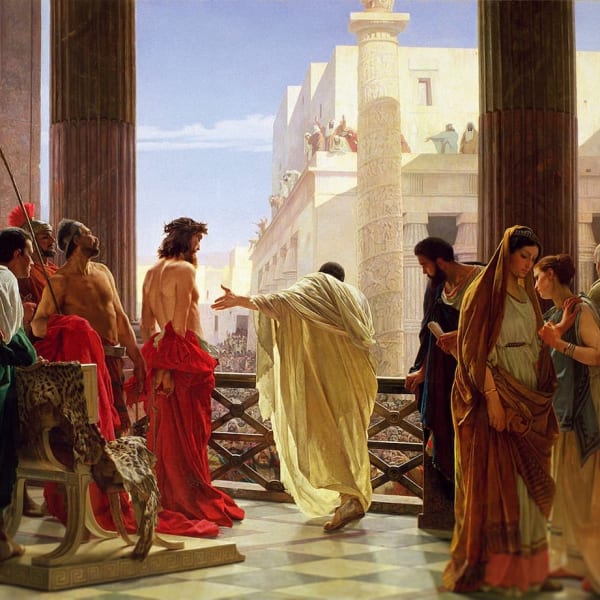
Before the scourging commenced, the soldiers placed the purple robe on Jesus, fashioned a crown of thorns for his head, and put a reed in his hand as a mock scepter. They knelt before him in mockery, saying, "Hail, king of the Jews," spat upon him, struck his face, and one soldier took the reed and struck his head before returning him to Pilate. The governor then presented the bleeding and lacerated prisoner to the crowd, declaring, "Behold the man! Again I declare to you that I find no crime in him, and having scourged him, I would release him." This spectacle of Jesus of Nazareth, clothed in the purple robe with thorns piercing his brow, his face bloodstained and form bowed with suffering, sent a profound shudder through the universe but failed to move his accusers, who had become emotionally enslaved by intense hatred and religious prejudice.
After brief shock at Jesus' condition, they shouted even more vehemently for his crucifixion. When Pilate perceived the futility of appealing to their compassion and asked what crime warranted death, the high priest declared, "We have a sacred law, and by that law this man ought to die because he made himself out to be the Son of God." This statement intensified Pilate's fear, recalling both his wife's warning and Greek mythology regarding divine beings visiting earth, prompting him to take Jesus inside for further examination.
7. Pilate's Last Interview
Trembling with fearful emotion, Pilate sat beside Jesus and inquired about his origins and divine nature, asking, "Where do you come from? Really, who are you? What is this they say, that you are the Son of God?" Jesus maintained a dignified silence, recognizing the futility of responding to such profound questions when posed by a fearful, vacillating judge who had already demonstrated his injustice by ordering an innocent man flogged. When met with silence, Pilate reminded Jesus of his power to either release or crucify him, to which Jesus responded with remarkable insight: "You could have no power over me except it were permitted from above. You could exercise no authority over the Son of Man unless the Father in heaven allowed it. But you are not so guilty since you are ignorant of the gospel. He who betrayed me and he who delivered me to you, they have the greater sin."
This exchange profoundly disturbed Pilate, who now bore the dual psychological burden of superstitious fear regarding Jesus' possible divine nature and mortal dread of the Jewish leaders' political influence. When he appeared before the crowd again, Pilate attempted a final evasion, suggesting that Jesus was merely a religious offender who should be judged according to Jewish law rather than Roman jurisdiction. However, just as Pilate approached the threshold of releasing Jesus, Caiaphas delivered the decisive threat that would collapse the governor's remaining moral resistance. The high priest, shaking an avenging finger in Pilate's face, declared, "If you release this man, you are not Caesar's friend, and I will see that the emperor knows all."
This explicit threat to Pilate's political career overshadowed all other considerations in the governor's mind, and his fear for personal advancement eclipsed his sense of justice. In a final display of ironic capitulation, Pilate brought Jesus before the judgment seat, pointed to him, and tauntingly said, "Behold your king." The Jews responded with the politically expedient but spiritually devastating declaration, "Away with him. Crucify him! We have no king but Caesar," thereby rejecting both their messianic hopes and their theocratic tradition in one expedient political pronouncement.
8. Pilate's Tragic Surrender
The trial before Pilate represented a profound perversion of justice, as Jesus stood as the Son of God incarnate in human form, arrested without indictment, accused without evidence, adjudged without witnesses, punished without a verdict, and now condemned to die by a judge who openly proclaimed his innocence. Pilate's attempt to appeal to Jewish patriotism by referring to Jesus as their king entirely failed, as the Jews were not anticipating a spiritual sovereign of Jesus' nature. The chief priests' declaration, "We have no king but Caesar," shocked even the unthinking populace, but the psychological momentum toward Jesus' execution had become unstoppable, even as some individuals dared to oppose it.
Pilate's fear of civil disturbance during the Passover festival in Jerusalem, combined with his recent reprimand from Caesar, overwhelmed any remaining inclination to protect Jesus despite recognizing his innocence. The governor orchestrated a final symbolic gesture to absolve himself of responsibility, calling for water and washing his hands before the multitude while declaring, "I am innocent of the blood of this man. You are determined that he shall die, but I have found no guilt in him. See you to it. The soldiers will lead him forth." The crowd responded with the chilling acceptance of responsibility that would echo through history: "His blood be on us and on our children."