Discover The Urantia Book \Papers\Advanced \The Betrayal and Arrest of Jesus

Paper 183 Overview: The Betrayal and Arrest of Jesus
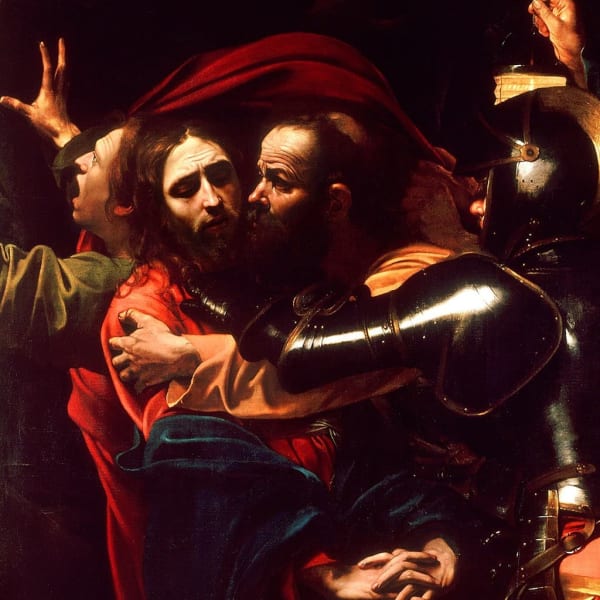
Jesus was betrayed by Judas and arrested. Despite being treated unjustly, he remained composed and dignified throughout his trials before the Jewish religious authorities.
Reading Level:
-
Summary
The betrayal and arrest of Jesus unfolded as a carefully orchestrated event in which Jesus consciously submitted to the Father's will while protecting his apostles from harm. Following his prayer in Gethsemane, Jesus deliberately positioned himself away from his followers to ensure their safety during his capture. Meanwhile, Judas methodically arranged for an armed contingent of temple guards and Roman soldiers to apprehend Jesus, driven by growing anxiety about potential resistance from the disciples. When these forces converged at Gethsemane, Jesus demonstrated remarkable composure and authority, identifying himself directly to his captors and rendering Judas's planned kiss of betrayal superfluous.
The events surrounding the arrest revealed profound contrasts between loyalty and betrayal. While most apostles scattered in fear despite their earlier professions of fidelity, John Zebedee secured permission to remain near Jesus through Roman intervention, establishing a vital witness presence. David Zebedee created an essential communication network that kept the scattered apostles informed during the coming trials. Throughout these chaotic moments, Jesus maintained spiritual sovereignty despite physical captivity, refusing to employ supernatural means of escape and accepting the natural conclusion of his mortal life experience. His silence following the arrest underscored his complete submission to the unfolding events.
-
Introduction
After Jesus had awakened Peter, James, and John from their brief slumber in Gethsemane, they discovered that the other apostles were already alert due to the arrival of two excited messengers seeking David Zebedee. These messengers had triggered the alertness of a Greek sentinel posted by Jesus's more apprehensive followers, who then roused his countrymen. Despite Jesus's attempts to disperse the gathering crowd, they remained reluctant to return to their tents, and in response, Jesus withdrew alone toward the olive press near the entrance to Gethsemane Park, deliberately separating himself from his followers.
Jesus intentionally isolated himself from the apostles to ensure their safety during his arrest, recognizing that their presence might provoke resistance that would result in their own capture. He was aware that his death had been orchestrated by the Jewish religious authorities with the full approval of Lucifer, Satan, and Caligastia, and understood that these rebellious spirits would have welcomed the destruction of his apostles alongside him. With calculated foresight, Jesus positioned himself alone at the olive press, where only John Mark secretly observed him from a nearby shed, while innumerable celestial observers witnessed this pivotal moment in the bestowal mission of the Creator Son.
-
1. The Father's Will
A critical theological clarification opens this section, warning against misinterpreting Jesus's willing submission to death as divine endorsement of the cruelty he endured. The text emphatically distinguishes between the Father's will that Jesus should complete the mortal experience, including natural death, and the brutal treatment inflicted by human agents acting from ignorance and hatred. While Jesus consciously aligned himself with the Father's purpose by accepting the "cup" of mortal destiny, the specific torments he suffered were neither demanded by the Father nor orchestrated by cosmic enemies, but rather represented the independent choices of morally compromised human beings.
The narrative emphasizes that ordinary mortals should not expect divine intervention to spare them from death, and likewise, Jesus elected to experience mortality's natural conclusion without supernatural rescue. In a profound illustration of divine-human cooperation, Jesus steadfastly refused to extricate himself from the unfolding conspiracy, allowing events to proceed according to natural human choices, even when these choices manifested as hatred and cruelty. This distinction preserves both divine goodness and human moral responsibility, clarifying that while the Father willed the bestowal experience to reach its natural conclusion, he neither caused nor required the specific expressions of human evil that accompanied Jesus's final hours.
The text presents the crucifixion not as divine child sacrifice but as the culmination of human rejection of truth and goodness, noting that even "the father of sin" turned away from the excruciating spectacle humans created. Thus, the narrative establishes that Jesus's death represented his complete identification with mortal experience, while the manner of his death revealed the depths of human moral failure rather than divine requirement.
-
2. Judas in the City
The narrative shifts to Judas's activities following his abrupt departure from the Last Supper, tracing his methodical betrayal as he first consulted his cousin before approaching the temple captain to arrange Jesus's arrest. Their arrival at Elijah Mark's residence came approximately fifteen minutes after Jesus and the eleven had departed for the Olivet camp, a timing discrepancy that significantly disturbed Judas's plans. His discomfort multiplied upon realizing that his intended strategy to apprehend Jesus quietly (when the city was calm and resistance unlikely) had been compromised, and he now faced the prospect of confronting more than sixty potentially armed followers in the Olivet camp.
Judas's psychological state deteriorated as the evening progressed, his disloyalty compounded by increasing cowardice. His exaggerated warnings about armed disciples prompted the Jewish authorities to seek Roman military assistance, initiating a complex chain of authorizations that required appeals to progressively higher officials and ultimately to Pilate himself. The reluctant governor, already retired with his wife, acquiesced primarily because the request came directly from the presiding officer of the Jewish Sanhedrin. By approximately 11:30 PM, Judas departed from the temple leading a substantial contingent of more than sixty individuals, including temple guards, Roman soldiers, and curious servants of the chief priests, a force far larger than originally anticipated and one that reflected Judas's escalating fears rather than actual necessity.
-
3. The Master's Arrest
As the armed contingent with torches and lanterns approached Gethsemane, Judas strategically positioned himself ahead of the group, intending to create the appearance that he had arrived separately to warn Jesus rather than to facilitate his capture. Meanwhile, approximately thirty of Jesus's followers, seeing the approaching soldiers, rushed down to the olive press where Jesus awaited. The scene crystallized into a dramatic tableau: Jesus standing calmly between two approaching groups, Judas from one direction and his loyal followers from the other, with the betrayer preparing to identify his Master with the prearranged signal of a kiss.
Jesus, however, masterfully preempted Judas's plan by directly addressing the foremost Roman soldier, asking whom they sought and then boldly declaring, "I am he." This authoritative self-identification was delivered with such "calm majesty" that many in the front ranks involuntarily stepped backward, momentarily overwhelmed by his presence. This direct revelation rendered Judas's betrayal kiss superfluous, though the traitor proceeded with it nonetheless to fulfill his bargain with the authorities. When Peter impulsively struck the high priest's servant with his sword, Jesus immediately ordered restraint, reminding Peter of his Father's will and noting that he could command "twelve legions of angels" if divine intervention were his objective. After being bound, Jesus questioned why they came armed against him "as if to seize a robber," noting his daily public teaching in the temple. His followers scattered in flight while John Mark, who had been hiding nearby, attempted to follow but escaped only by abandoning his linen coat to a pursuing soldier.
-
4. Discussion at the Olive Press
Following Jesus's arrest, the apostles reconvened at the olive press to deliberate their response, with James Zebedee rejoining them after becoming separated from Peter and John. Despite being formally released from leadership authority by Jesus earlier that evening, Andrew remained silent in this critical moment. Simon Zelotes passionately advocated immediate action to rescue Jesus, but Nathaniel countered with a measured reminder of Jesus's consistent teachings regarding nonresistance and their commission to preserve their lives for future ministry. This philosophical division reflected the fundamental tension between political-revolutionary expectations and spiritual-transformative understanding that had characterized the apostolic circle throughout Jesus's ministry.
As the discussion progressed, Matthew and Philip recounted Jesus's prohibition against armed defense, while Thomas persuasively argued that rescue attempts would prove futile given Jesus's refusal to defend himself or employ his supernatural powers. This pragmatic assessment ultimately convinced the group to scatter for their own safety, with an agreement that David Zebedee would maintain their communication network. By 2:30 AM, the camp stood deserted except for David and a few messengers. The apostles dispersed to various hiding places: five (Nathaniel, Matthew, Philip, and the twins) concealed themselves in Bethpage and Bethany, while four others (Thomas, Andrew, James, and Simon Zelotes) found refuge within Jerusalem. Meanwhile, Peter and John Zebedee followed the procession to Annas's residence, with Peter later returning to the Gethsemane camp in profound despair. Throughout the crucifixion, John alone fulfilled Jesus's directive to remain nearby, serving as the critical information source for David's messengers who maintained communication between the scattered apostles and Jesus's family.
-
5. On the Way to the High Priest's Palace
As the procession departed Gethsemane, a jurisdictional conflict emerged between the Jewish temple captain and the Roman centurion regarding Jesus's destination. Asserting established protocol, the Roman officer directed that Jesus be taken to Annas, the former high priest and father-in-law of Caiaphas, since Romans typically conducted their dealings with Jewish ecclesiastical matters through him. Judas attempted to maintain proximity to the officers but faced such profound contempt that neither the Jewish nor Roman officials would acknowledge him, a silent censure that intensified his internal turmoil.
John Zebedee's courageous decision to follow closely behind Jesus nearly resulted in his arrest when the temple captain ordered him bound as "one of this fellow's followers." However, the Roman commander intervened decisively, invoking Roman legal tradition that permitted a prisoner one friend to stand with him at trial. The officer noted John's refusal to draw weapons in the garden and explicitly ordered that no one should interfere with the apostle's presence. This unexpected Roman protection enabled John to remain near Jesus throughout the subsequent proceedings, a privilege that proved invaluable for later historical accounts. Meanwhile, Judas, overcome by shame at this contrast between his betrayal and John's loyalty, fell behind the procession and approached Annas's palace alone. From the moment of his arrest until his arrival at Annas's residence, Jesus maintained complete silence, offering not a single word in response to his captors or the unfolding events.
UB Reference
-
Read the full Urantia Book paper using this link:
Paper 183 - The Betrayal and Arrest of Jesus