Discover The Urantia Book \Papers\Advanced \In Gethsemane

Paper 182 Overview: In Gethsemane
In Gethsemane, Jesus prayed in deep sorrow, fully surrendering to the Father’s will. His loneliness and anguish marked the final preparation before betrayal and the unfolding of his final mission.
Reading Level:
-
Summary
At approximately ten o'clock on Thursday evening, Jesus led his eleven apostles from the home of Elijah and Mary Mark back toward their encampment at Gethsemane, unknowingly followed by John Mark who was determined to witness the unfolding events. As they journeyed through the darkened paths of Jerusalem and crossed the brook Kidron, the apostles began to seriously contemplate Judas's conspicuous absence, particularly in light of the Master's earlier prediction of betrayal. Their apprehensions intensified upon reaching camp and confirming Judas was not present, compelling them to question Andrew, who could only express his fear that their treasurer had indeed abandoned their fellowship to execute his treacherous plan.
What transpired in Gethsemane over the next several hours would constitute one of the most profound spiritual struggles ever recorded, as Jesus moved through several phases of preparation for his impending sacrifice. Beginning with a transcendent prayer for his disciples and all future believers, Jesus then arranged for messages to be delivered to followers in other locations, before finally withdrawing with Peter, James, and John to experience his most intense personal struggle between his human desire to avoid suffering and his divine commitment to fulfill the Father's will. Throughout this night of spiritual victory amid emotional anguish, Jesus demonstrated the perfect reconciliation between his human and divine natures, ultimately achieving complete submission to the plan for his bestowal while his loyal but exhausted apostles failed to maintain their vigilance during his hour of greatest need.
-
Introduction
It was approximately ten o'clock Thursday night when Jesus led the eleven apostles from the home of Elijah and Mary Mark on their way back to the Gethsemane camp, with John Mark secretly following at a discreet distance. John Mark, having obtained several hours of rest while Jesus was with the apostles in the upper room, awakened upon hearing their departure and, draping himself in a linen coat, trailed the group through the city, across the brook Kidron, and to their private encampment adjacent to Gethsemane Park. His vigilance would prove historically significant, as he positioned himself to witness everything and overhear much of what Jesus said from this point until the crucifixion, providing a firsthand account of these pivotal events.
As Jesus and the eleven made their way back to camp, the apostles grew increasingly concerned about Judas's prolonged absence and began discussing the Master's prediction that one of them would betray him. Though they refrained from openly commenting about Judas until reaching camp, upon arrival they immediately noticed his absence and questioned Andrew about their treasurer's whereabouts. Andrew's response revealed his growing suspicion: "I do not know where Judas is, but I fear he has deserted us." This realization marked the beginning of a night that would forever change their understanding of Jesus's mission and test the limits of their faith as they witnessed the beginning of his passion.
-
1. The Last Group Prayer
Upon arriving at camp, Jesus immediately addressed his apostles with somber gravity, saying, "My friends and brethren, my time with you is now very short, and I desire that we draw apart by ourselves while we pray to our Father in heaven for strength to sustain us in this hour and henceforth in all the work we must do in his name." He then led them a short distance up the Mount of Olives, where they could see Jerusalem in the distance, and asked them to kneel around him in a circle, reminiscent of their original ordination ceremony. Standing in their midst, illuminated by the mellow moonlight, Jesus lifted his eyes toward heaven and delivered what would become known as his intercessory prayer, beginning with the profound declaration, "Father, my hour has come; now glorify your Son that the Son may glorify you."
Jesus continued his prayer by acknowledging the authority granted to him over all living creatures in his realm and his power to give eternal life to those who become faith sons of God. He defined eternal life as knowing the Father as the only true God and believing in the one sent into the world, then affirmed he had completed the work of exalting the Father on earth and had nearly finished his bestowal upon their created children. Jesus proclaimed he had manifested the Father to the men chosen from the world and given to him, teaching them that all he had came from the Father and that the life he lived in the flesh was meant to reveal the Father to the worlds. He emphasized that these disciples had sincerely received God's word and had come to understand that Jesus came from the Father and would soon return to him.
The prayer then focused specifically on the disciples, as Jesus said, "I do pray for these chosen men. And I pray for them not as I would pray for the world, but as for those whom I have chosen out of the world to represent me to the world after I have returned to your work." He acknowledged that these men were given to him by the Father, and while everything that was his belonged to the Father, he now asked that he might be honored in these men as the Father had been exalted in him. Jesus recognized their weaknesses but attested to their trustworthiness, saying, "These men are weak and frail, but I know we can trust them; I have proved them; they love me, even as they reverence you." He asked not that they be taken out of the world but that they be protected from evil and sanctified in truth, noting that just as he had been sent into the world, he was sending them forth as his representatives.
The scope of Jesus's prayer then expanded beyond the immediate circle, as he said, "I would pray not only for these eleven men but also for all others who now believe, or who may hereafter believe the gospel of the kingdom through the word of their future ministry." His desire was for all believers to be unified in spiritual fellowship, just as he and the Father were one, so that the world might believe in his divine mission. Jesus emphasized that the glory given to him had been shared with believers so they might achieve the same unity with the divine, stating, "If my children are one as we are one, and if they love one another as I have loved them, all men will then believe that I came forth from you." The prayer concluded with a vision of future glory, as Jesus longed for his followers to eventually join him in witnessing "the eternal harvest of the seed sowing of time in the likeness of mortal flesh." After his prayer ended, the eleven remained kneeling in silence for several minutes before quietly returning to camp.
Jesus's prayer for unity did not imply uniformity or doctrinal rigidity among his followers. The narrator of the account explains that Jesus recognized the creative value of individual spiritual experience within the community of believers, observing that "sin creates a dead level of evil inertia, but righteousness nourishes the creative spirit of individual experience in the living realities of eternal truth and in the progressive communion of the divine spirits of the Father and the Son." This insight illuminates Jesus's vision for genuine spiritual fellowship that transcends doctrinal finality or sectarian superiority, embracing instead the dynamic, progressive nature of each individual's relationship with divine truth.
Throughout his prayer and ministry, Jesus had effectively revealed the Father's name to the world through his perfected life in the flesh, expanding humanity's understanding of the divine beyond the limited "I AM" revelation given to Moses. The depth of this revelation was demonstrated through a series of profound self-declarations that appear in the account, including "I am the bread of life," "I am the living water," "I am the light of the world," "I am the desire of all ages," "I am the good shepherd," "I am the resurrection and the life," "I am the way, the truth, and the life," and "I am the living link between time and eternity." These statements collectively illustrate how divine love reveals God's nature while eternal truth progressively discloses his name in ever-expanding proportions, providing a multi-dimensional understanding of the Creator's relationship with his creation.
-
2. Last Hour Before the Betrayal
The apostles were profoundly shocked to return to camp and discover Judas's absence, finally beginning to grasp the reality of Jesus's warnings about betrayal. While the eleven engaged in heated discussion about their traitorous fellow apostle, David Zebedee and John Mark privately approached Jesus to inform him that they had been observing Judas for several days and knew conclusively that he intended to betray Jesus to his enemies. Jesus listened attentively to their report but responded with remarkable equanimity, stating only, "My friends, nothing can happen to the Son of Man unless the Father in heaven so wills. Let not your hearts be troubled; all things will work together for the glory of God and the salvation of men." This response exemplified Jesus's absolute trust in the divine plan, even as human treachery was unfolding around him.
As the hour advanced, Jesus's demeanor grew increasingly solemn and sorrowful, concerning the apostles who were reluctant to retire despite his encouragement to rest. Ultimately, Jesus dismissed most of them to their tents but requested that Peter, James, and John remain with him, indicating his desire for their companionship during his time of greatest emotional struggle. Before the group separated, Simon Zelotes led them to his tent where weapons were stored and distributed swords to everyone except Nathaniel, who steadfastly refused to arm himself. Nathaniel's refusal was grounded in his consistent understanding of Jesus's teaching that "his kingdom is not of this world, and that his disciples should not fight with the sword to bring about its establishment." This philosophical division among the apostles regarding the appropriate response to the impending crisis revealed their varying interpretations of Jesus's mission and teachings.
With most of the apostles retiring to their tents, Jesus called for a messenger named Jacob and entrusted him with an urgent communication for Abner in Philadelphia, saying, "The Master sends greetings of peace to you and says that the hour has come when he will be delivered into the hands of his enemies, who will put him to death, but that he will rise from the dead and appear to you shortly, before he goes to the Father, and that he will then give you guidance to the time when the new teacher shall come to live in your hearts." Jesus similarly addressed the visiting Greeks who were encamped with them, informing them of his imminent arrest and execution while reassuring them of his resurrection. The apostles, preoccupied with the shocking revelation of Judas's desertion and overwhelmed by the unusual nature of Jesus's farewell prayer, departed without their customary personal goodnights, failing to grasp the immediacy of the danger.
Despite Jesus's clear indications of imminent danger, most of the apostles sought sleep with the assumption that nothing would happen until morning, as they believed the Jewish authorities would not act until after daybreak due to Passover preparations. Only David Zebedee and John Mark fully comprehended that Jesus's enemies, led by Judas, would come that very night. David arranged to stand guard on the upper trail leading to the Bethany-Jerusalem road, while John Mark positioned himself along the path coming up from the Kidron to Gethsemane. Before David assumed his self-appointed sentry duty, he bid farewell to Jesus, expressing the joy he had found in service, to which Jesus responded, "David, my son, others have done that which they were directed to do, but this service have you done of your own heart, and I have not been unmindful of your devotion. You, too, shall some day serve with me in the eternal kingdom."
As these vigilant preparations were being made around the camp, Judas Iscariot was meeting with the captain of the temple guards, who had assembled his men in preparation for Jesus's arrest. David Zebedee, ever thoughtful, had also sent for Jesus's family, informing Jesus that they were staying in Jericho and would arrive the following morning. John Mark, originally positioned as a sentinel near the road, soon abandoned his post when he observed Jesus withdrawing with Peter, James, and John into a nearby ravine. Overcome with devotion and curiosity, John Mark followed them and concealed himself in the bushes, from which vantage point he witnessed and overheard the events that transpired during Jesus's final moments in the garden before the arrival of Judas and the armed guards.
-
3. Alone in Gethsemane
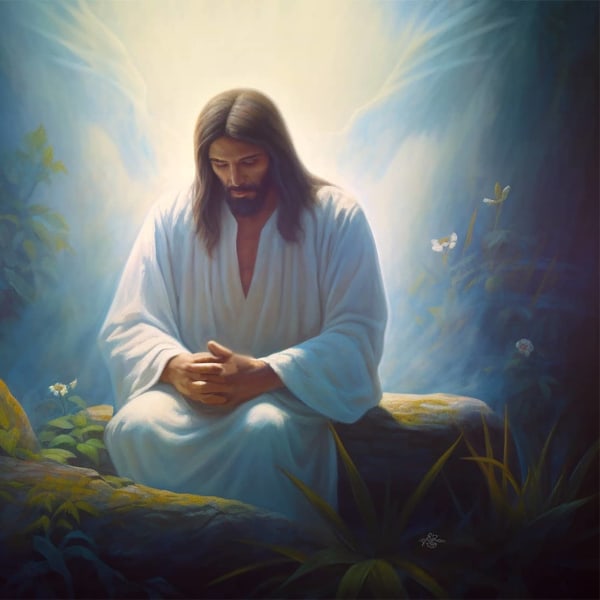
Jesus led Peter, James, and John to a secluded ravine where he had often retreated for prayer and communion with the Father. The three apostles immediately recognized that Jesus was profoundly troubled, observing that never before had they seen their Master so "grievously oppressed" and "heavy-laden and sorrowful." Upon reaching his customary place of devotion, Jesus instructed the three to sit and maintain a vigilant watch while he withdrew about a stone's throw away to pray in solitude. Falling prostrate upon the ground, Jesus began his agonizing supplication: "My Father, I came into this world to do your will, and so have I. I know that the hour has come to lay down this life in the flesh, and I do not shrink therefrom, but I would know that it is your will that I drink this cup. Send me the assurance that I will please you in my death even as I have in my life."
After praying briefly, Jesus returned to find the three apostles sound asleep, their eyes heavy with exhaustion despite the gravity of the moment. Gently rousing them, Jesus asked with palpable disappointment, "What! can you not watch with me even for one hour? Cannot you see that my soul is exceedingly sorrowful, even to death, and that I crave your companionship?" After the apostles awoke fully, Jesus again withdrew to pray alone, this time saying, "Father, I know it is possible to avoid this cup—all things are possible with you—but I have come to do your will, and while this is a bitter cup, I would drink it if it is your will." During this second prayer, a mighty angel descended to Jesus's side, speaking words of encouragement and physically strengthening him for the ordeal ahead.
Returning once more to his disciples, Jesus found them asleep again, prompting him to awaken them with the admonition, "In such an hour I need that you should watch and pray with me—all the more do you need to pray that you enter not into temptation—wherefore do you fall asleep when I leave you?" For a third time, Jesus withdrew to pray, this time achieving complete surrender to the divine will: "Father, you see my sleeping apostles; have mercy upon them. The spirit is indeed willing, but the flesh is weak. And now, O Father, if this cup may not pass, then would I drink it. Not my will, but yours, be done." Upon concluding this prayer, Jesus lay momentarily prostrate before rising and returning to find his apostles still asleep. With a gesture of tender compassion, he said, "Sleep on now and take your rest; the time of decision is past. The hour is now upon us wherein the Son of Man will be betrayed into the hands of his enemies."
The narrator of the account provides profound insight into the spiritual significance of Jesus's Gethsemane experience, explaining that "each time he prayed in the garden, his humanity laid a firmer faith-hold upon his divinity; his human will more completely became one with the divine will of his Father." The mighty angel who appeared to Jesus conveyed the message that the Father desired his Son to complete his earth bestowal by experiencing death just as all mortal creatures must, affirming the necessity of this final aspect of Jesus's incarnation experience. The account further reveals that earlier in the evening, drinking the cup had not seemed so difficult, but as Jesus bade farewell to his apostles and experienced the natural "ebb and flow of feeling which is common to all human experience," the trial grew increasingly daunting. Nevertheless, Jesus ultimately achieved the conviction that the Father intended natural events to take their course, and he firmly resolved not to employ his sovereign power as the supreme head of a universe to save himself.
The depth of Jesus's emotional and spiritual struggle during this pivotal hour cannot be overstated. The account describes how the human heart of Jesus was crushed by multiple factors: isolation from his family in the flesh, the betrayal of one of his chosen associates, the rejection by Joseph's people, and the torture of baffled love and rejected mercy. These overwhelming human sentiments bore down on him "with indescribable heaviness," yet Jesus found strength in memories of his childhood in Nazareth and his ministry in Galilee, particularly recalling "the sunrise and sunset on the shimmering Sea of Galilee." Through this profound spiritual process, Jesus ultimately achieved complete victory, as "the spirit had triumphed over the flesh; faith had asserted itself over all human tendencies to fear or entertain doubt." By the time Judas and the soldiers arrived, Jesus had fully regained his customary poise, having passed the supreme test of "the full realization of the human nature" and standing prepared to face his enemies with equanimity and "in the full assurance of his invincibility as a mortal man unreservedly dedicated to the doing of his Father's will."