Discover The Urantia Book \Papers\Advanced \Monday in Jerusalem

Paper 173 Overview: Monday in Jerusalem
On Monday in Jerusalem, Jesus boldly challenged religious hypocrisy and corruption. He cleansed the temple, taught openly, and intensified the growing tension with religious authorities plotting against him.
Reading Level:
-
Summary
Monday during Jesus's final week in Jerusalem marked a pivotal turning point, beginning with his dramatic cleansing of the temple and culminating in the Sanhedrin's formal decision to eliminate him. The temple cleansing represented Jesus's authoritative condemnation of the commercialization of worship and exploitation of worshippers, as he personally drove out the sacrificial animals while the electrified pilgrims spontaneously overturned the money-changers' tables. This catalytic event further inflamed the religious authorities' determination to destroy Jesus, even as it demonstrated the popular support he maintained among the common people. Throughout this momentous day, Jesus employed a series of strategic parables that not only deflected the authorities' attempts to entrap him but also prophetically illustrated the impending rejection of Jewish religious leadership and the future expansion of the kingdom beyond traditional boundaries.
The narrative reveals multiple dimensions of conflict: theological disputes with religious authorities, Jesus's moral indictment of corrupt religious practices, and the escalating conspiracy to eliminate him. Jesus demonstrated remarkable spiritual authority and tactical wisdom by redirecting his opponents' challenges, exposing their hypocrisy through thought-provoking parables, and articulating the principles of the kingdom in ways that resonated with the common people while confounding the religious elite. By day's end, the die was cast: the Sanhedrin unanimously decreed Jesus's death, while the apostles sensed an impending crisis without fully comprehending that these events were precisely aligned with Jesus's previously stated mission to fulfill the Father's will through sacrifice.
-
Introduction
Early Monday morning, Jesus and his apostles assembled at Simon's home in Bethany for a brief conference before departing for Jerusalem. The twelve were noticeably subdued, still processing the previous day's events and wrestling with uncertainty about Jesus's abrupt tactical shift and his directive that they abstain from public teaching throughout the Passover week. Their journey down Mount Olivet was characterized by meditative silence, with Jesus leading the way while the apostles followed in contemplative introspection.
Upon arriving at the temple around nine o'clock, they entered the large court where Jesus often taught, and after greeting awaiting believers, Jesus mounted a teaching platform while the apostles withdrew to observe. For most of the apostles, their paramount concern was what unprecedented action Jesus might take that day, but Judas Iscariot's thoughts had already turned in a more ominous direction. He was actively deliberating whether to continue with Jesus and his associates or to sever his relationship with the apostolic movement altogether.
-
1. Cleansing the Temple
An extensive commercial enterprise had developed within the temple precincts, ostensibly to facilitate worship but effectively exploiting worshippers and enriching the temple treasury and priestly families. The practice of selling sacrificial animals in the temple courts had evolved because worshippers feared their personally provided animals might be rejected by official inspectors, while temple-purchased animals, though overpriced, were guaranteed acceptance. Similarly, money-changers profited by exchanging various currencies for the temple shekel required for dues and offerings, often charging exorbitant commissions that particularly burdened the poor.
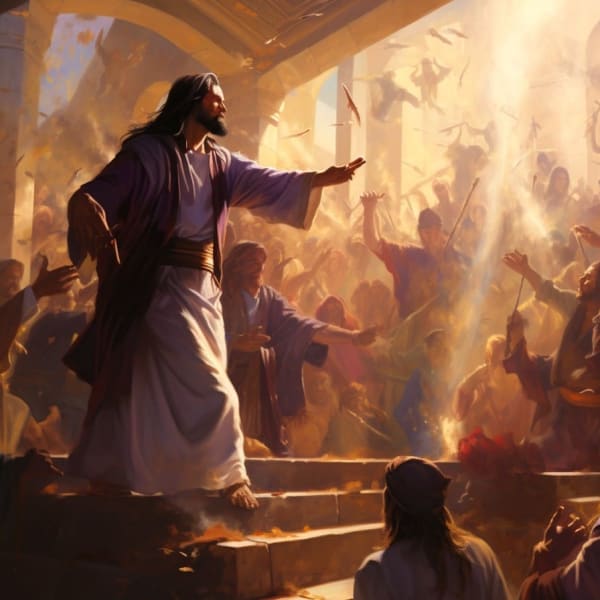
When Jesus arrived at the temple, he witnessed this scene of commerce and confusion, including a heated argument at a money-changer's table and the mistreatment of a simple Galilean by arrogant Judeans. Moved by righteous indignation, Jesus stepped down from the teaching platform and, taking a whip from a lad who was driving cattle through the court, personally drove the animals from the temple. He then proceeded to the farthest cattle pens, opening the gates of every stall and driving out all the imprisoned animals. This dramatic action served as a catalyst for the assembled pilgrims, who were "electrified" by Jesus's authoritative intervention and, with uproarious shouting, spontaneously moved toward the bazaars and overturned the tables of the money-changers. Jesus declared, "My house shall be called a house of prayer for all nations, but you have made it a den of robbers," while the people stationed guards at the temple entrances to prevent the return of commerce that day.
The apostles, unprepared for this dramatic intervention, remained huddled near the speaker's stand while Jesus spent the remainder of the day teaching in the now-purified temple courts. This cleansing episode demonstrated not only Jesus's moral indignation at the commercialization of religion but also revealed his view on the legitimate use of force to protect the majority from exploitation by unjust minorities entrenched behind political, financial, or ecclesiastical power. It further illustrated that Jesus did not merely condemn corruption verbally but was willing to take decisive action against "shrewd, wicked, and designing men" who organized themselves to exploit the idealistic and unprotected.
-
2. Challenging the Master's Authority
The cleansing of the temple effectively postponed Jesus's arrest, as the Jewish leaders feared the multitude's response should they attempt to apprehend him publicly. At their noon meeting, the Sanhedrin unanimously agreed that Jesus must be destroyed but remained divided over the methodology and timing of his capture. They deployed five groups to entangle Jesus in his teaching, hoping to discredit him before the people and thereby diminish the risk of public backlash when they moved against him.
At approximately two o'clock, as Jesus was teaching on "The Liberty of Sonship," these religious authorities interrupted him with a seemingly legitimate question regarding his authority to cleanse the temple. Jesus, recognizing their duplicitous intent, responded with a strategic counter-question about John the Baptist's authority: "The baptism of John, whence was it? Did John get his authority from heaven or from men?" This masterful response placed his interrogators in an impossible dilemma: acknowledging John's divine authority would implicitly validate Jesus's authority as well, while denying it would anger the multitude who revered John as a prophet. Unable to answer without either undermining their position or inciting the crowd, they retreated in confusion, declaring, "We cannot answer; we do not know." Jesus then declined to answer their original question, effectively exposing their dishonesty while implicitly affirming that his authority, like John's, came from heaven. The people readily discerned the religious leaders' insincerity, which further enhanced Jesus's moral authority while deepening the authorities' determination to destroy him.
Jesus's response was not merely tactical evasion but a profound assertion of spiritual principle. As the narrative explains, Jesus had consistently asserted that his teaching and works were empowered by his Father in heaven, precisely the authority that the Sanhedrin refused to acknowledge. By connecting his authority to the same source as John's (which the leaders dared not publicly deny), Jesus effectively answered their question while exposing their intellectual dishonesty. This encounter exemplified Jesus's genius for dealing with adversaries in ways that transformed their attempts to ensnare him into opportunities to illuminate truth and inspire the common people, who "could not fail to distinguish between the moral majesty of the Master and the designing hypocrisy of his enemies."
-
3. Parable of the Two Sons
As the confounded Pharisees stood silently before him following their failed attempt to discredit his authority, Jesus addressed them with the parable of the two sons. In this instructive narrative, a landowner asked both his sons to work in his vineyard; the first son initially refused but later repented and fulfilled his father's request, while the second son verbally agreed but never actually complied. When Jesus asked which son truly did the father's will, the people rightly identified the first son, the one whose actions ultimately aligned with his father's directive, despite his initial resistance.
Jesus proceeded to apply this parable directly to the religious leaders, explaining that tax collectors and prostitutes, despite their initial rejection of righteous paths, were entering the kingdom of God ahead of the self-righteous Pharisees and scribes who professed devotion but failed to produce the fruits of genuine faith. This parable illuminated the inevitable clash between the new, living religion of the spirit that Jesus proclaimed and the older religion of ceremony, tradition, and authority that the religious leaders defended. Throughout this confrontation, the twelve apostles remained near Jesus but did not participate in these exchanges, honoring his instruction to refrain from public teaching during the Passover week while each apostle privately processed these events according to his own understanding and temperament.
Jesus explicitly clarified that his opposition was not directed toward the Pharisees and Sadducees personally, but rather toward their systems of teaching and practice. This distinction underscored Jesus's fundamental posture of loving all individuals while firmly opposing institutions and ideologies that obstructed spiritual growth and authentic relationship with God. The parable itself functioned on multiple levels: as a pointed critique of religious hypocrisy, as an affirmation of the redemptive potential in even the most socially marginalized individuals, and as an illustration of the Father's valuation of genuine repentance over empty religious performance. The narrative thus captures a decisive confrontation between two irreconcilable approaches to spirituality: one centered on external compliance with religious authority, and another founded on internal transformation and authentic obedience to divine guidance.
-
4. Parable of the Absent Landlord
After the chief Pharisees and scribes withdrew to deliberate further, Jesus addressed the multitude with the parable of the absent landlord, a story rich with allegorical significance for the Jewish nation. He described a householder who meticulously planted and equipped a vineyard before leasing it to tenants and departing for a distant country. When harvest time arrived, the householder sent servants to collect his rental, but the tenants violently mistreated them, beating some and killing others. After dispatching more trusted servants who received similar treatment, the householder ultimately sent his beloved son, believing the tenants would respect him, but instead, they killed the son, thinking they would thereby gain his inheritance.
When Jesus asked what the vineyard owner would do to these wicked tenants, the people responded that he would destroy them and entrust the vineyard to worthy farmers. Some listeners recognized that this parable referred to the Jewish nation's historical rejection of the prophets and their imminent rejection of Jesus himself. Jesus confirmed this interpretation by citing the scriptural metaphor of the stone rejected by builders becoming the cornerstone, and explicitly warned that the kingdom of God would be taken from them and given to those who would produce its fruits. The religious leaders, perceiving that Jesus had spoken this parable against them, became even more determined to destroy him, though they continued to fear the public's reaction. By evening, this parable had contributed significantly to the Sanhedrin's formal decision to eliminate both Jesus and Lazarus.
The parable functioned as both a historical indictment and a prophetic warning, tracing Israel's pattern of rejecting divine messengers while simultaneously forecasting the religious authorities' imminent rejection of Jesus himself. The imagery of the vineyard drew upon established prophetic symbolism (particularly from Isaiah) where Israel was portrayed as God's vineyard, making the allegorical significance unmistakable to those familiar with Jewish scripture. The parable's conclusion, that the vineyard would be given to others who would render its fruits, presaged the impending transition of spiritual leadership from the established Jewish religious hierarchy to a more inclusive community of believers who would embrace Jesus's message. This prophetic dimension proved particularly provocative to the religious authorities, who recognized that Jesus was directly challenging their legitimacy as spiritual leaders and forecasting their replacement as custodians of divine truth.
-
5. Parable of the Marriage Feast
After the scribes and rulers departed, Jesus delivered to the assembled crowd the parable of the marriage feast, which further illuminated the consequences of rejecting divine invitation. He described a king who prepared an elaborate wedding celebration for his son and dispatched messengers to summon the invited guests, who not only refused to attend but mistreated and killed the king's servants. The enraged king destroyed these rebellious subjects and instead invited strangers from highways and byways, both worthy and unworthy, to fill his banquet hall. However, upon finding one guest without appropriate wedding attire, the king ordered this unprepared participant cast out, emphasizing that invitation alone was insufficient without proper preparation and respect for the host's provisions.
A sympathetic believer in the crowd asked how they would recognize the sign of Jesus's divine sonship, to which Jesus responded enigmatically: "Only one sign shall be given you. Destroy this temple, and in three days I will raise it up." The people, including his apostles, failed to comprehend that he was referring not to the physical temple but to his body and forthcoming resurrection. At approximately four o'clock, Jesus led his apostles from the temple to establish a camp nearer Jerusalem in accordance with his earlier instructions to Andrew, Philip, and Thomas. They traveled in somber silence, with the apostles increasingly sensing that something momentous and potentially tragic was imminent. Though the morning's temple cleansing had briefly rekindled their hopes, the afternoon's events had created a growing awareness that a profound crisis was approaching, though they still could not fully reconcile this with their expectations of a triumphant Messiah.
This final parable of the day completed a trilogy of teachings that progressively revealed the consequences of rejecting divine overtures. While the parable of the two sons addressed individual hypocrisy and the parable of the vineyard addressed historical rejection of prophets, this marriage feast parable expanded the scope to encompass the universal invitation to participate in the kingdom. The parable contained multiple layers of meaning: it illustrated God's persistent invitation despite repeated rejection; it foretold the extension of spiritual opportunity beyond traditional religious boundaries; and it emphasized the necessity of proper spiritual preparation even when receiving divine grace. The king's invitation to both "good and bad" from the highways reflected Jesus's inclusive ministry to social outcasts, while the expulsion of the unprepared guest balanced this inclusivity with the expectation of appropriate spiritual response and transformation. As the apostles departed the temple that afternoon, they experienced a profound disconnect between their expectations of messianic triumph and the increasingly apparent trajectory toward conflict and sacrifice that Jesus's teachings were indicating.