Discover The Urantia Book \Papers\Advanced \Going into Jerusalem

Paper 172 Overview: Going into Jerusalem
Jesus' entry into Jerusalem was a peaceful yet profound public declaration of his spiritual mission. Though welcomed joyfully, he fully understood the rejection and suffering that soon awaited him.
Reading Level:
-
Summary
Jesus and his apostles arrived in Bethany on Friday afternoon, March 31, where Jesus lodged with Simon while attracting numerous visitors who sought to see both him and Lazarus. Despite the Sanhedrin's decree of death against him, Jesus maintained remarkable composure, exhibiting a majestic calmness that contrasted with his apostles' vigilance as they kept armed watch through the night. The chief priests, though aware of Jesus' whereabouts, strategically refrained from attempting to seize him among his supporters, instead waiting for his anticipated entry into Jerusalem, where they held jurisdiction.
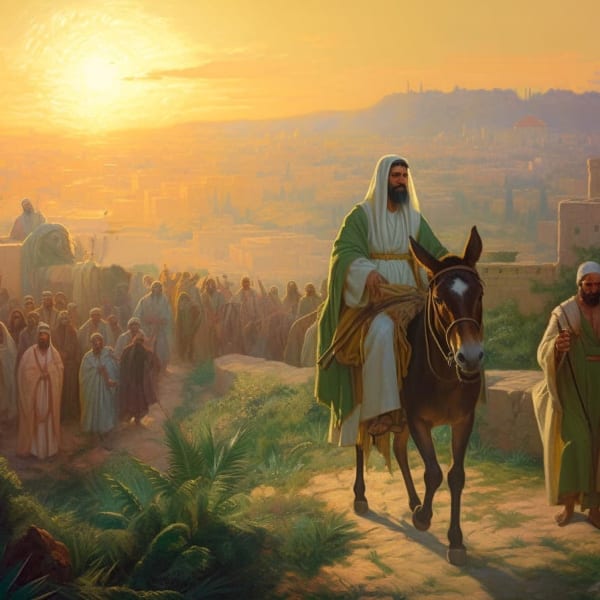
Jesus deliberately orchestrated a symbolic entry into Jerusalem on Sunday afternoon, fulfilling Zechariah's prophecy by riding on a donkey as a visual declaration of his peaceful mission rather than as a militant conqueror on horseback. The procession from Bethany attracted enthusiastic crowds who spread garments and branches before him, shouting "Hosanna to the son of David," though Jesus recognized the superficiality of their acclaim. Upon reaching the summit of Olivet and beholding Jerusalem, Jesus wept over the city, prophesying its destruction for failing to recognize "the time of divine visitation," a poignant moment of sorrow amidst the jubilation that revealed his profound understanding that this popular demonstration provided temporary protection but would not prevent his ultimate rejection and crucifixion.
-
Introduction
Jesus and his apostles arrived at Bethany shortly after four o'clock on Friday afternoon, March 31, where arrangements had been made for him to stay with Simon, a neighboring believer, since Lazarus's resurrection had attracted so many visitors. That evening, Jesus received numerous visitors, with the residents of Bethany and Bethpage understanding that Jesus was not the type of king who would defy the Sanhedrin's decree to proclaim earthly rulership, though many others harbored such expectations. The chief priests, informed of Jesus' presence in Bethany, strategically decided against attempting to seize him among his friends, preferring to await his entrance into Jerusalem, where they exercised authority.
Throughout this period of imminent danger, Jesus exhibited a majesty and composure that astonished even his apostles, who organized themselves to watch over him in pairs through the night, many of them armed with concealed swords. Early the next morning, hundreds of pilgrims arrived from Jerusalem, even violating Sabbath travel restrictions, eager to see both Jesus and Lazarus, whom he had raised from the dead, a living testimony that continued to complicate the religious authorities' efforts to discredit Jesus' mission and message.
-
1. Sabbath at Bethany
Throughout Judea, people had been speculating whether Jesus would dare to attend the Passover in Jerusalem, and they rejoiced upon learning of his presence in Bethany. The chief priests and Pharisees were pleased that Jesus was now within their jurisdiction but remained concerned about his boldness and particularly troubled by Lazarus's resurrection, which continued to generate faith among the populace. Six days before the Passover, after the Sabbath concluded, the residents of Bethany and Bethpage organized a public banquet at Simon's home to honor both Jesus and Lazarus, deliberately defying the Sanhedrin's decree of condemnation. Martha supervised the meal service while Mary, in accordance with Jewish custom that prohibited women from participating in public banquets, remained with the female observers.
During this celebration, Mary approached Jesus with an alabaster container of rare and costly ointment, anointed his head, and then poured the remainder on his feet, wiping them with her hair, filling the house with fragrance and creating a moment of profound devotion. When Judas Iscariot criticized this apparent waste of resources that could have benefited the poor, Jesus gently rebuked him, saying: "Let her alone, every one of you. Why do you trouble her about this, seeing that she has done a good thing in her heart?" Jesus explained that Mary had preserved this ointment for his burial and that her act of devotion would be remembered wherever the gospel was preached throughout the world. This public correction deeply wounded Judas's pride, crystallizing his resentment and accelerating his path toward betrayal, while simultaneously prompting the chief priests to decide that Lazarus must also be eliminated, as his very existence provided compelling evidence of Jesus' miraculous power.
-
2. Sunday Morning with the Apostles
On Sunday morning in Simon's garden, Jesus gathered his twelve apostles for final instructions before their journey to Jerusalem, advising them to refrain from public teaching during the Passover sojourn and to remain near him in vigilant prayer. Though Jesus was aware that many of his followers, including several apostles, carried concealed weapons, he made no reference to this fact as he briefly reviewed their shared ministry from their ordination near Capernaum to the present moment. This solemn retrospective was received by the apostles in attentive silence, and they asked no questions about the implications of this summary of their work together. Earlier that morning, David Zebedee had delivered to Judas the funds realized from selling the Pella encampment equipment, which Judas then entrusted to Simon for safekeeping in anticipation of their needs in Jerusalem.
Following this conference with the apostles, Jesus spoke privately with Lazarus, instructing him to avoid making himself a sacrifice to the vengefulness of the Sanhedrin, guidance that prompted Lazarus to flee to Philadelphia when officers later came to arrest him. Despite the gravity of the situation and Jesus' awareness of the tragic events about to unfold, he maintained an unusual cheerfulness and exceptional good humor that prevented his followers from fully comprehending the seriousness of their circumstances. This deliberate demeanor created a protective psychological barrier that shielded his disciples from premature anxiety, as they remained unable to grasp the reality of his repeated warnings about his impending death.
-
3. The Start for Jerusalem
At approximately one-thirty on Sunday afternoon, Jesus prepared to depart for Jerusalem, experiencing profound affection for Bethany and its sincere inhabitants who had wholeheartedly accepted him, unlike Nazareth, Capernaum, and Jerusalem which had rejected his message. This village of believers had provided the appropriate spiritual environment for Jesus to perform his most spectacular miracle, the resurrection of Lazarus, not to generate faith where it did not exist, but because the people already believed in his divine mission. Throughout the morning, Jesus had contemplated his approach to Jerusalem, recognizing that he was nearing the culmination of his earthy career with his death decreed by the Sanhedrin, and determined that the time had come to allow a more public expression of his messianic character.
Jesus deliberately chose to fulfill Zechariah's prophecy which depicted the Messiah as a man of peace entering Jerusalem on a donkey rather than as a militant king on horseback, sending Peter and John to secure the animal while David Zebedee and his associates spread word of Jesus' approach throughout Jerusalem. As the procession moved toward Jerusalem, growing numbers of enthusiastic pilgrims joined the celebration, placing garments and branches along the path and shouting, "Hosanna to the son of David; blessed is he who comes in the name of the Lord." When they reached the summit of Olivet, providing a panoramic view of Jerusalem and the temple, Jesus halted the procession and wept over the city, prophetically lamenting: "O Jerusalem, if you had only known, even you, at least in this your day, the things which belong to your peace, and which you could so freely have had! But now are these glories about to be hid from your eyes." This emotional moment revealed Jesus' profound understanding that despite the day's enthusiasm, the people would soon reject him, failing to recognize the spiritual nature of his kingdom and their opportunity for genuine salvation.
-
4. Visiting About the Temple
After the Alpheus twins returned the donkey to its owner, Jesus and the ten apostles moved through the temple courts, observing the Passover preparations without interference from the religious authorities. The Sanhedrin hesitated to arrest Jesus because they greatly feared the people's reaction, a circumstance Jesus had anticipated and which justified his permission of the public demonstration, providing a protective buffer that allowed him one final opportunity to present his message to Jerusalem's inhabitants and the thousands of Passover visitors. This strategic entry accomplished what no amount of preaching could have achieved: it temporarily prevented his immediate arrest while creating the conditions for his final public teachings.
As evening approached and the crowds dispersed to seek food, Jesus remained in the temple with his immediate followers, who were unusually reflective and silent following the day's extraordinary events. Jesus observed the treasury activities, watching people make their contributions according to their means, and called specific attention to a poor widow who contributed two small copper coins. "Heed well what you have just seen," Jesus instructed his apostles. "This poor widow cast in more than all the others, for all these others, from their superfluity, cast in some trifle as a gift, but this poor woman, even though she is in want, gave all that she had, even her living." This spontaneous teaching moment exemplified Jesus' ability to extract profound spiritual lessons from ordinary circumstances. As darkness fell, after walking through the temple courts one final time, recalling emotions from previous visits including his childhood experiences, Jesus simply said, "Let us go up to Bethany for our rest," and departed with Peter and John to Simon's house while the other apostles found accommodations in Bethany and Bethpage.
-
5. The Apostles' Attitude
The return journey to Bethany proceeded in striking silence, with Jesus walking ahead while the bewildered apostles followed without speaking until they reached Simon's house and separated for the night. These "ambassadors of the kingdom" experienced diverse and inexplicable emotions as they processed the day's events, struggling to reconcile their expectations with Jesus' actions and unable to sleep except for the Alpheus twins. No twelve human beings had ever experienced such a complex mixture of confusion, anticipation, disappointment, and dawning realization as these men who had committed their lives to Jesus yet could not comprehend his true mission or the significance of these final days in Jerusalem.
Each apostle processed the day's events through the particular lens of his personality and expectations: Andrew remained preoccupied with his leadership responsibilities, vigilantly monitoring his fellow apostles rather than interpreting the triumphal entry; Peter experienced crushing disappointment when Jesus failed to capitalize on the public enthusiasm with a powerful pronouncement or call to action; James Zebedee felt perplexed by the emotional high of the processional followed by Jesus' seemingly passive behavior at the temple; John alone partially grasped the symbolic significance of Jesus fulfilling Zechariah's prophecy about a peaceful Messiah; Philip initially feared Jesus might ask him to feed the multitude but felt relieved when no such request came; Nathaniel most clearly understood Jesus' strategic purpose in protecting himself from immediate arrest through the public demonstration; Matthew experienced an emotional revelation when he recognized the prophetic significance of the entry; Thomas initially found the procession childish but later appreciated its strategic cleverness; Simon Zelotes began the day envisioning a nationalist uprising but ended in complete disillusionment; the Alpheus twins simply enjoyed the experience without analytical overthinking; and Judas Iscariot felt disgusted by what he perceived as a farcical display, his pride wounded by the ridicule of a Sadducean friend. This encounter significantly advanced his determination to abandon Jesus and the apostolic mission.