Discover The Urantia Book \Papers\Advanced \The Sojourn at Tyre and Sidon

Paper 156 Overview: The Sojourn at Tyre and Sidon
While in Phoenicia, Jesus ministered quietly, sharing the universal gospel of the Father’s love. He encouraged the apostles to embrace all peoples and broadened their understanding of the spiritual kingdom’s global reach.
Reading Level:
Summary
This paper chronicles a pivotal sojourn in Jesus' ministry when he and his apostles retreated to the predominantly Gentile territories of Tyre and Sidon along the Phoenician coast. This strategic withdrawal from the increasing hostility in Jewish regions became a productive period of teaching and expansion of the kingdom message beyond previously established cultural boundaries. The narrative illuminates Jesus' inclusive approach to ministry, particularly through the healing of the Syrian woman's afflicted daughter, an illustrative encounter symbolizing the extension of spiritual fellowship beyond Jewish exclusivity to embrace sincere faith regardless of ethnic origin.
During these six weeks in Phoenician territories, Jesus delivered profound discourses on spiritual progression, the nature of temptation, the proper understanding of scripture, and the foundations of spiritual character development. His teachings in Tyre particularly elaborated on transforming temptation through spiritual affection rather than mere suppression of desires, and included his rare employment of a carpentry metaphor highlighting the necessity of sound moral foundations. This period proved exceptionally fruitful, as the Gentiles of the region demonstrated remarkable receptivity to the gospel of the kingdom, often comprehending more fully than many Jews the universality of God's laws and the impartiality of the Divine toward all peoples, validating Jesus' prophetic declaration that the kingdom would be embraced by Gentiles if "the children of Abraham" failed to demonstrate sufficient faith.
Introduction
On Friday afternoon, June 10, Jesus and his entourage arrived in the environs of Sidon, taking residence at the home of a wealthy woman who had previously been a patient at the Bethsaida hospital during the height of Jesus' public acclaim. The evangelists and apostles were accommodated with the woman's friends in the immediate vicinity, allowing them to rest over the Sabbath day in these refreshing surroundings before commencing nearly two and a half weeks of ministry in Sidon and its neighboring areas, prior to visiting coastal cities farther north.
This June Sabbath day was characterized by profound quietude among the group, as the evangelists and apostles remained deeply engaged in contemplation regarding Jesus' recent discourses on religion delivered during their journey to Sidon. Despite their concentrated meditation, their comprehension remained partial and imperfect, a recurrent pattern throughout Jesus' ministry as his followers consistently struggled to transcend their cultural preconceptions and grasp the revolutionary spiritual principles he espoused. This cognitive dissonance between their traditional religious expectations and Jesus' transcendent teachings would persist as a central challenge throughout their association with him.
1. The Syrian Woman
In close proximity to Karuska's residence, where Jesus was staying, lived a Syrian woman named Norana who, having heard accounts of Jesus' reputation as a healer and teacher, brought her twelve-year-old daughter afflicted with a severe nervous disorder manifesting in convulsions and other distressing symptoms. Despite Jesus' instructions to his associates to maintain his privacy during this period of intended rest, Karuska's servant had informed Norana of the Master's presence, assuring her that Jesus could heal her daughter, whom she believed was possessed by an unclean spirit according to the prevailing superstitions of that era.
When the Alpheus twins explained that Jesus was resting and should not be disturbed, Norana displayed remarkable persistence, declaring she would remain until the Master finished his rest. Her determination withstood successive attempts by Peter and Thomas to dissuade her, culminating in a poignant exchange with Simon Zelotes, who emphasized the Jewish-Gentile distinction by suggesting it was inappropriate to "take the bread intended for the children of the favored household and cast it to the dogs." Norana's humble yet profound response, in which she acknowledged her status as a "dog" in Jewish estimation while affirming her place as a "believing dog" worthy of fallen crumbs, was striking. Her faith, along with her daughter's timely convulsion, prompted Jesus to emerge and heal the child, commending Norana's exceptional trust and affirming his later observation that Gentiles often showed greater capacity for saving faith than many of Abraham's children.
2. Teaching in Sidon
Upon entering Sidon, Jesus and his companions crossed a bridge that inspired his metaphorical observation: "This world is only a bridge; you may pass over it, but you should not think to build a dwelling place upon it." This profound statement conveyed the transient nature of material existence compared to enduring spiritual realities. Jesus established his teaching headquarters at the home of Justa and her mother Bernice just north of the city, instituting a methodical schedule wherein he personally instructed the twenty-four each morning while they dispersed throughout Sidon for public teaching during afternoons and evenings, a pattern that proved remarkably effective in disseminating the kingdom message.
The apostles and evangelists derived considerable encouragement from the extraordinary receptivity demonstrated by the Gentiles of Sidon, with numerous individuals embracing the kingdom during their six-week sojourn in Phoenicia. These Syrophoenicians exhibited remarkable spiritual perception, comprehending Jesus' teachings about universal law and divine impartiality with greater clarity than many of his Jewish followers. Jesus clarified to the twenty-four that his withdrawal from Galilee stemmed not from cowardice but from strategic timing, as he was not yet prepared for open confrontation with established religious authorities. His instruction during this period emphasized spiritual progression, the impossibility of stagnation in the spiritual life, and the necessity of continually advancing in righteousness or inevitably retrograding into sin, admonishing them to pursue the "full stature of divine sonship" rather than remaining content with spiritual childhood.
3. The Journey up the Coast
On Tuesday, June 28, the Master and his associates departed Sidon, continuing northward along the coast to Porphyreon and Heldua where they experienced favorable reception among the Gentile population. Numerous individuals were incorporated into the kingdom during this productive week of teaching and preaching, with the apostles concentrating their efforts in Porphyreon while the evangelists conducted their ministry in Heldua. During this period, Jesus temporarily separated from the main group for three to four days to visit the coastal city of Beirut, meeting with a Syrian believer named Malach who had previously encountered Jesus at Bethsaida the year before.
The group reassembled in Sidon on Wednesday, July 6, remaining at Justa's residence until Sunday morning when they commenced their journey to Tyre, traveling southward along the coastal route through Sarepta and arriving at their destination on Monday, July 11. By this juncture, the apostles and evangelists had become accustomed to ministering among these predominantly Gentile populations, who were primarily descendants of earlier Canaanite tribes with Semitic origins but conversant in Greek. The apostles registered considerable surprise at the enthusiastic receptivity these Gentiles demonstrated toward the gospel message and their remarkable readiness to embrace the spiritual truths presented to them, a stark contrast to the growing resistance Jesus encountered in predominantly Jewish territories.
4. At Tyre
From July 11 to July 24, Jesus and his disciples conducted an intensive teaching campaign in Tyre, implementing a collaborative strategy wherein each apostle partnered with an evangelist to form teaching pairs that disseminated the gospel message throughout all districts of the city and its surrounding regions. The diverse, polyglot population of this commercially vibrant seaport received their message with remarkable enthusiasm, resulting in numerous baptisms into the external fellowship of the kingdom. Jesus established his headquarters at the residence of a Jewish believer named Joseph, situated approximately three to four miles south of Tyre in proximity to the historic tomb of Hiram, who had reigned as king during the eras of David and Solomon.
Daily, throughout this two-week period, the apostles and evangelists entered Tyre via Alexander's causeway to conduct modest gatherings, returning each evening to their encampment at Joseph's residence. A consistent procession of believers journeyed from the city to converse with Jesus at his temporary domicile. The Master delivered only one public address in Tyre, on the afternoon of July 20, expounding upon the Father's universal love for humanity and the Son's mission to reveal the Father to all races. The populace demonstrated such profound interest in the kingdom gospel that the Melkarth temple opened its doors for Jesus' teaching, a location that would later serve as the site for a Christian church, symbolizing the enduring impact of Jesus' brief ministry there.
5. Jesus' Teaching at Tyre
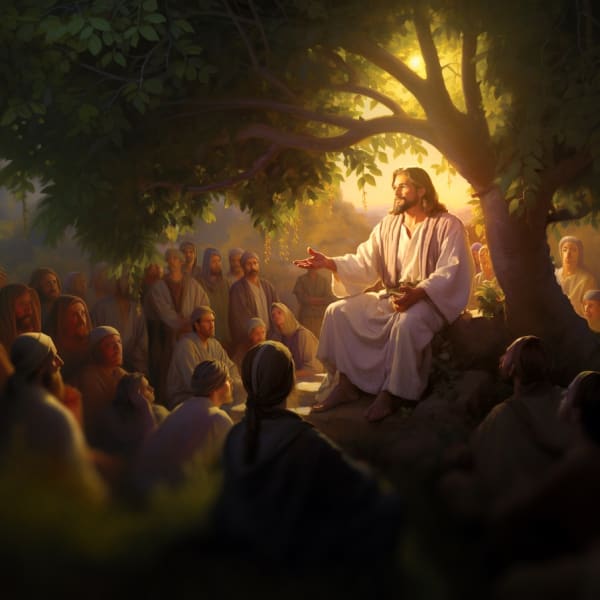
In his Tyrian discourse, Jesus employed the evocative metaphor of a white lily that, while rooted in murky soil, elevates its pristine blossom into the sunlight, illustrating how mortal beings, despite their biological origins in "animal soil," could through faith transcend their material nature to embrace spiritual truth and produce "noble fruits of the spirit." Jesus uniquely incorporated a parable relating to his carpentry trade, his only recorded use of such an occupational reference, to emphasize the futility of attempting to construct noble character upon deficient moral foundations, comparing it to a carpenter meticulously working with internally decayed timber that ultimately proves unsuitable for structural purposes. This analogy underscored his teaching that while the human mind and morals constitute the foundation, the "spirit nature" represents the evolving superstructure of immortal destiny.
When Nathaniel inquired about the prayer phrase "lead us not into temptation," questioning why a benevolent God would induce temptation, Jesus provided a profound theological correction, explaining how ancient Hebrew prophets attributed both positive and negative experiences directly to divine causation. Jesus clarified that temptation originates from internal human selfishness and animal impulses rather than divine manipulation. He expounded that overcoming temptation requires not mere willpower or suppression of desires, but the cultivation of genuine affection for higher ideals: "beauty is always triumphant over ugliness in the hearts of all who are illuminated by the love of truth." Jesus continued with extensive instruction into the night, addressing topics including the essentials of success (ambition, judgment, wisdom, and determination), the nature of spiritual destiny (faith, love, and devotion to truth), and the importance of transcending narrow self-love to embrace the outgoing divine love that seeks to satisfy others' needs.
6. The Return from Phoenicia
At approximately noon on Sunday, July 24, Jesus and the twelve departed from Joseph's residence south of Tyre, journeying southward along the coast to Ptolemais where they paused for a day of rest and fellowship. Peter addressed the local community of believers that evening, continuing the pattern of apostolic teaching that had characterized their Phoenician sojourn. The following day, they proceeded eastward inland, traveling via the Tiberias road to the vicinity of Jotapata, where they further instructed the believers in kingdom principles before continuing their itinerary northward along the Nazareth-Mount Lebanon trail through Ramah to Zebulun, conducting meetings at various villages en route.
From Zebulun, they traversed to the junction with the Magdala-Sidon road near Gischala before making their way to Gennesaret on Galilee's western shore, south of Capernaum, where they had arranged to rendezvous with David Zebedee to deliberate regarding their next evangelical initiatives. Upon learning that numerous leaders had assembled on the opposite shore near Kheresa, they immediately crossed the lake and rested briefly in the hills before proceeding to the park where Jesus had previously fed the five thousand, conducting a three-day conference attended by approximately fifty individuals representing the remnants of the once-substantial community of believers from Capernaum and surrounding areas. During Jesus' absence from Galilee, opposition to his movement had substantially diminished, with a gradual resurgence of public meetings among believers. There was also a surprising shift in attitude from both Philip and Herod Antipas, who now expressed willingness to permit Jesus' activities within their respective territories, setting the stage for his final and climactic year of ministry.
UB Reference
Read the full Urantia Book paper using this link:
Paper 156 - The Sojourn at Tyre and Sidon