Discover The Urantia Book \Papers\Advanced \Tarrying and Teaching by the Seaside

Paper 151 Overview: Tarrying and Teaching by the Seaside
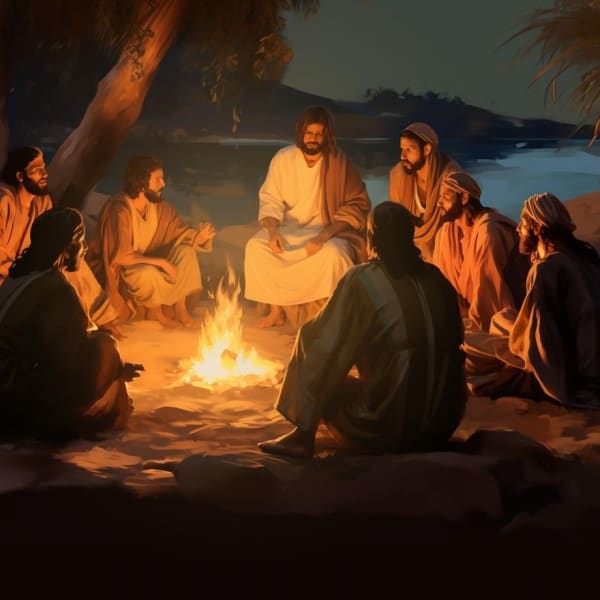
By the seaside, Jesus taught using parables to reveal spiritual truths to diverse audiences. He emphasized personal decision, faith growth, and the inner realities of the kingdom rather than seeking signs or material rewards.
Reading Level:
-
Summary
Paper 151 chronicles a pivotal transition in Jesus' teaching ministry following the reconvening of his followers at Bethsaida after their preaching tours. This period marks Jesus' inaugural implementation of the parabolic teaching method, beginning with the parable of the sower, which he first delivered to the multitudes and subsequently explained to his bewildered apostles. The ensuing discourse on the nature and purpose of parables provides insight into Jesus' pedagogical strategy, utilizing familiar analogies to convey celestial truths, simultaneously revealing meaning to sincere seekers while preserving truth from those antagonistic to his mission.
The narrative encompasses several significant events occurring by the seaside, including Jesus' presentation of multiple foundational parables, the interpretive discussions among his followers, their dramatic lake crossing during which a windstorm was calmed, and the healing of the Kheresa lunatic. Through these experiences, Jesus continually shaped his apostles' understanding, challenging their materialistic interpretations while guiding them toward spiritual discernment. This paper illustrates the Master's methodology in preparing his followers for the progressive revelation of kingdom truths, accommodating diverse intellectual capacities while simultaneously addressing immediate physical needs and deeper spiritual realities.
-
Introduction
By March 10, the scattered preaching and teaching groups had reassembled at Bethsaida, with many utilizing Thursday night and Friday for fishing expeditions before attending Sabbath services at the synagogue, where an aged Jew from Damascus discoursed on the glory of father Abraham. Jesus secluded himself in the hills for most of this Sabbath, returning Saturday evening to deliver a memorable discourse to the assembled groups on "The mission of adversity and the spiritual value of disappointment," a teaching that profoundly affected his hearers and remained indelibly impressed upon their memories. This period of reflection and instruction served as a crucial transitional phase in Jesus' ministry, preparing his followers for the increasingly challenging work ahead.
The Master's demeanor during this time betrayed a lingering sadness from his recent rejection at Nazareth, a subtle melancholy that the apostles detected beneath his characteristic cheerfulness. James and John provided companionship to Jesus throughout much of this period, while Peter attended to the practical responsibilities of directing the newly assembled corps of evangelists. As the group tarried before their journey to Jerusalem for Passover, the women devoted themselves to house-to-house visitation, gospel teaching, and ministering to the sick throughout Capernaum and neighboring communities, demonstrating the practical application of the kingdom message through service and compassion.
-
1. The Parable of the Sower
Around this time, Jesus inaugurated his parabolic teaching method as an approach to instructing the increasingly large multitudes that gathered to hear him. Following a night of extended conversation with his apostles, Jesus retreated alone to Andrew and Peter's fishing boat early Sunday morning to meditate on the next phase of kingdom expansion. His solitude was short-lived, however, as by ten o'clock nearly a thousand people had congregated along the shore, clamoring for his attention and instruction. When Peter approached suggesting he might address the crowd, Jesus instead introduced his first formal parable: the story of a sower whose seeds fell on various types of ground, yielding dramatically different results depending on the soil quality.
The apostles and close associates were perplexed by this departure from Jesus' usual direct teaching style, gathering later that evening in the Zebedee garden to question him about these "dark sayings." Jesus explained that his followers were privileged to comprehend the mysteries of the kingdom directly, while for the multitudes, particularly those antagonistic to his message, parables served a dual purpose: illuminating truth for sincere seekers while concealing deeper meanings from those who might distort or misuse them. He cited the prophet's description of those whose hearts had "waxed gross" and whose ears were "dull of hearing" as justification for this pedagogical approach, though the apostles still struggled to fully grasp the significance of this teaching methodology.
-
2. Interpretation of the Parable
Peter and his companions, after extensive discussion, concluded that the parable of the sower constituted an allegory wherein each narrative element corresponded to a spiritual reality. Approaching Jesus with this interpretation, Peter was first asked to articulate his understanding, whereupon he proposed that the sower represented gospel preachers, the seed symbolized God's word, and the various soils depicted different categories of hearers: the wayside representing those who fail to comprehend, the rocky places signifying superficial believers who falter under tribulation, the thorny ground corresponding to those whose spiritual growth is choked by worldly concerns, and the good soil representing varying degrees of genuine spiritual receptivity. After Peter finished, Nathaniel offered an alternative interpretation with similar elements but different emphases, leading to an animated debate among the apostles.
The escalating disagreement was redirected when Thomas insightfully recalled Jesus' previous admonition against interpreting parables as allegories, reminding his fellows that parables typically conveyed one central truth rather than establishing elaborate correspondences between narrative details and spiritual realities. The Master commended Thomas for this discernment, affirming that the parable's primary purpose was to illustrate how the effectiveness of gospel proclamation varied according to the spiritual receptivity of hearers and conditions beyond the teacher's control. This episode illuminated the dangers of allegorical over-interpretation while providing a guiding principle for understanding subsequent parables, a lesson that dramatically transformed the apostles' approach to Jesus' teaching, though they would still occasionally indulge in speculative interpretations among themselves.
-
3. More About Parables
The apostles' fascination with parables continued unabated, prompting them to devote the entire following evening to further exploration of this teaching methodology. Jesus began this instructional session by emphasizing the necessity of adapting one's teaching approach to the diverse intellectual and spiritual capacities of different audiences, explaining that parables allowed each hearer to derive meaning commensurate with their spiritual receptivity. He cautioned that while they should let their light shine with wisdom and discretion, nothing in the kingdom would ultimately remain hidden, and he underscored the importance of paying attention not only to what truth was taught but how it was received, noting that "to him who has shall be given more."
Jesus proceeded to enumerate the distinctive advantages of parabolic teaching: parables simultaneously address multiple levels of intellect and spiritual development; they utilize familiar material realities to illuminate unfamiliar spiritual concepts; they facilitate unbiased moral decisions by circumventing personal defensiveness; they stimulate thought through auditory engagement; they present new and potentially controversial truths while minimizing direct confrontation with established traditions; and they enhance memory retention by creating associations with common experiences that serve as future reminders. The Master concluded by revealing that the parable of the sower served dual purposes, reviewing his own ministry thus far while forecasting the apostles' future experiences in kingdom proclamation, and noted that parables also effectively countered accusations that his works were accomplished through demonic power, since nature-based analogies contradicted prevailing views that natural phenomena originated from spiritual beings and supernatural forces.
-
4. More Parables by the Sea
The following day, Jesus resumed teaching from a boat, presenting the parable of the wheat and weeds, wherein a man's agricultural efforts were sabotaged by an enemy who sowed weeds among his wheat. Rather than risking damage to the developing crop through premature separation, the wise landowner instructed his servants to allow both plants to mature until harvest, when definitive sorting could safely occur. After addressing questions from the attentive crowd, Jesus proceeded to deliver a sequence of additional kingdom parables, each illuminating different aspects of spiritual reality through accessible everyday analogies.
This constellation of parables included: the mustard seed that grows from minuscule beginnings into a substantial plant hosting birds in its branches; the leaven that transforms dough through unseen but pervasive influence; a treasure hidden in a field that prompts the discoverer to joyfully sacrifice all possessions for its acquisition; a merchant who likewise surrenders all assets to obtain one pearl of exceptional value; and a sweep net that gathers marine life indiscriminately before the subsequent separation of the valuable from the worthless. From this juncture forward, Jesus predominantly employed parables in his public teaching, reserving more explicit expositions for the evening instructional sessions with his apostles and evangelists, during which he would explain the deeper implications of these illustrative narratives and address specific inquiries regarding their interpretation and application.
-
5. The Visit to Kheresa
As the multitude continued to expand throughout the week, Jesus, seeking respite from the constant demands of ministry, proposed crossing to the eastern shore of the lake. During their transit, the party encountered one of the characteristic violent windstorms of the Sea of Galilee, a meteorological phenomenon resulting from the lake's position approximately seven hundred feet below sea level, surrounded by high banks and steep gorges that create dramatic temperature differentials and resultant air movement, particularly after sunset. The tempest tore away their sail, forcing the experienced oarsmen to struggle against the powerful wind and waves that threatened to overwhelm their vessel.
Throughout this tumultuous crossing, Jesus remained asleep in the stern until Peter, abandoning his oar as water flooded the boat, awakened him with urgent appeals for intervention. Jesus responded by addressing Peter's agitation rather than the elements, saying, "Why are you so filled with fear? Where is your faith? Peace, be quiet." The atmospheric disturbance subsequently subsided into an unusual calm, a coincidence from a purely meteorological perspective, but one that the apostles, particularly Peter, interpreted as a nature miracle demonstrating Jesus' authority over physical elements. Despite Jesus' explicit explanation that he had spoken to their troubled spirits rather than commanding the elements, his followers persisted in their supernatural interpretation, establishing a pattern of miraculous attribution that would characterize their understanding of many similar events. Upon reaching shore late that evening, the group rested in their boats until morning, when Jesus suggested they retreat to the hills to contemplate the Father's kingdom while recovering from their strenuous ministry activities.
-
6. The Kheresa Lunatic
The eastern shoreline near their landing site featured a steep hillside dotted with caverns hewn from the rock, many of which served as ancient sepulchres and comprised the cemetery of the small village of Kheresa. As Jesus and his companions passed this burial ground en route to their hillside breakfast location, they encountered a mentally disturbed man named Amos who inhabited these caves. This individual, while occasionally experiencing periods of lucidity during which he maintained reasonable social functioning, suffered from episodic mental disturbances that drove him to seek isolation among the tombs, where his distressed vocalizations and erratic behavior frightened passersby.
Upon recognizing Jesus, whom he had previously heard preach during a lucid interval in Bethsaida, Amos prostrated himself before the Master, exclaiming that he was possessed by devils and imploring Jesus not to torment him. Perceiving the man's emotional rather than physiological affliction, Jesus compassionately took his hand, raised him to his feet, and authoritatively stated, "Amos, you are not possessed of a devil; I command you to come out of this spell." This intervention resulted in an immediate psychological transformation that restored Amos to rational function. The incident acquired legendary embellishment when a nearby herd of swine, startled by dogs, plunged over a precipice into the sea shortly after Amos's recovery, generating the popular but erroneous belief that Jesus had transferred evil spirits from the man into the animals. While this misconception reinforced the permanence of Amos's cure by convincing him that his tormenting spirits had been permanently eliminated, it also prompted the superstitious local population to request Jesus's departure from their region the following morning.
UB Reference
-
Read the full Urantia Book paper using this link:
Paper 151 - Tarrying and Teaching by the Seaside