Discover The Urantia Book \Papers\Advanced \The Passover at Jerusalem

Paper 142 Overview: The Passover at Jerusalem
During Passover, Jesus expanded his teaching, engaging with religious leaders and individuals. He clarified spiritual truths, challenged traditional authority, and emphasized the personal experience of faith over ritual practice.
Reading Level:
Summary
During April of the first year of Jesus's public ministry, he and the apostles engaged in transformative work throughout Jerusalem during Passover, establishing a pattern of teaching that strategically expanded the gospel beyond its initial Palestinian boundaries. Jesus taught daily in the temple while the apostles conducted auxiliary teaching sessions outside the sacred enclosure, articulating their four-point message: the imminence of the kingdom, entrance through faith in divine sonship, love as the governing principle, and obedience to the Father's will as the kingdom's law. This period marked the deliberate transition from a localized Galilean movement to an international mission, as Passover pilgrims from throughout the Roman Empire encountered Jesus's revolutionary teachings and subsequently disseminated them upon returning to their distant homes.
This Jerusalem sojourn provided Jesus with critical opportunities to clarify profound theological concepts through both public discourses and intimate personal encounters. His interactions with various individuals—including Jacob the Cretan merchant, Flavius the Greek Jew, Nicodemus the Sanhedrin member, and his apostolic corps—served as platforms for elucidating the evolutionary nature of religious comprehension, especially regarding the concept of Deity. Jesus meticulously traced the developmental progression of the Jewish concept of God from primitive tribal consciousness through successive revelatory expansions, culminating in his revelation of the Universal Father. This pedagogical approach not only addressed immediate misunderstandings but also provided a guiding perspective for interpreting scripture and religious tradition in light of continuing revelation, showing that spiritual truth unfolds progressively through human history.
Introduction
Throughout April, Jesus and the apostles conducted an intensive ministry in Jerusalem, retreating each evening to Bethany, though Jesus occasionally lodged in Jerusalem at the home of Flavius, a Greek Jew whose residence became a discreet meeting place for prominent Jews seeking private audience with the Master. This strategic arrangement allowed Jesus to maintain contact with various segments of Jerusalem society while providing necessary respite from the increasing tensions with religious authorities.
Jesus's first day in the city included a visit to Annas, former high priest and relative of Zebedee's wife, who received Jesus with noticeable reservation and coldness despite their prior relationship. Discerning Annas's apprehension, Jesus departed with the incisive observation that "Fear is man's chief enslaver and pride his great weakness," prophetically identifying the spiritual barriers that would eventually lead Annas to participate in his judgment and condemnation. This encounter foreshadowed the institutional resistance Jesus would face throughout his ministry from religious authorities trapped in the rigid constructs of tradition and self-interest.
1. Teaching in the Temple
Throughout the Passover festival, Jesus or one of his apostles taught daily within the temple precincts, while the apostles conducted additional teaching groups outside when the Passover crowds exceeded the temple's capacity. Their message consistently emphasized four fundamental principles that constituted the core of Jesus's kingdom proclamation: the kingdom of heaven's imminence, entrance through faith in God's fatherhood (thereby becoming divine sons), love as the governing rule of kingdom life, and obedience to the Father's will producing spiritual fruit as the kingdom's law. This concise yet comprehensive articulation of the gospel provided hearers with both the theological foundation and practical application of Jesus's revolutionary spiritual paradigm.
The chief priests and religious authorities grew increasingly concerned about Jesus's expanding influence, particularly as hundreds of Passover visitors embraced his message with enthusiasm. While these religious leaders debated potential countermeasures, they inadvertently allowed a pivotal development in the gospel's propagation—Passover pilgrims who encountered Jesus's teaching carried it "to the uttermost parts of the Roman Empire and also to the East," marking the critical transition of the kingdom message beyond Palestine's borders. This spontaneous dissemination through converted travelers established the pattern for how the gospel would eventually permeate the Mediterranean world, extending far beyond what Jesus's personal ministry alone could accomplish in its brief duration.
2. God's Wrath
Jacob, a wealthy Jewish merchant from Crete attending the Passover festivities, sought a private audience with Jesus through Andrew to resolve his theological confusion regarding divine nature. He articulated the fundamental tension between Jesus's portrayal of a compassionate, loving Father and the traditional Jewish conception derived from Moses and the prophets depicting Yahweh as jealous, wrathful, and vengeful toward evildoers who disobeyed his laws. This inquiry represented the central theological challenge facing many sincere Jews attempting to reconcile Jesus's revolutionary concept of God with their deeply ingrained religious traditions and scriptural interpretations.
Jesus responded by elucidating the progressive nature of divine revelation, explaining that while God himself remains changeless, human comprehension of his nature expands through successive generations of spiritual illumination. He employed the analogy of parental discipline, noting how immature children misinterpret corrective action as anger or resentment while mature offspring recognize the same actions as expressions of farsighted affection. Jesus emphasized that spiritual growth similarly requires advancing beyond primitive conceptions to more mature understandings, stating: "Under the bright light of this hour you should see the Father as none of those who have gone before ever beheld him." Jacob, comprehending this evolutionary perspective of revelation, responded with the simple yet profound declaration of faith: "Rabbi, I believe; I desire that you lead me into the Father's kingdom."
3. The Concept of God
That evening, the apostles—deeply affected by Jesus's conversation with Jacob—presented numerous questions regarding the Father, prompting Jesus to deliver a comprehensive exposition on the evolutionary development of the God concept among the Jewish people. He delineated six distinct phases in this theological progression: from the primitive tribal deity of the Sinai clans (Yahweh), through Melchizedek's teaching of El Elyon (the Most High God), to the Egyptian-influenced concept of El Shaddai, the Paradise Trinity remnant in the Elohim tradition, Isaiah's expansion to a Universal Creator who was both powerful and merciful, and finally culminating in Jesus's revelation of the Father in heaven. This methodical analysis demonstrated that revelation adapts to human capacity for comprehension, progressively elevating religious understanding through cultural and historical contexts.
Jesus further illuminated how this conceptual evolution manifested in scriptural interpretation and ethical development, comparing the early ten commandments (focused on ritual and tribal concerns) with the more ethically advanced Sinai commandments, and finally with Isaiah's transformation of these into the supreme law of love. When the apostles expressed shock at this evolutionary view of their sacred traditions, Jesus directed them to scriptural evidences of this progression, citing how later biblical writers reinterpreted earlier narratives to align with their expanded understanding of God's nature. He referenced how one account attributed evil to God ("the anger of the Lord was kindled against Israel, so much so that he moved David against them"), while a later narrative of the same event attributed the action to Satan instead, reflecting theological development. This methodical deconstruction of scriptural inconsistencies revealed the progressive nature of divine revelation, challenging the apostles to recognize truth as dynamically unfolding rather than statically preserved.
4. Flavius and Greek Culture
Flavius, a proselyte of the gate who had embraced Judaism without full conversion through circumcision and baptism, initially harbored apprehension about hosting Jesus in his aesthetically adorned home, fearing that his collection of statues and artistic treasures might offend Jesus's Jewish sensibilities regarding the prohibition of images. However, contrary to his expectations, Jesus displayed genuine interest and appreciation for Flavius's artistic collection, asking thoughtful questions about each piece as they moved through the beautifully appointed residence. This unexpected response presented an opportunity for Jesus to address a significant cultural tension between religious tradition and aesthetic appreciation that had long troubled Hellenized Jews.
Jesus explained that Flavius had misinterpreted Moses's prohibition against images, which was contextually necessary in ancient times to combat idolatry among "darkened minds," but was never intended to prohibit aesthetic appreciation of beauty and artistic expression. He articulated a profound distinction between worshiping objects and appreciating the creative beauty they embodied, saying: "You should no longer say it is such and such a time until the harvest. Behold these people coming out from a Samaritan city to hear us; I tell you the fields are already white for the harvest." This teaching represented a fundamental reorientation of religious understanding—shifting from negative prohibitions to positive expressions of spiritual truth through personal relationship with God and service to fellow humans. Flavius so thoroughly embraced Jesus's teachings that he was baptized by John's disciples and subsequently hosted a feast where sixty of his friends were introduced to Jesus, many of whom became believers themselves.
5. The Discourse on Assurance
During Passover week, Jesus delivered a pivotal sermon in the temple responding to a profound spiritual inquiry from a Damascus visitor seeking certainty regarding Jesus's divine mission and the reality of kingdom entrance. Eschewing intellectual arguments or miraculous demonstrations, Jesus approached this fundamental question of spiritual assurance through the relational paradigm of fatherhood, asking rhetorically: "What father among you who is a worthy and kindhearted father would keep his son in anxiety or suspense regarding his status in the family or his place of security in the affections of his father's heart?" This approach reframed salvation from an achievement to be earned to a relationship to be experienced, directly addressing the questioner's underlying concern about spiritual security.
Jesus proceeded to establish three foundational principles of spiritual assurance: first, that authentic relationship with God as Father removes uncertainty about acceptance; second, that the Supreme Spirit bears witness with the human spirit confirming divine sonship; and third, that this inner certainty produces transformative spiritual fruits that overcome doubt. He quoted Isaiah's prophecy that "when the spirit is poured upon us from on high, then shall the work of righteousness become peace, quietness, and assurance forever," connecting prophetic expectation with present fulfillment in his ministry. This message of relational certainty powerfully affected both the gathered crowd, who remained for hours asking questions, and the apostles themselves, who subsequently proclaimed the kingdom message with notably greater confidence and conviction after witnessing how this teaching of spiritual assurance resonated with their listeners' deepest spiritual needs.
6. The Visit with Nicodemus
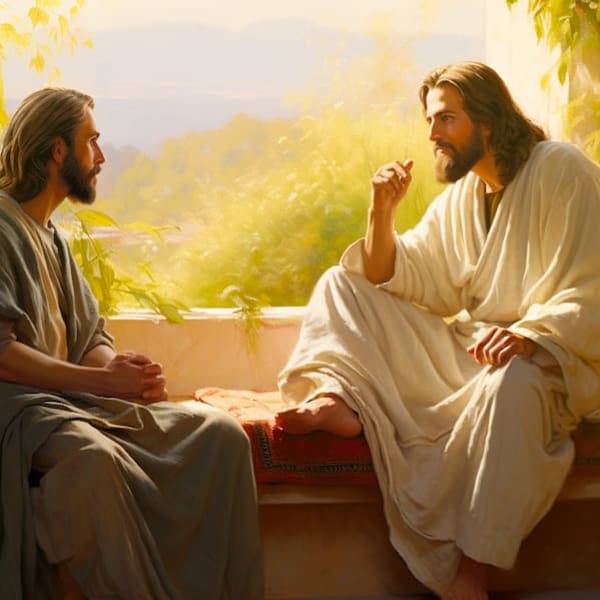
Nicodemus, a wealthy and influential member of the Jewish Sanhedrin, arranged through Andrew to meet Jesus privately after nightfall at Flavius's home, seeking to avoid public association with Jesus while satisfying his intellectual and spiritual curiosity. Despite his clandestine approach, Nicodemus opened with a candid acknowledgment of Jesus's divine commission: "Rabbi, we know that you are a teacher sent by God, for no mere man could so teach unless God were with him." Jesus, eschewing both deference to Nicodemus's status and rebuke of his secretive approach, responded with calm dignity by immediately directing the conversation to the central spiritual requirement: "Verily, verily, I say to you, Nicodemus, except a man be born from above, he cannot see the kingdom of God."
When Nicodemus interpreted this metaphor literally and expressed bewilderment at the concept of physical rebirth, Jesus explained the distinction between physical and spiritual nativity, employing the analogy of wind to illustrate spiritual reality's invisible yet undeniable effects. He gradually led Nicodemus to understand that spiritual rebirth entails willingly submitting to the indwelling spirit's guidance—a profound challenge for a self-accomplished religious leader. Jesus identified Nicodemus's fundamental impediment as his inability to "submit his will to the will of the divine Father as a little child is willing to submit to the guidance and leading of a wise and loving earthly father," despite his considerable achievements in self-development, self-restraint, and moral qualities. Though Nicodemus departed without full comprehension that night, the encounter planted seeds that later enabled him to defend Jesus before the Sanhedrin and, with Joseph of Arimathea, claim Jesus's body after crucifixion—demonstrating how transformative spiritual truth often requires time to fully germinate in human consciousness.
7. The Lesson on the Family
Following their return to Bethany after an intensive day in Jerusalem, Thomas posed a series of practical questions regarding how kingdom believers should address various social, economic, and legal matters including slavery, property, poverty, and justice. Rather than providing specific regulations or social reforms, Jesus first clarified that he and the apostles were living a unique "bestowal experience" not intended as a universal pattern, and then proceeded to explain that the kingdom concept would evolve in understanding, eventually being better comprehended through family relationships than political structures. He stated: "The people of another age will better understand the gospel of the kingdom when it is presented in terms expressive of the family relationship—when man understands religion as the teaching of the fatherhood of God and the brotherhood of man, sonship with God."
Jesus systematically delineated seven foundational aspects of authentic family life as illustrations of the divine-human relationship: existence (the inherent parent-child relationship), security and pleasure (parental provision), education and training (preparation for greater responsibility), discipline and restraint (guidance and correction), companionship and loyalty (intimate communion and support), love and mercy (forgiveness and patience), and provision for the future (inheritance and continuity). Throughout this extended discourse, Jesus drew precise parallels between these familial characteristics and corresponding spiritual realities in the believer's relationship with God, culminating in his declaration: "This entire relationship of a son to the Father, I know in perfection, for all that you must attain of sonship in the eternal future I have now already attained. The Son of Man is prepared to ascend to the right hand of the Father." This profound statement revealed Jesus's unique position as both exemplar and enabler of divine sonship, having perfected the very relationship he invited his followers to enter.
8. In Southern Judea
By late April, opposition from Pharisees and Sadducees had intensified to such a degree that Jesus and the apostles strategically withdrew from Jerusalem to conduct a month-long ministry of personal work in the southern Judean region, particularly in Bethlehem and Hebron. This tactical retreat from public preaching to intimate house-to-house visitation allowed tensions to subside while continuing their kingdom proclamation through more discreet channels. During this period, Jesus and Abner also spent time at Engedi visiting the Nazarite community, though most of these ascetic adherents rejected Jesus's teachings because he did not advocate fasting and physical self-denial as spiritual practices.
After their productive southern ministry, which added many souls to the kingdom, Jesus and the apostles returned to Jerusalem in early June when opposition had temporarily abated. They established an unobtrusive camp in Gethsemane garden on the Mount of Olives, entering the city infrequently while receiving interested inquirers at their encampment. Even in this discrete arrangement, the influence of Jesus's teaching continued to spread, as evidenced when Nicodemus and Joseph of Arimathea attempted to visit but retreated out of fear. The relative peace was disrupted when Simon, a Sanhedrin member, publicly declared his support for Jesus's teachings, rekindling official opposition and prompting Jesus to depart for Samaria and the Decapolis. This pattern of strategic advancement followed by tactical withdrawal characterized Jesus's ministry methodology, demonstrating his commitment to proclamation while prudently preserving his mission until "his hour" should come.