Discover The Urantia Book \Papers\Advanced \The Paradise Trinity

Paper 10 Overview: The Paradise Trinity
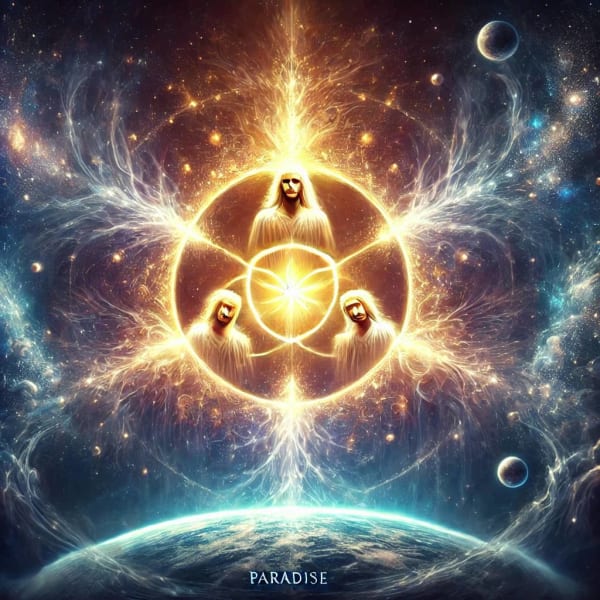
The Paradise Trinity is the united deity of the Father, Son, and Spirit, expressing perfect unity. Through the Trinity, divine justice, love, and wisdom are administered across all realities, ensuring harmony and eternal purpose.
Reading Level:
Summary
The Paradise Trinity of eternal Deities facilitates the Universal Father's transcendence of personality absolutism through the perfect association of his infinite personal will with Deity absoluteness. The Eternal Son, the divine Sons, the Conjoint Actor, and his universe children collectively provide for the Father's liberation from the inherent limitations of primacy, perfection, changelessness, eternity, universality, absoluteness, and infinity. This trinity relationship enables the full expression and perfect revelation of the eternal nature of Deity while simultaneously establishing the foundation for divine justice through the Stationary Sons and the absolute oneness of the three original, coordinate, and coexistent personalities: God the Father, God the Son, and God the Spirit.
From the vantage point of the circle of eternity, examining the endless past, present, and future of universal affairs, the author discerns only one inescapable inevitability: the Paradise Trinity. The Trinity stands as the only truly inevitable aspect of the universe of universes. When contemplating the past, present, and future dimensions of time, the author considers nothing else in all creation to have been inevitable. The existing master universe, whether viewed in retrospect or prospect, becomes conceptually impossible without the Trinity. While alternate or multiple methods of cosmic administration might be postulated given the Paradise Trinity, without the Father, Son, and Spirit, it becomes impossible to conceptualize how the Infinite could achieve threefold and coordinate personalization while maintaining absolute Deity oneness. No alternative creation concept satisfies the Trinity standards of completeness—the absoluteness inherent in Deity unity coupled with the volitional liberation intrinsic to the threefold personalization of Deity.
Introduction
The Paradise Trinity of eternal Deities facilitates the Father's escape from personality absolutism by perfectly associating the limitless expression of God's infinite personal will with the absoluteness of Deity. The Eternal Son and the various Sons of divine origin, together with the Conjoint Actor and his universe children, effectively provide for the Father's liberation from the limitations otherwise inherent in primacy, perfection, changelessness, eternity, universality, absoluteness, and infinity. This divine association creates a cosmic balance that enables the Father's personality to function without the constraints that would otherwise accompany his absolute nature.
The Paradise Trinity effectively provides for the full expression and perfect revelation of the eternal nature of Deity. The Stationary Sons of the Trinity likewise afford a full and perfect revelation of divine justice within the universal order. The Trinity represents Deity unity, resting eternally upon the absolute foundations of the divine oneness of the three original, coordinate, and coexistent personalities: God the Father, God the Son, and God the Spirit. This trinitarian relationship establishes the fundamental structure through which all reality functions, making it not merely a theological concept but the essential underpinning of the entire cosmos and its operations, from the most infinitesimal to the grandest scale.
1. Self-Distribution of the First Source and Center
From the unfathomable reaches of eternity past, the Universal Father inaugurated a profound policy of self-distribution that stems from his selfless, loving, and lovable nature. This fundamental characteristic causes him to reserve to himself only those powers and authorities which he finds impossible to delegate or bestow. Throughout the endless ages, the Father has divested himself of every part of himself that could possibly be bestowed upon any other Creator or creature. He has delegated to his divine Sons and their associated intelligences every power and all authority that could be transferred to them, holding back nothing that could be shared.
In the administration of local universes, the Father has made each Sovereign Creator Son as perfect, competent, and authoritative as the Eternal Son is in the original central universe. With unparalleled generosity, the Father has given away all of himself and his attributes that he could possibly divest himself of—in every way, in every age, in every place, to every person, and in every universe except that of his central indwelling. Divine personality transcends self-centeredness; rather, self-distribution and sharing of personality characterize divine freewill selfhood. While creatures naturally seek association with other personal beings, Creators are inherently moved to share divinity with their universe children, exemplifying how the personality of the Infinite manifests as the Universal Father who shares reality and equality with the Eternal Son and the Conjoint Actor.
2. Deity Personalization
Through the transcendent technique of trinitization, the Father divests himself of the unqualified spirit personality that constitutes the Son, simultaneously constituting himself as the eternal Father of this very Son and thereby securing unlimited capacity to become the divine Father of all subsequently created, eventuated, or otherwise personalized types of intelligent will creatures. As the absolute and unqualified personality, the Father can function only as and with the Son, but as a personal Father, he continues to bestow personality upon the diverse hosts of intelligent will creatures at different levels, maintaining personal relationships of loving association with this vast family of universe children.
After the Father has bestowed upon the personality of his Son the fullness of himself in a complete and perfect act of self-bestowal, the eternal partners conjointly bestow those qualities and attributes that constitute another being like themselves. This conjoint personality, the Infinite Spirit, completes the existential personalization of Deity and establishes the fundamental trinity relationship. The Son is indispensable to the fatherhood of God, and the Spirit is indispensable to the fraternity of the Second and Third Persons. This trinitarian association represents a minimum social group, which is but one of many reasons supporting the philosophical inevitability of the Conjoint Actor within the divine order. The First Source and Center manifests as the infinite father-personality and the unlimited source personality, while the Eternal Son represents the unqualified personality-absolute, that divine being who stands throughout time and eternity as the perfect revelation of God's personal nature. The Infinite Spirit, then, emerges as the conjoint personality—the unique personal consequence of the everlasting Father-Son union.
3. The Three Persons of Deity
Notwithstanding the singular nature of Deity, there exist three positive and divine personalizations of Deity, evidenced in the Father's pronouncement: "Let us make mortal man in our own image." This plurality recurs throughout the Urantian writings, demonstrating recognition of the three Sources and Centers' existence and operations. While the Son and Spirit maintain the same and equal relations to the Father in the Trinity association from an eternal and divine perspective, when viewed from the domains of space and in terms of time-bound expressions, they reveal relationships of markedly diverse character and function.
The divine Sons truly embody the "Word of God," while the children of the Spirit manifest as the "Act of God." God speaks through the Son and, with the Son, acts through the Infinite Spirit, with these divine beings working together in exquisite fraternity as equal siblings sharing admiration and love for their honored and divinely respected common Father. Although the Father, Son, and Spirit are certainly equal in nature and coordinate in being, there exist unmistakable differences in their universe performances. When acting independently, each person of Deity appears limited in absoluteness, demonstrating the essential complementarity of their trinitarian relationship. The Universal Father, prior to his self-willed divestment of the personality, powers, and attributes that constitute the Son and the Spirit, might have been conceptualized as an unqualified, absolute, and infinite Deity. However, such a theoretical First Source and Center without a Son could not authentically be considered the Universal Father, as fatherhood necessitates sonship. Moreover, the Father never existed in solitary isolation, as the Son and Spirit are coeternal with him.
4. The Trinity Union of Deity
Among all absolute associations, the Paradise Trinity occupies a unique position as an exclusive association of personal Deity. God functions as God only in relation to God and to those beings capable of knowing God, but as absolute Deity, he functions exclusively in the Paradise Trinity and in relation to universe totality. Eternal Deity achieves perfect unification while simultaneously maintaining three perfectly individualized persons of Deity. The Paradise Trinity makes possible the simultaneous expression of all the diverse character traits and infinite powers of the First Source and Center and his eternal coordinates, along with all the divine unity of the universe functions of undivided Deity.
The Trinity represents an association of infinite persons functioning in a non-personal capacity but without contradicting personality, comparable to how a father, son, and grandson might form a corporate entity that is non-personal yet remains subject to their personal wills. The Paradise Trinity exists as a concrete reality: the Deity union of Father, Son, and Spirit. Nevertheless, the Father, Son, or Spirit, or any two of them, can function in relation to this selfsame Paradise Trinity, though they can also collaborate in non-Trinity configurations as persons. Such non-trinitarian collaboration, however, does not constitute the Trinity itself. The Trinity functions in mysterious ways that transcend human comprehension, manifesting as three-in-one and one-as-two acting for two. While the Trinity influences all universe affairs and must be considered in explaining cosmic events or personality relationships, mortals are limited to a finite conception of the Trinity and should view it according to their individual enlightenment and in harmony with their mental and spiritual responses.
5. Functions of the Trinity
While individual Deities possess distinctive attributes, ascribing attributes to the Trinity itself proves conceptually inconsistent. This divine association more appropriately manifests functions such as justice administration, totality attitudes, coordinate action, and cosmic overcontrol. These functions operate actively at supreme, ultimate, and (within Deity limitations) absolute levels as they pertain to all living realities possessing personality value. The functional expression of the Trinity transcends mere summation of the Father's divinity endowment combined with the specialized attributes unique to the personal existence of the Son and Spirit.
The Trinity association of the three Paradise Deities catalyzes the evolution, eventuation, and deification of entirely new meanings, values, powers, and capacities for universal revelation, action, and administration. Living associations, whether human families, social groups, or the Paradise Trinity, are not augmented through arithmetical summation alone; rather, the group potential invariably exceeds the simple aggregate of component individual attributes. The Trinity maintains unique attitudes as the Trinity toward the entire universe across past, present, and future dimensions. These attitudes manifest simultaneously and may apply multiply to any isolated situation or event, including distinct approaches toward the finite, the absonite, and the absolute. The Trinity Infinite involves the coordinate action of all triunity relationships of the First Source and Center, both deified and undeified, making it challenging for personalities to comprehend and requiring consideration of the seven triunities to partially resolve certain paradoxes.
6. The Stationary Sons of the Trinity
All law originates with the First Source and Center, who embodies law itself. The administration of spiritual law inherently belongs to the Second Source and Center, while the revelation of law, the promulgation and interpretation of divine statutes, functions as the responsibility of the Third Source and Center. The application of law, justice, falls within the province of the Paradise Trinity and is executed by certain Sons of the Trinity who serve as instruments of divine adjudication throughout the realms.
Justice inheres in the universal sovereignty of the Paradise Trinity, while goodness, mercy, and truth characterize the universe ministry of the divine personalities whose Deity union constitutes the Trinity. Justice does not represent the attitude of the Father, Son, or Spirit individually; rather, it embodies the Trinity attitude of these personalities of love, mercy, and ministry. Justice never functions as a personal attitude but always as a plural function of these divine beings. Evidence, which forms the foundation of fairness (justice in harmony with mercy), is supplied by the personalities of the Third Source and Center, who serve as the conjoint representative of the Father and Son throughout all realms and to the minds of intelligent beings across creation. The final application of justice according to submitted evidence comes through the Stationary Sons of the Trinity; beings who partake of the Trinity nature of the united Father, Son, and Spirit, including ten orders from the Trinitized Secrets of Supremacy to the Universal Censors, who render the just judgment of supreme fairness throughout the seven superuniverses.
7. The Overcontrol of Supremacy
The First, Second, and Third Persons of Deity exist in perfect equality with each other and essential oneness, fulfilling the scriptural truth that "The Lord our God is one God." This divine Trinity of eternal Deities manifests perfection of purpose and unity of execution in all their cosmic endeavors. When mortal minds contemplate the Trinity, they perceive an entity concerned primarily with totality—total planet, total universe, total superuniverse, total grand universe—because the Trinity represents the total of Deity and embodies numerous other cosmic principles of totality.
The Supreme Being, while less than and different from the Trinity functioning in finite universes, appears to reflect the attitude of the Trinity of Supremacy within certain limitations during the present era of incomplete power-personalization. Although the Father, Son, and Spirit do not personally function with the Supreme Being, they collaborate with him as the Trinity during the current universe age, likely maintaining a similar relationship with the Ultimate. The exact nature of the personal relationship between the Paradise Deities and God the Supreme following his eventual complete evolution remains speculative. The overcontrol of Supremacy demonstrates an unpredictability characterized by developmental incompleteness, reflecting both the incompleteness of the Supreme and the limitations of finite reactions to the Paradise Trinity. While mortals might question whether apparently random events like catastrophes, accidents, or illnesses correlate with the Supreme Being's function, observation suggests that all such mysterious situations eventually contribute to the welfare and progress of the universes, possibly through the meaningful pattern created by the Supreme and the Trinity's overcontrol.
8. The Trinity Beyond the Finite
Many truths and facts pertaining to the Paradise Trinity can only be partially comprehended by recognizing Trinity functions that transcend finite limitations. While detailed discussion of the Trinity of Ultimacy's functions would be inadvisable, we can acknowledge that God the Ultimate represents the Trinity manifestation comprehended by the Transcendentalers. The author suggests that the unification of the master universe constitutes the eventuating act of the Ultimate, likely reflecting certain, though not all, phases of the absonite overcontrol of the Paradise Trinity, with the Ultimate manifesting the Trinity in relation to the absonite similar to how the Supreme partially represents the Trinity in relation to the finite.
The Universal Father, Eternal Son, and Infinite Spirit constitute, in a certain sense, the fundamental personalities of total Deity. Their union in the Paradise Trinity and the absolute function of the Trinity equate to the function of total Deity, transcending both finite and absonite realms. While no single Paradise Deity personally encompasses all Deity potential, collectively all three activate the pre-personal and existential potential of total Deity, the Deity Absolute. Three infinite persons appear to be the minimum number required to activate this pre-personal and existential potential. The relationship between the Universal Father and the Deity Absolute remains one of respect and worship rather than personal knowledge. Some beings in another universe taught that finaliters might eventually become children of the Deity Absolute, but the author remains unwilling to accept this solution to the mystery surrounding the finaliters' future. While these perfected mortals may potentially grasp the absonite nature of the Father's ultimate attributes and character, their ability to attain the super-ultimate levels of absolute Deity remains uncertain, suggesting that even if they partially comprehend the Deity Absolute, the mystery of the Universal Absolute would continue to challenge ascending and progressing finaliters throughout eternity.